Liliana M Davalos – författare
Visar alla böcker från författaren Liliana M Davalos. Handla med fri frakt och snabb leverans.
4 produkter
4 produkter
Inbunden, Engelska, 2020
582 kr
Skickas inom 5-8 vardagar
With more than two hundred species distributed across most of mainland Mexico, Central and South America, and islands in the Caribbean Sea, the Phyllostomidae bat family (American leaf-nosed bats) is one of the world's most diverse mammalian families in terms of its trophic, or feeding, diversity. From an insectivorous ancestry, extant species have evolved into several dietary classes, including blood-feeding, vertebrate carnivory, and the consumption of nectar, pollen, and fruit, in a period of about 30 million years. Phyllostomidae's plant-visiting species are responsible for pollinating more than five hundred species of neotropical shrubs, trees, vines, and epiphytes--many of which are economically and ecologically important--and they also disperse the seeds of at least another five-hundred plant species. Fruit-eating and seed-dispersing members of this family thus play a crucial role in the regeneration of neotropical forests, and the fruit eaters are among the most abundant mammals in these habitats.Coauthored by leading experts in the field and synthesizing the latest advances in molecular biology and ecological methods, Phyllostomid Bats is the first overview in more than forty years of the evolution of the many morphological, behavioral, physiological, and ecological adaptations in this family. Featuring abundant illustrations as well as details on the current conservation status of phyllostomid species, it is both a comprehensive reference for these ecologically vital creatures and a fascinating exploration of the evolutionary process of adaptive radiation.
E-bok
Engelska, 20201 243 kr
Läs direkt efter köp
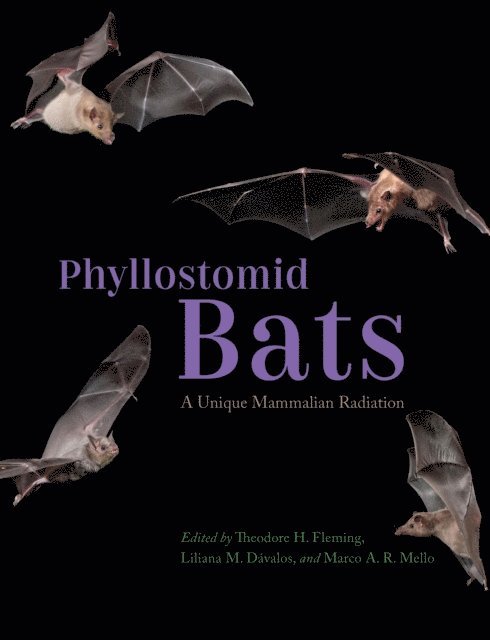
With more than two hundred species distributed from California through Texas and across most of mainland Mexico, Central and South America, and islands in the Caribbean Sea, the Phyllostomidae bat family (American leaf-nosed bats) is one of the world’s most diverse mammalian families. From an insectivorous ancestor, species living today, over about 30 million years, have evolved a hyper-diverse range of diets, from blood or small vertebrates, to consuming nectar, pollen, and fruit. Phyllostomid plant-visiting species are responsible for pollinating more than five hundred species of neotropical shrubs, trees, vines, and epiphytes—many of which are economically and ecologically important—and they also disperse the seeds of at least another five hundred plant species. Fruit-eating and seed-dispersing members of this family thus play a crucial role in the regeneration of neotropical forests, and the fruit eaters are among the most abundant mammals in these habitats. Coauthored by leading experts in the field and synthesizing the latest advances in molecular biology and ecological methods, Phyllostomid Bats is the first overview in more than forty years of the evolution of the many morphological, behavioral, physiological, and ecological adaptations in this family. Featuring abundant illustrations as well as details on the current conservation status of phyllostomid species, it is both a comprehensive reference for these ecologically vital creatures and a fascinating exploration of the evolutionary process of adaptive radiation.
E-bok
Spanska, 202145 kr
Läs direkt efter köp
De lectura obligada tanto para académicos como para diseñadores de políticas públicas, Los orígenes de la cocaína proporciona evidencia importante que apunta a la necesidad de replantear las estrategias que han fallado en el intento de reducir la oferta de cocaína y más bien promover un desarrollo a largo plazo, equitativo y medioambientalmente sostenible, en las regiones más pobres de los Andes.Coletta A. Youngers, Oficina en Washington para Asuntos Latinoamericanos (WOLA) En los años sesenta del siglo xx, los gobiernos de Colombia, Perú y Bolivia lanzaron en cada país programas de asentamiento agrícola en las tierras bajas de la vasta frontera amazónica. Dos décadas más tarde, estas mismas zonas se habían transformado en los centros de producción de cocaína de las Américas. Con base en conceptos históricos y antropológicos, Los orígenes de la cocaína explora cómo estos tres países han tenido resultados paralelos en cuanto a economías ilícitas fronterizas y culturas cocaleras, a pesar de que para mediados del siglo tenían trayectorias políticas divergentes. Mediante la combinación de análisis transnacionales, nacionales y locales, a lo largo de estas páginas se examina en profundidad los orígenes de la economía de las drogas ilícitas en el continente. Al ser el primer estudio importante sobre el viraje de la colonización agraria a la narcotización, Los orígenes de la cocaína es de interés tanto para especialistas como para estudiantes de posgrado de historia, antropología, desarrollo y estudios medioambientales de América Latina.
E-bok
PDF, Spanska, 202145 kr
Läs direkt efter köp
De lectura obligada tanto para académicos como para diseñadores de políticas públicas, Los orígenes de la cocaína proporciona evidencia importante que apunta a la necesidad de replantear las estrategias que han fallado en el intento de reducir la oferta de cocaína y más bien promover un desarrollo a largo plazo, equitativo y medioambientalmente sostenible, en las regiones más pobres de los Andes.Coletta A. Youngers, Oficina en Washington para Asuntos Latinoamericanos (WOLA) En los años sesenta del siglo xx, los gobiernos de Colombia, Perú y Bolivia lanzaron en cada país programas de asentamiento agrícola en las tierras bajas de la vasta frontera amazónica. Dos décadas más tarde, estas mismas zonas se habían transformado en los centros de producción de cocaína de las Américas. Con base en conceptos históricos y antropológicos, Los orígenes de la cocaína explora cómo estos tres países han tenido resultados paralelos en cuanto a economías ilícitas fronterizas y culturas cocaleras, a pesar de que para mediados del siglo tenían trayectorias políticas divergentes. Mediante la combinación de análisis transnacionales, nacionales y locales, a lo largo de estas páginas se examina en profundidad los orígenes de la economía de las drogas ilícitas en el continente. Al ser el primer estudio importante sobre el viraje de la colonización agraria a la narcotización, Los orígenes de la cocaína es de interés tanto para especialistas como para estudiantes de posgrado de historia, antropología, desarrollo y estudios medioambientales de América Latina.