• Fri frakt över 249 kr
  • •
  • Snabba leveranser
  • •
  • Billiga böcker
Kundservice

Du är på sajten för privatpersoner.

Företag, bibliotek eller offentlig verksamhet?

Du handlar på classic.bokus.com, där alla dina funktioner finns intakta.
Till classic.bokus.com
Bokus logotyp. Gå till startsidan.
  • Erbjudanden
  • Nyheter
  • Student
  • Topplistor
  • Barn & ungdom
  • Bokus Play
  • E-böcker
  • Pocketböcker
  • Spel & pussel

10% rabatt på allt med kod NYSTART10 →

Sidfot

Mina sidor

    Hjälp

    • Kundservice
    • Vanliga frågor och svar
    • Frakt och leverans
    • Retur vid ångerrätt
    • Reklamera vara
    • Betalning
    • Köpvillkor
    • Allmänna villkor
    • Information om webbplatsens tillgänglighet

    Om Bokus

    • Om oss
    • Pressrum
    • För studenter
    • För företag
    • För bibliotek och offentlig verksamhet
    • För leverantörer
    • Hållbarhet

    Populärt

    • Aktuella erbjudanden
    • Presentkort
    • Studentlitteratur
    • Nya böcker
    • Topplistor
    • Signerade böcker
    • Engelska böcker

    Inspiration

    • Boktips
    • BookTok
    • Populära bokserier
    • Barnbokskaraktärer
    • Populära författare
    Logotyp för Bokus
    Följ oss på Facebook (extern länk)Följ oss på Instagram (extern länk)Följ oss på YouTube (extern länk)Följ oss på TikTok (extern länk)
    bokus @ CookiesAnpassa cookiesIntegritetspolicyKöpvillkor
    Till Citymail hemsida (extern länk)Till Budbee hemsida (extern länk)Till Postnord hemsida (extern länk)Till Schenker hemsida (extern länk)Till Early Bird hemsida (extern länk)Till Walleys hemsida (extern länk)
    1. Naturvetenskap och teknik
    2. Matematik och naturvetenskap
    3. Biologi
    4. Däggdjur

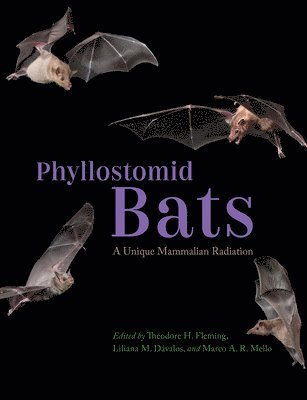
    Phyllostomid Bats

    A Unique Mammalian Radiation

    AvTheodore H Fleming,Liliana M Davalos

    Inbunden, Engelska, 2020

    577 kr

    Beställningsvara. Skickas inom 5-8 vardagar. Fri frakt över 249 kr.

    Beskrivning

    With more than two hundred species distributed across most of mainland Mexico, Central and South America, and islands in the Caribbean Sea, the Phyllostomidae bat family (American leaf-nosed bats) is one of the world's most diverse mammalian families in terms of its trophic, or feeding, diversity. From an insectivorous ancestry, extant species have evolved into several dietary classes, including blood-feeding, vertebrate carnivory, and the consumption of nectar, pollen, and fruit, in a period of about 30 million years. Phyllostomidae's plant-visiting species are responsible for pollinating more than five hundred species of neotropical shrubs, trees, vines, and epiphytes--many of which are economically and ecologically important--and they also disperse the seeds of at least another five-hundred plant species. Fruit-eating and seed-dispersing members of this family thus play a crucial role in the regeneration of neotropical forests, and the fruit eaters are among the most abundant mammals in these habitats.Coauthored by leading experts in the field and synthesizing the latest advances in molecular biology and ecological methods, Phyllostomid Bats is the first overview in more than forty years of the evolution of the many morphological, behavioral, physiological, and ecological adaptations in this family. Featuring abundant illustrations as well as details on the current conservation status of phyllostomid species, it is both a comprehensive reference for these ecologically vital creatures and a fascinating exploration of the evolutionary process of adaptive radiation.

    Produktinformation

    • Utgivningsdatum:2020-10-05
    • Mått:216 x 279 x 37 mm
    • Vikt:1 566 g
    • Format:Inbunden
    • Språk:Engelska
    • Antal sidor:512
    • Förlag:The University of Chicago Press
    • ISBN:9780226696126

    Utforska kategorier

    • Däggdjur inom Naturvetenskap och teknik
    • Däggdjur inom Djur och Natur
    • Biovetenskap inom Naturvetenskap och teknik

    Mer om författaren

    Theodore H. Fleming is professor emeritus of biology at the University of Miami, where he worked for thirty years. Among his recent books are Island Bats and The Ornaments of Life, both published by the University of Chicago Press, and No Species Is an Island. Liliana M. Davalos is professor of conservation biology at Stony Brook University. She is coeditor of The Origins of Cocaine and coauthor of the 2016 World Drug Report. Marco A. R. Mello is professor of ecology at the University of Sao Paulo, Brazil. He served as the president of the Brazilian Bat Research Society and is the author, in Portuguese, of Sobrevivendo na Ciencia: Um Pequeno Manual para a Jornada do Cientista.

    Recensioner i media

    "When reading a book like this magnificent new volume from the University of Chicago Press, Phyllostomid Bats: A Unique Mammalian Radiation, it’s important to understand the usage in the title: the radiation being discussed here is out-filing and endless tiny, fussy adaptations that a group of species can make to a variety of ecological and behavioral niches. As the book’s editors point out right away, the marquee example of adaptive radiation will probably always be Darwin’s famous finches, but in any case of animal adaptation, bats, specifically microchiroptera (the little bats, not the big flying foxes), some of the most successful creatures in evolutionary story, will always merit extra attention. . . . Phyllostomid Bats, although abstruse and nerdy in the extreme, is a wonderful intaglio of the sheer ferocious inventiveness of evolution. These leaf-nosed bats have radiated out to fill and exploit every conceivable niche where food and breeding might be found; in their endless forms—and in the wearily predictable ways they’re threatened in the twenty-first century—they are, among other things, fascinating bellwethers. And readers who might have a bat aficionado on their gift-recipient list? Well, their course is clear this book-season."

    Innehållsförteckning

    • Section 1 Introduction1 Overview of This BookTheodore H. Fleming, Liliana M. Dávalos, and Marco A. R. Mello2 Setting the Stage: Climate, Geology, and BiotaTheodore H. FlemingSection 2 Phylogeny and Evolution3 Phylogeny, Fossils, and Biogeography: The Evolutionary History of Superfamily Noctilionoidea (Chiroptera: Yangochiroptera)Norberto P. Giannini and Paúl M. Velazco4 Diversity and Discovery: A Golden AgeAndrea L. Cirranello and Nancy B. Simmons5 Fragments and Gaps: The Fossil RecordNancy B. Simmons, Gregg F. Gunnell, and Nicolas J. Czaplewski6 Phylogenetics and Historical BiogeographyLiliana M. Dávalos, Paúl M. Velazco, and Danny Rojas7 Adapt or Live: Adaptation, Convergent Evolution, and PlesiomorphyLiliana M. Dávalos, Andrea L. Cirranello, Elizabeth R. Dumont, Stephen J. Rossiter, and Danny Rojas8 The Evolution of Body Size in Noctilionoid BatsNorberto P. Giannini, Lucila I. Amador, and R. Leticia Moyers ArévaloSection 3 Contemporary Biology9 Structure and Function of Bat Wings: A View from the PhyllostomidaeSharon M. Swartz and Justine J. Allen10 The Relationship between Physiology and DietAriovaldo P. Cruz-Neto and L. Gerardo Herrera M.11 Sensory and Cognitive EcologyJeneni Thiagavel, Signe Brinkløv, Inga Geipel, and John M. Ratcliffe12 Reproduction and Life HistoriesRobert M. R. Barclay and Theodore H. Fleming13 Patterns of Sexual Dimorphism and Mating SystemsDanielle M. Adams, Christopher Nicolay, and Gerald S. WilkinsonSection 4 Trophic Ecology14 The Omnivore’s Dilemma: The Paradox of the Generalist PredatorsClaire T. Hemingway, M. May Dixon, and Rachel A. Page15 Vampire BatsJohn W. Hermanson and Gerald G. Carter16 The Ecology and Evolution of Nectar FeedersNathan Muchhala and Marco Tschapka17 The Frugivores: Evolution, Functional Traits, and Their Role in Seed DispersalRomeo A. Saldaña-Vázquez and Theodore H. FlemingSection 5 Population and Community Ecology18 Roosting Ecology: The Importance of Detailed DescriptionArmando Rodríguez-Durán19 Population BiologyTheodore H. Fleming and Angela M. G. Martino20 Community EcologyRichard D. Stevens and Sergio Estrada-Villegas21 Network Science as a Framework for Bat StudiesMarco A. R. Mello and Renata L. Muylaert22 Contemporary BiogeographyRichard Stevens, Marcelo M. Weber, and Fabricio VillalobosSection 6 Conservation23 Challenges and Opportunities for the Conservation of Brazilian PhyllostomidsEnrico Bernard, Mariana Delgado-Jaramillo, Ricardo B. Machado, and Ludmilla M. S. Aguiar24 Threats, Status, and Conservation Perspectives for Leaf-Nosed BatsJafet M. Nassar, Luis F. Aguirre, Bernal Rodríguez-Herrera, and Rodrigo A. MedellínContributorsIndex