Luigino Bruni – författare
Visar alla böcker från författaren Luigino Bruni. Handla med fri frakt och snabb leverans.
59 produkter
The Microeconomics of Wellbeing and Sustainability
Recasting the Economic Process
Av Leonardo Becchetti, Luigino Bruni m. fl.
Häftad, 2019
1265 kr
Lägg i varukorg
The Microeconomics of Wellbeing and Sustainability: Recasting the Economic Process explores the civil economy tradition in economic thought. Gaining increasing consensus worldwide, this alternative-not heterodox-view of the economic process and agents explains how modern economics is placing …
Microeconomics of Wellbeing and Sustainability
Recasting the Economic Process
Av Stefano Zamagni, Luigino Bruni m. fl.
E-bok, 2019
1812 kr
Lägg i varukorg
The Microeconomics of Wellbeing and Sustainability: Recasting the Economic Process explores the civil economy tradition in economic thought. Gaining increasing consensus worldwide, this alternative—not heterodox—view of the economic process and agents explains how modern economics is placing …
Policies for Happiness
Av Pier Luigi Porta, Luigino Bruni m. fl.
E-bok, 2016
1435 kr
Lägg i varukorg
In recent years, debates on the economics of happiness have shown that, over the long-term, well-being is influenced more by social and personal relationships than by income. This evidence challenges the traditional economic policy paradigm that has emphasized income as the primary determinant of …
Economics and Happiness
Framing the Analysis
Av Pier Luigi Porta, Luigino Bruni
E-bok, 2005
403 kr
Lägg i varukorg
This book is the first of its kind to provide a comprehensive overview of the burgeoning field of happiness and economics. The essays collected in this book provide an authoritative and comprehensive assessment of the theoretical, applied and partly experimental aspects of the whole field and …
Capabilities and Happiness
Av Maurizio Pugno, Flavio Comim m. fl.
E-bok, 2008
1797 kr
Lägg i varukorg
Few would dispute that the well-being of individuals is one of the most desirable aims of human actions. However, approaches on how to define, measure, evaluate, and promote well-being differ widely. The conventional economic approach takes income (or the power to acquire market goods) as the most …
Manual of Political Economy
A Critical and Variorum Edition
Av Vilfredo Pareto, Luigino Bruni m. fl.
E-bok, 2014
491 kr
Lägg i varukorg
Vilfredo Pareto''s Manual of Political Economy is a ''classic'' study in the history of economic thought for many reasons, the most noteworthy of which include the setting of general equilibrium economics within a choice theoretic framework based on the opposition between tastes and obstacles; the …
Policies for Happiness
Av Stefano Bartolini, Ennio Bilancini m. fl.
Inbunden, 2016
1733 kr
Lägg i varukorg
In recent years, debates on the economics of happiness have shown that, over the long-term, well-being is influenced more by social and personal relationships than by income. This evidence challenges the traditional economic policy paradigm that has emphasized income as the primary determinant of …
Manual of Political Economy
A Critical and Variorum Edition
Av Vilfredo Pareto, Aldo Montesano m. fl.
Häftad, 2020
628 kr
Lägg i varukorg
Vilfredo Pareto's Manual of Political Economy is a 'classic' study in the history of economic thought for many reasons, the most noteworthy of which include the setting of general equilibrium economics within a choice theoretic framework based on the opposition between tastes and obstacles; the …
Economics and Happiness
Framing the Analysis
Av Luigino Bruni, Pier Luigi Porta m. fl.
Häftad, 2007
834 kr
Lägg i varukorg
This book is the first of its kind to provide a comprehensive overview of the burgeoning field of happiness and economics. The essays collected in this book provide an authoritative and comprehensive assessment of the theoretical, applied and partly experimental aspects of the whole field and …
Economics and Happiness
Framing the Analysis
Av Luigino Bruni, Pier Luigi Porta m. fl.
Inbunden, 2005
2509 kr
Lägg i varukorg
This book is the first of its kind to provide a comprehensive overview of happiness in Economics. Although it is comparatively unusual to put happiness and economics together, the association appears increasingly exciting and fruitful. A number of studies have been produced following Richard …
Capabilities and Happiness
Av Luigino Bruni, Flavio Comim m. fl.
Inbunden, 2008
2810 kr
Lägg i varukorg
Few would dispute that the well-being of individuals is one of the most desirable aims of human actions. However, approaches on how to define, measure, evaluate, and promote well-being differ widely. The conventional economic approach takes income (or the power to acquire market goods) as the most …
Manual of Political Economy
A Critical and Variorum Edition
Av Vilfredo Pareto, Aldo Montesano m. fl.
Inbunden, 2014
3489 kr
Lägg i varukorg
Vilfredo Pareto's Manual of Political Economy is a 'classic' study in the history of economic thought for many reasons, the most noteworthy of which include the setting of general equilibrium economics within a choice theoretic framework based on the opposition between tastes and obstacles; the …
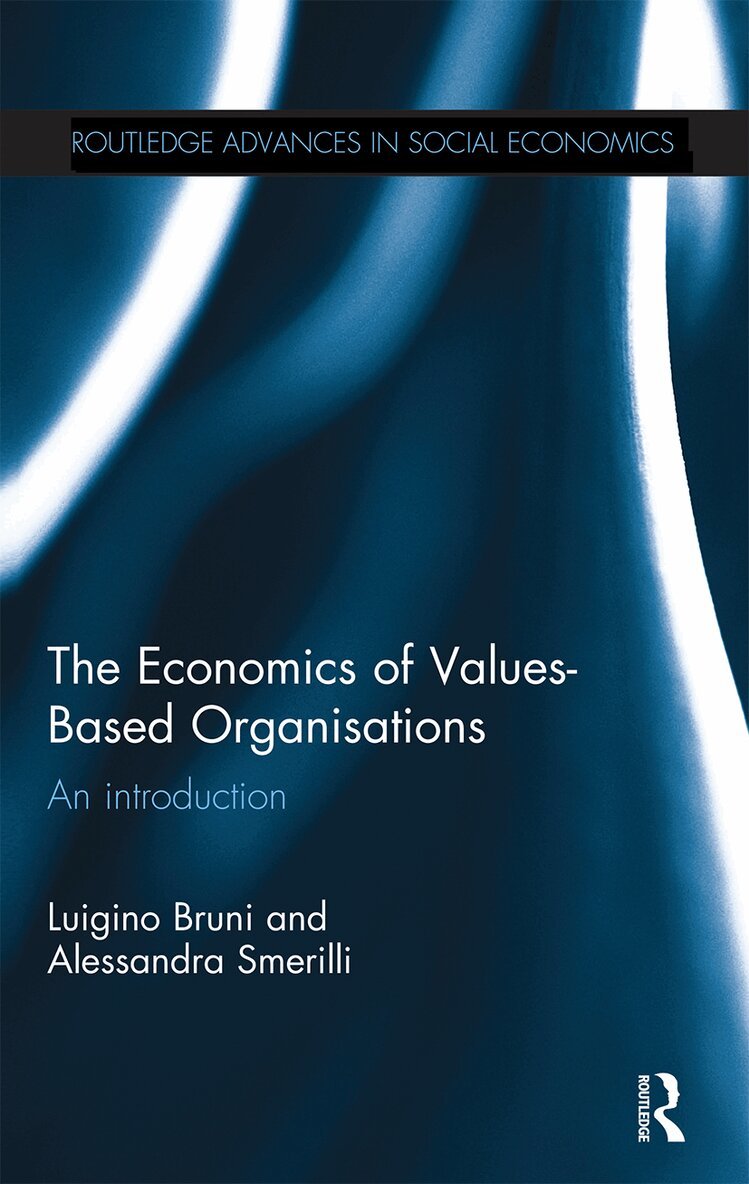
Economics of Values-Based Organisations
An Introduction
Av Luigino Bruni, Alessandra Smerilli
Häftad, 2020
713 kr
Lägg i varukorg
This book looks at the governance of values-based organizations (VBOs), which are organizations with a mission and identity based on ideals. Examples of VBOs include non-profit organizations, charities, NGOs, environmental, educational or cultural organizations, and social enterprises. The main …
Economics of Values, Ideals and Organizations
Inbunden, 2021
1029 kr
Lägg i varukorg
Values-based organizations are institutions, communities and non-governmental organizations (NGOs) which are inspired by a mission or a vocation – for these groups it is their ideals which are most important to them and economics does not have a way to incorporate that into its analysis. This book …
Economics of Values, Ideals and Organizations
Häftad, 2022
383 kr
Lägg i varukorg
Values-based organizations are institutions, communities and non-governmental organizations (NGOs) which are inspired by a mission or a vocation – for these groups it is their ideals which are most important to them and economics does not have a way to incorporate that into its analysis. This book …
Civil Happiness
Economics and Human Flourishing in Historical Perspective
Inbunden, 2006
2591 kr
Lägg i varukorg
Economists have long laboured under the misapprehension that all humans exist as rational beings that find happiness in maximizing their personal utility. This impressive volume presents an historical review of the evolution of economic thought, from economic philosophy to contemporary mathematical …
Reciprocity, Altruism and the Civil Society
In praise of heterogeneity
Inbunden, 2008
1481 kr
Lägg i varukorg
The main emphasis of this new book from Luigino Bruni is a praise of heterogeneity, arguing that society works when different people are able to cooperate in many different ways. The author engages in a novel approach to reciprocity looking at its different forms in society, from cautious or …
New Essays on Pareto's Economic Theory
Av Luigino Bruni, Aldo Montesano
Inbunden, 2009
2591 kr
Lägg i varukorg
Pareto's Manual of Political Economy, first published in 1905, introduced the analytical approach which has characterised a significant part of twentieth century economic theory. In particular, the Manual examined the ordinal representation of the individual choice, the issue of the general …
Civil Happiness
Economics and Human Flourishing in Historical Perspective
Häftad, 2009
773 kr
Lägg i varukorg
Economists have long laboured under the misapprehension that all humans exist as rational beings that find happiness in maximizing their personal utility. This impressive volume presents an historical review of the evolution of economic thought, from economic philosophy to contemporary mathematical …
Reciprocity, Altruism and the Civil Society
In praise of heterogeneity
Häftad, 2009
560 kr
Lägg i varukorg
The main emphasis of this new book from Luigino Bruni is a praise of heterogeneity, arguing that society works when different people are able to cooperate in many different ways. The author engages in a novel approach to reciprocity looking at its different forms in society, from cautious or …
Charismatic Principle in Social Life
Av Luigino Bruni, Barbara Sena
Inbunden, 2012
2445 kr
Lägg i varukorg
Max Weber laid the foundations for the meaning of ‘charisma’ in modern secular usage. This new volume argues for the importance of the ‘charismatic principle’ in history, economics and society. This volume brings together a number of contributors at the cross section between economics, theology, …
Economics of Values-Based Organisations
An Introduction
Av Luigino Bruni, Alessandra Smerilli
Inbunden, 2014
2591 kr
Lägg i varukorg
This book looks at the governance of values-based organizations (VBOs), which are organizations with a mission and identity based on ideals. Examples of VBOs include non-profit organizations, charities, NGOs, environmental, educational or cultural organizations, and social enterprises. The main …
Economics of Values, Ideals and Organizations
E-bok, 2021
393 kr
Lägg i varukorg
Values-based organizations are institutions, communities and non-governmental organizations (NGOs) which are inspired by a mission or a vocation – for these groups it is their ideals which are most important to them and economics does not have a way to incorporate that into its analysis. This …
Economics of Values, Ideals and Organizations
E-bok, 2021
393 kr
Lägg i varukorg
Values-based organizations are institutions, communities and non-governmental organizations (NGOs) which are inspired by a mission or a vocation – for these groups it is their ideals which are most important to them and economics does not have a way to incorporate that into its analysis. This …
Capitalism and Christianity
Origins, Spirit and Betrayal of the Market Economy
E-bok, 2023
813 kr
Lägg i varukorg
Drawing on debates about the religious nature and origins of contemporary European capitalism, this book argues for a distinction between a Northern/Protestant and a Southern/Catholic spirit of capitalism. The first part of the book explores the history of the relationship between capitalism and …
Capitalism and Christianity
Origins, Spirit and Betrayal of the Market Economy
E-bok, 2023
831 kr
Lägg i varukorg
Drawing on debates about the religious nature and origins of contemporary European capitalism, this book argues for a distinction between a Northern/Protestant and a Southern/Catholic spirit of capitalism. The first part of the book explores the history of the relationship between capitalism and …
Capitalism and Christianity
Origins, Spirit and Betrayal of the Market Economy
Inbunden, 2023
2516 kr
Lägg i varukorg
Drawing on debates about the religious nature and origins of contemporary European capitalism, this book argues for a distinction between a Northern/Protestant and a Southern/Catholic spirit of capitalism. The first part of the book explores the history of the relationship between capitalism and …
Capitalism and Christianity
Origins, Spirit and Betrayal of the Market Economy
Häftad, 2025
707 kr
Lägg i varukorg
Drawing on debates about the religious nature and origins of contemporary European capitalism, this book argues for a distinction between a Northern/Protestant and a Southern/Catholic spirit of capitalism. The first part of the book explores the history of the relationship between capitalism and …
Modern Guide to the Economics of Happiness
Av Luigino Bruni, Alessandra Smerilli m. fl.
Häftad, 2022
597 kr
Lägg i varukorg
Exploring the modern approach to the economics of happiness, which came about with the Easterlin Paradox, this book analyses and assesses the idea that as a country gets richer the happiness of its citizens remains the same. The book moves through three distinct pillars of study in the field: first …
Reciprocity, Altruism and the Civil Society
In praise of heterogeneity
E-bok, 2008
642 kr
Lägg i varukorg
The main emphasis of this new book from Luigino Bruni is a praise of heterogeneity, arguing that society works when different people are able to cooperate in many different ways. The author engages in a novel approach to reciprocity looking at its different forms in society, from cautious or …