M. Nalini – författare
2 255 kr
Skickas inom 10-15 vardagar
The global race to develop and deploy automated vehicles is still hindered by significant challenges, with the related complexities requiring multidisciplinary research approaches. Knowledge Graph-Based Methods for Automated Driving offers sought-after, specialized know-how for a wide range of readers both in academia and industry on the use of graphs as knowledge representation techniques which, compared to other relational models, provide a number of advantages for data-driven applications like automated driving tasks. The machine learning pipeline presented in this volume incorporates a variety of auxiliary information, including logic rules, ontology-informed workflows, simulation outcomes, differential equations, and human input, with the resulting operational framework being more reliable, secure, efficient as well as sustainable. Case studies and other practical discussions exemplify these methods’ promising and exciting prospects for the maturation of scalable solutions with potential to transform transport and logistics worldwide.
Systematically covers knowledge graphs for automated driving processesIncludes real-life case studies, facilitating an understanding of current challengesAnalyzes the impact of various technological aspects related to automation across a range of transport modes, networks, and infrastructures2 855 kr
Läs direkt efter köp
2 500 kr
Skickas inom 10-15 vardagar
2 839 kr
Läs direkt efter köp
2 864 kr
Läs direkt efter köp
2 092 kr
Skickas inom 5-8 vardagar
2 382 kr
Läs direkt efter köp
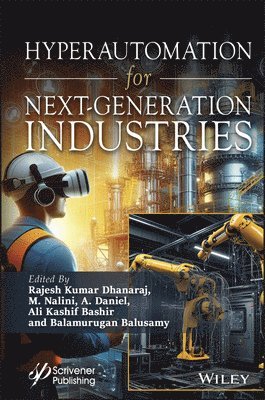
This book is essential for anyone looking to understand how hyperautomation can revolutionize businesses by simplifying operations, reducing errors, and creating more intelligent and adaptable workplaces through the use of automation technologies such as artificial intelligence, machine learning, and robotic process automation.
The use of automation technologies to simplify any and every activity conceivable in a business, allowing repeated operations to operate without manual intervention, is known as hyperautomation. Hyperautomation transforms current and old processes and equipment by utilizing artificial intelligence, machine learning, and robotic process automation. This digital transformation may assist a business in gaining cost and resource efficiency, allowing it to prosper in a more competitive environment. With the advancement of automation technologies, hyperautomation is becoming more prevalent. Companies are shifting their methods to create more human-centered and intelligent workplaces. This change has ushered in a new era for organizations that rely on technology and automation tools to stay competitive. Businesses may move beyond technology’s distinct advantages to genuine digital agility and scale adaptability when all forms of automation operate together in close partnership.
Automation tools must be simple to incorporate into the current technological stack while not requiring too much effort from IT. A platform must be able to plug and play with a wide range of technologies to achieve hyperautomation. The interdependence of automation technologies is a property that is connected to hyperautomation. Hyperautomation saves individuals time and money by reducing errors. Hyperautomation has the potential to create a workplace that is intelligent, adaptable, and capable of making quick, accurate decisions based on data and insights. Model recognition is used to determine what to do next and to optimize processes with the least amount of human engagement possible.
2 382 kr
Läs direkt efter köp
This book is essential for anyone looking to understand how hyperautomation can revolutionize businesses by simplifying operations, reducing errors, and creating more intelligent and adaptable workplaces through the use of automation technologies such as artificial intelligence, machine learning, and robotic process automation.
The use of automation technologies to simplify any and every activity conceivable in a business, allowing repeated operations to operate without manual intervention, is known as hyperautomation. Hyperautomation transforms current and old processes and equipment by utilizing artificial intelligence, machine learning, and robotic process automation. This digital transformation may assist a business in gaining cost and resource efficiency, allowing it to prosper in a more competitive environment. With the advancement of automation technologies, hyperautomation is becoming more prevalent. Companies are shifting their methods to create more human-centered and intelligent workplaces. This change has ushered in a new era for organizations that rely on technology and automation tools to stay competitive. Businesses may move beyond technology’s distinct advantages to genuine digital agility and scale adaptability when all forms of automation operate together in close partnership.
Automation tools must be simple to incorporate into the current technological stack while not requiring too much effort from IT. A platform must be able to plug and play with a wide range of technologies to achieve hyperautomation. The interdependence of automation technologies is a property that is connected to hyperautomation. Hyperautomation saves individuals time and money by reducing errors. Hyperautomation has the potential to create a workplace that is intelligent, adaptable, and capable of making quick, accurate decisions based on data and insights. Model recognition is used to determine what to do next and to optimize processes with the least amount of human engagement possible.
4 075 kr
Skickas inom 5-8 vardagar
3 719 kr
Skickas inom 5-8 vardagar