Marco de Gemmis - Böcker
Visar alla böcker från författaren Marco de Gemmis. Handla med fri frakt och snabb leverans.
6 produkter
6 produkter
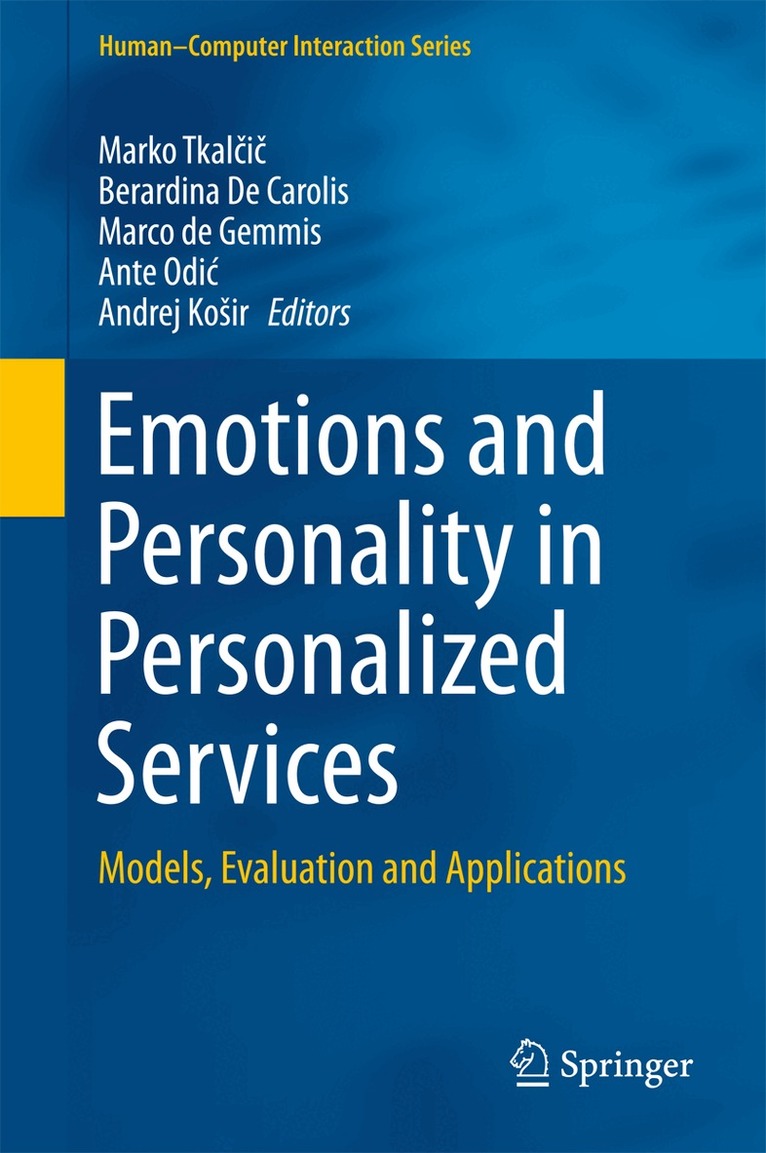
Emotions and Personality in Personalized Services
Models, Evaluation and Applications
Inbunden, Engelska, 2016
1 034 kr
Skickas inom 10-15 vardagar
Personalization is ubiquitous from search engines to online-shopping websites helping us find content more efficiently and this book focuses on the key developments that are shaping our daily online experiences. With advances in the detection of end users’ emotions, personality, sentiment and social signals, researchers and practitioners now have the tools to build a new generation of personalized systems that will really understand the user’s state and deliver the right content. With leading experts from a vast array of domains from user modeling, mobile sensing and information retrieval to artificial intelligence, human-computer interaction (HCI) social computing and psychology, a broad spectrum of topics are covered. From discussing psychological theoretical models and exploring state-of-the-art methods for acquiring emotions and personality in an unobtrusive way, as well as describing how these concepts can be used to improve various aspects of the personalization processand chapters that discuss evaluation and privacy issues.Emotions and Personality in Personalized Systems will help aid researchers and practitioners develop and evaluate user-centric personalization systems that take into account the factors that have a tremendous impact on our decision-making – emotions and personality.
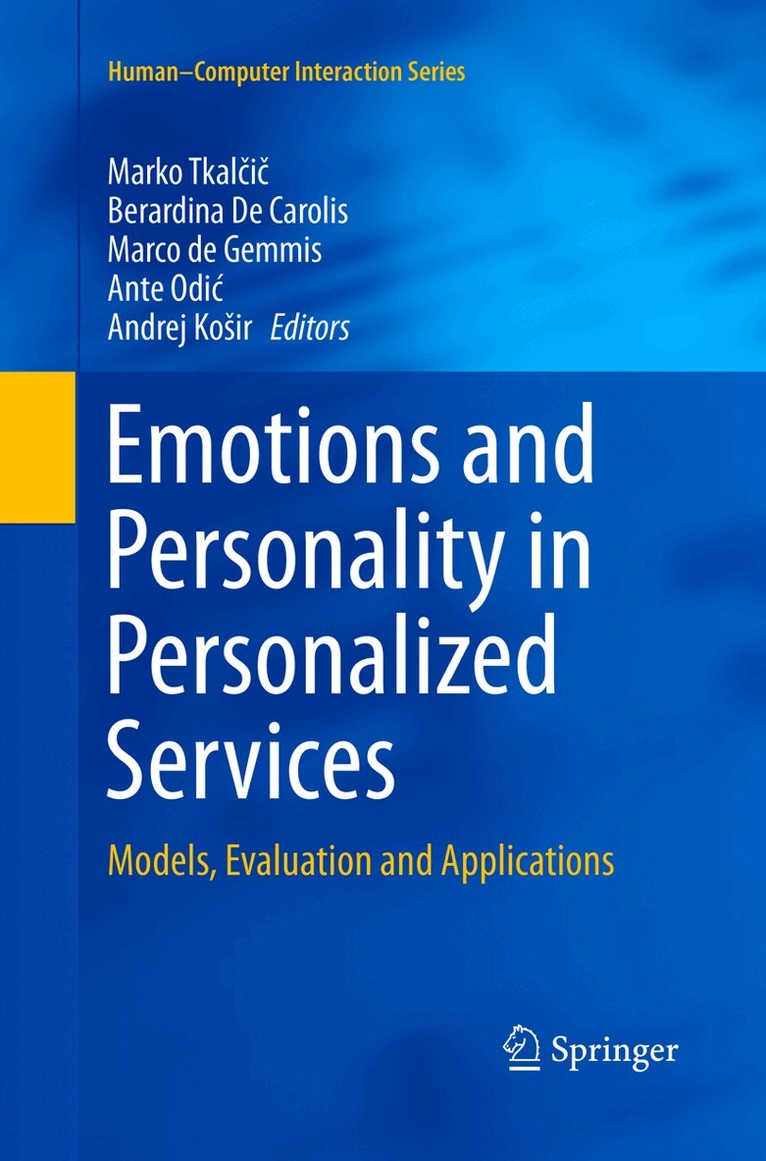
Emotions and Personality in Personalized Services
Models, Evaluation and Applications
Häftad, Engelska, 2018
1 096 kr
Skickas inom 10-15 vardagar
Personalization is ubiquitous from search engines to online-shopping websites helping us find content more efficiently and this book focuses on the key developments that are shaping our daily online experiences. With advances in the detection of end users’ emotions, personality, sentiment and social signals, researchers and practitioners now have the tools to build a new generation of personalized systems that will really understand the user’s state and deliver the right content. With leading experts from a vast array of domains from user modeling, mobile sensing and information retrieval to artificial intelligence, human-computer interaction (HCI) social computing and psychology, a broad spectrum of topics are covered. From discussing psychological theoretical models and exploring state-of-the-art methods for acquiring emotions and personality in an unobtrusive way, as well as describing how these concepts can be used to improve various aspects of the personalization processand chapters that discuss evaluation and privacy issues.Emotions and Personality in Personalized Systems will help aid researchers and practitioners develop and evaluate user-centric personalization systems that take into account the factors that have a tremendous impact on our decision-making – emotions and personality.
1 096 kr
Skickas inom 10-15 vardagar
There is generalagreementthat the quality of Machine Learning and Kno- edgeDiscoveryoutputstronglydependsnotonlyonthequalityofsourcedata andsophisticationoflearningalgorithms,butalsoonadditional,task/domain speci?c input provided by domain experts for the particular session. There is however less agreement on whether, when and how such input can and should e?ectively be formalized and reused as explicit prior knowledge. In the ?rst ofthe two parts into which the book is divided, we aimed to - vestigate current developments and new insights on learning techniques that exploit prior knowledge and on promising application areas. With respect to application areas, experiments on bio-informatics / medical and Web data environments are described. This part comprises a selection of extended c- tributionstothe workshopPrior Conceptual Knowledge inMachine Learning and Knowledge Discovery (PriCKL), held at ECML/PKDD 2007 18th - ropean Conference on Machine Learning and 11th European Conference on PrinciplesandPracticeofKnowledgeDiscoveryinDatabases).Theworkshop is part of the activities of the "SEVENPRO - Semantic Virtual Engineering for Product Design" project of the European 6th Framework Programme.The second part of the book has been motivated by the speci?cation of Web 2.0. We observe Web 2.0 as a powerful means of promoting the Web as a social medium, stimulating interpersonal communication and fostering the sharing of content, information, semantics and knowledge among people. Chapters are authored by participants to the workshop Web Mining 2.0, heldatECML/PKDD2007.Theworkshophostedresearchontheroleofweb mininginandfortheWeb2.0.Itispartoftheactivitiesoftheworkinggroups "UbiquitousData-InteractionandDataCollection"and"HumanComputer Interaction and Cognitive Modelling" of the Coordination Action "KDubiq - Knowledge Discovery in Ubiquitous Environments" of the European 6th Framework Programme.
Del 301 - Studies in Computational Intelligence
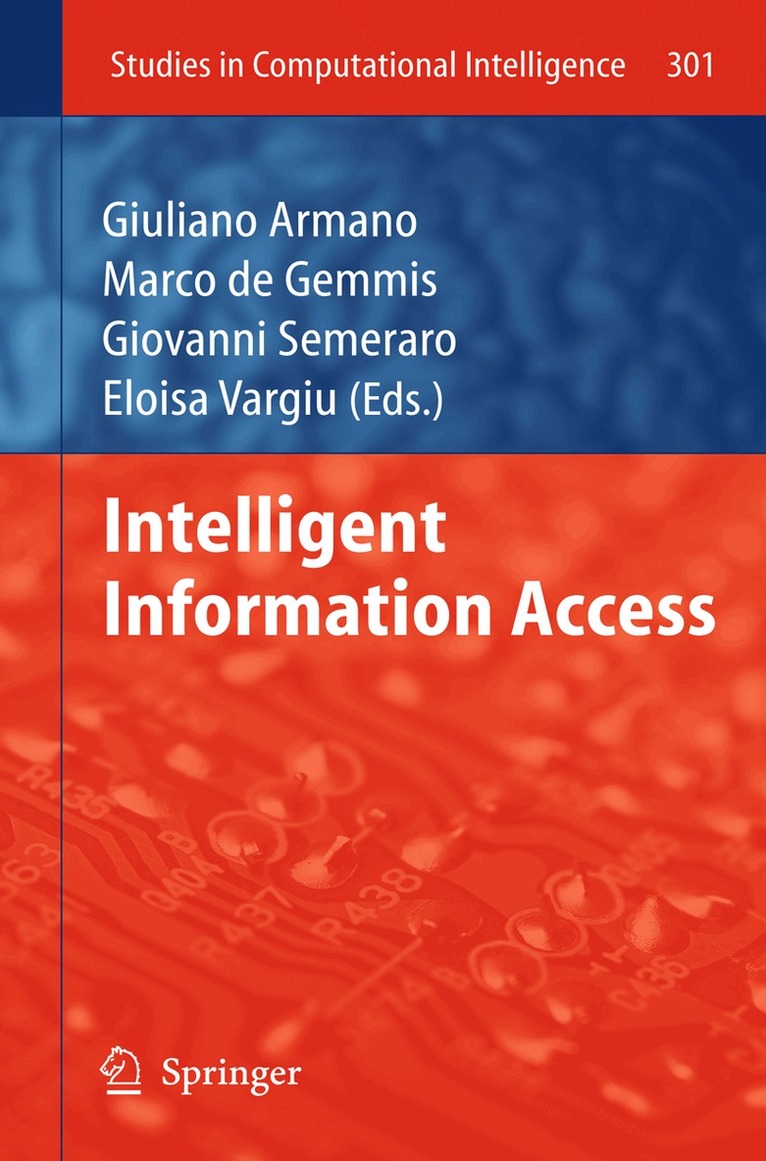
Intelligent Information Access
Inbunden, Engelska, 2010
1 096 kr
Skickas inom 10-15 vardagar
Intelligent Information Access techniques attempt to overcome the limi- tions of current search devices by providing personalized information items and product/service recommendations. They normally utilize direct or in- rect user input and facilitate the information search and decision processes, according to user needs, preferences and usage patterns. Recent devel- ments at the intersection of Information Retrieval, Information Filtering, MachineLearning,UserModelling,NaturalLanguageProcessingandHuman- Computer Interaction o?er novel solutions that empower users to go beyond single-sessionlookuptasksandthataimatservingthemorecomplexrequi- ment: "Tell me what I don't know that I need to know". Information?ltering systems,speci?callyrecommendersystems,havebeenrevolutionizingtheway information seekers?nd what they want, becausethey e?ectively prune large informationspacesandhelpusersinselectingitemsthatbestmeettheirneeds and preferences. Recommender systems rely strongly on the use of various machine learning tools and algorithms for learning how to rank, or predict user evaluation, of items. Information Retrieval systems, on the other hand, also attempt to address similar ?ltering and ranking problems for pieces of information such as links, pages, and documents.But they generally focus on the development of global retrieval techniques, often neglecting individual user needs and preferences. The book aims to investigate current developments and new insights into methods, techniques and technologies for intelligent information access from a multidisciplinary perspective. It comprises six chapters authored by part- ipants in the research event Intelligent Information Access,heldinCagliari (Italy) in December 2008.
1 096 kr
Skickas inom 10-15 vardagar
Intelligent Information Access techniques attempt to overcome the limi- tions of current search devices by providing personalized information items and product/service recommendations. They normally utilize direct or in- rect user input and facilitate the information search and decision processes, according to user needs, preferences and usage patterns. Recent devel- ments at the intersection of Information Retrieval, Information Filtering, MachineLearning,UserModelling,NaturalLanguageProcessingandHuman- Computer Interaction o?er novel solutions that empower users to go beyond single-sessionlookuptasksandthataimatservingthemorecomplexrequi- ment: "Tell me what I don't know that I need to know". Information?ltering systems,speci?callyrecommendersystems,havebeenrevolutionizingtheway information seekers?nd what they want, becausethey e?ectively prune large informationspacesandhelpusersinselectingitemsthatbestmeettheirneeds and preferences. Recommender systems rely strongly on the use of various machine learning tools and algorithms for learning how to rank, or predict user evaluation, of items. Information Retrieval systems, on the other hand, also attempt to address similar ?ltering and ranking problems for pieces of information such as links, pages, and documents.But they generally focus on the development of global retrieval techniques, often neglecting individual user needs and preferences. The book aims to investigate current developments and new insights into methods, techniques and technologies for intelligent information access from a multidisciplinary perspective. It comprises six chapters authored by part- ipants in the research event Intelligent Information Access,heldinCagliari (Italy) in December 2008.
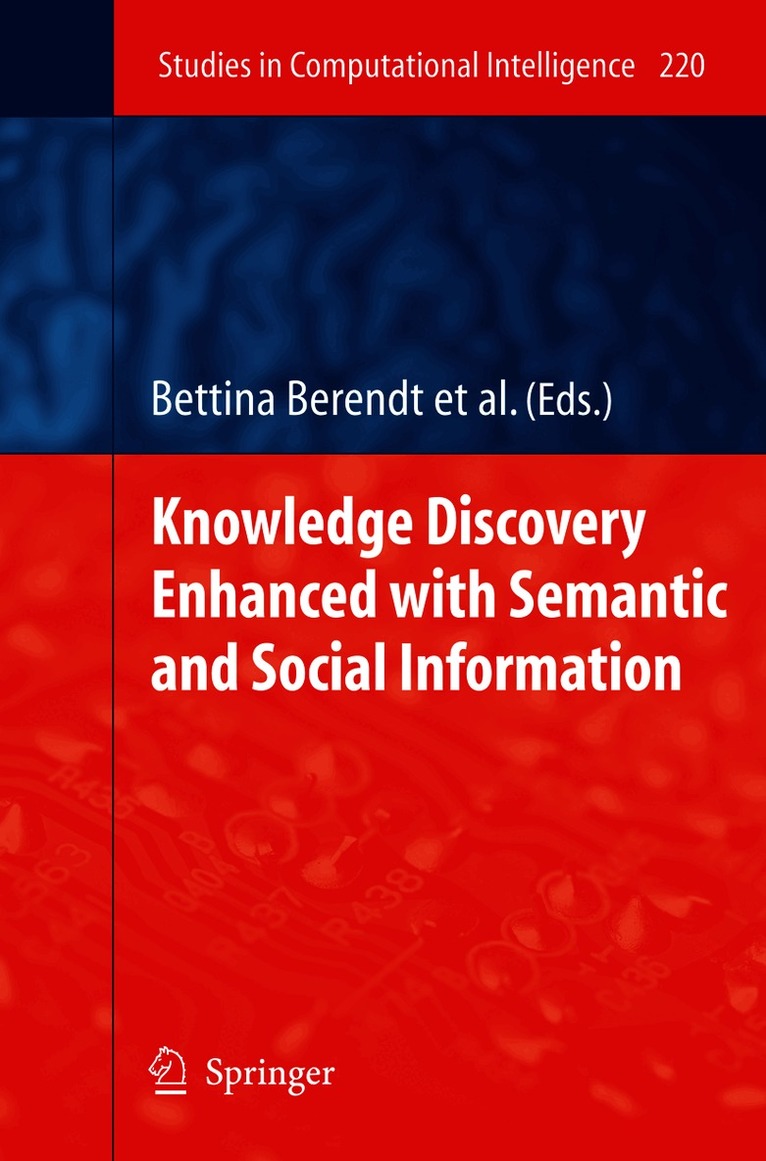
Del 220 - Studies in Computational Intelligence
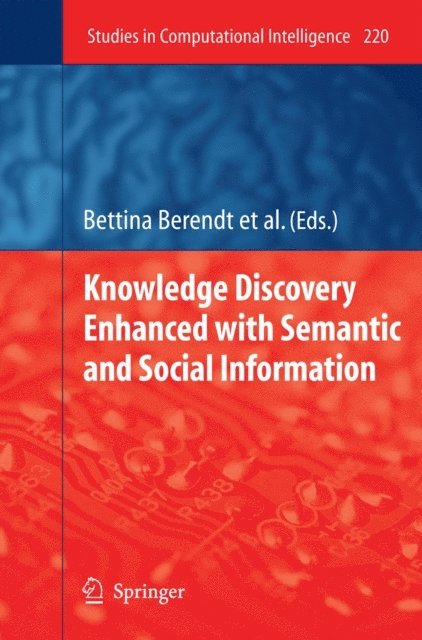
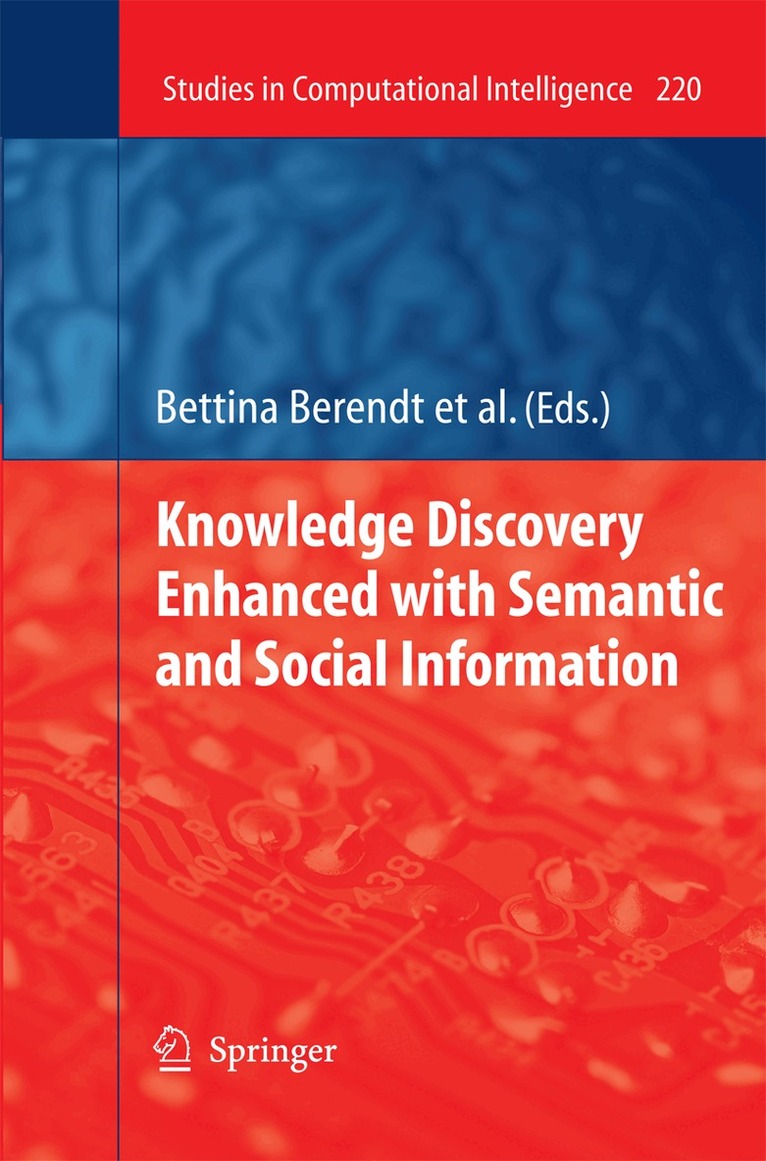
Knowledge Discovery Enhanced with Semantic and Social Information
Häftad, Engelska, 2014
1 096 kr
Skickas inom 10-15 vardagar
There is generalagreementthat the quality of Machine Learning and Kno- edgeDiscoveryoutputstronglydependsnotonlyonthequalityofsourcedata andsophisticationoflearningalgorithms,butalsoonadditional,task/domain speci?c input provided by domain experts for the particular session. There is however less agreement on whether, when and how such input can and should e?ectively be formalized and reused as explicit prior knowledge. In the ?rst ofthe two parts into which the book is divided, we aimed to - vestigate current developments and new insights on learning techniques that exploit prior knowledge and on promising application areas. With respect to application areas, experiments on bio-informatics / medical and Web data environments are described. This part comprises a selection of extended c- tributionstothe workshopPrior Conceptual Knowledge inMachine Learning and Knowledge Discovery (PriCKL), held at ECML/PKDD 2007 18th - ropean Conference on Machine Learning and 11th European Conference on PrinciplesandPracticeofKnowledgeDiscoveryinDatabases).Theworkshop is part of the activities of the "SEVENPRO - Semantic Virtual Engineering for Product Design" project of the European 6th Framework Programme.The second part of the book has been motivated by the speci?cation of Web 2.0. We observe Web 2.0 as a powerful means of promoting the Web as a social medium, stimulating interpersonal communication and fostering the sharing of content, information, semantics and knowledge among people. Chapters are authored by participants to the workshop Web Mining 2.0, heldatECML/PKDD2007.Theworkshophostedresearchontheroleofweb mininginandfortheWeb2.0.Itispartoftheactivitiesoftheworkinggroups "UbiquitousData-InteractionandDataCollection"and"HumanComputer Interaction and Cognitive Modelling" of the Coordination Action "KDubiq - Knowledge Discovery in Ubiquitous Environments" of the European 6th Framework Programme.