Marco Elio Tabacchi - Böcker
Visar alla böcker från författaren Marco Elio Tabacchi. Handla med fri frakt och snabb leverans.
5 produkter
5 produkter
1 434 kr
Skickas inom 10-15 vardagar
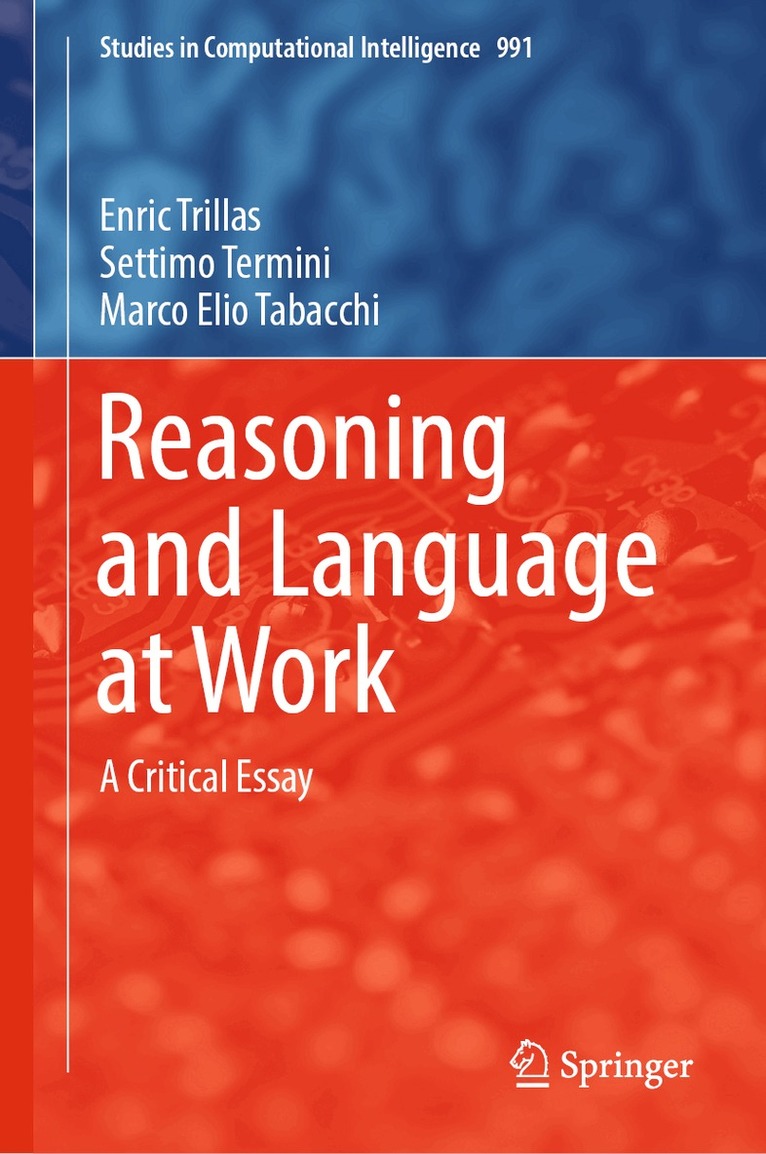
This book furthers the historical and technical debate by looking at reasoning as the action of language when it is devoted to explaining or foretelling, based on the authors’ centennial combined experience in fuzzy logic. A simple logical model mixing abductions and deductions is introduced in order to attain speculations, conjectures that may be responsible for induction, and creativity in reasoning. A central point and a dire hypothesis of the book are that such process can be implemented by computation and as such can lead to a new approach to automatic thinking and reasoning. On top of the technical approach, the relationship between reasoning and thinking is also analyzed trying to establish links with notions and concepts of thinkers from the European Middle Age to the current days.This book is recommended to young researchers that are interested in either the scientific or philosophical aspects of computational thinking, and can further the debate between the two approaches.
1 422 kr
Skickas inom 10-15 vardagar
This book furthers the historical and technical debate by looking at reasoning as the action of language when it is devoted to explaining or foretelling, based on the authors’ centennial combined experience in fuzzy logic. A simple logical model mixing abductions and deductions is introduced in order to attain speculations, conjectures that may be responsible for induction, and creativity in reasoning. A central point and a dire hypothesis of the book are that such process can be implemented by computation and as such can lead to a new approach to automatic thinking and reasoning. On top of the technical approach, the relationship between reasoning and thinking is also analyzed trying to establish links with notions and concepts of thinkers from the European Middle Age to the current days.This book is recommended to young researchers that are interested in either the scientific or philosophical aspects of computational thinking, and can further the debate between the two approaches.
Del 437 - Studies in Fuzziness and Soft Computing
Meandering Around Fuzziness
Inbunden, Engelska, 2025
2 378 kr
Skickas inom 10-15 vardagar
The present book, showing the meandering of the authors within the intricate grove of aspects of different nature (technical, mathematical and epistemological) of fuzziness, offers to the reader a chance for easily focusing the main questions of an interdisciplinary debate. The reader can, in fact, inspect nooks and crannies of this forest more hidden than those of a casual visitor even of the authors themselves, under the guide of this book which is both a Baedeker of an unknown territory and a preliminary map. The reader is allowed, then, to form a personal idea of the questions involved and possibly to afford the questions in a new way, when looking for a personal investigation on them. The meandering touches upon, in fact, very general questions at the interplay of epistemology, logic and applications. Think about, for instance, the connection between fuzziness and vagueness. Are they only different names used by different communities of scholars or they represent truly different ways of looking at what happens in our representations when we depart from the reassuring (but limiting) picture of a black and white world without any shade? More, is the theory of fuzziness measures only a sort of extension of the notion of information in a fuzzy world or is (also) something more? Enric Trillas strongly argues in favor of a radical thesis: “this theory is what definitely certifies that fuzziness is a scientific notion, since measurabilility is one of the essential requirements to be scientific.” This import of this point of view is wider that it can seem, since it also paves the way, indicating general conditions to be fulfilled, for accepting as “scientific” also any other different formal explicatum of the informal explicandum of vagueness. By moving around the woods under the guide of the authors, the reader will also discover that all the meaningful results have been found since a useful and apt conceptual environment did exist. The one of information sciences under the changing of different labels and characterizing names, Cybernetics, System theory before names that are still in the arena. The presence of this favorable context is what allowed to pose “meaningful questions” which, subsequently, helped the discovery of innovative results. The book presents a mixture of unpublished essays and already published ones which had been presented, along the time, to difference audiences. The former stress the joint relevance of the latter ones which would have not appeared by seeing the single items in isolation. The book offers an original view on the intricacy of the relationships among conceptual questions and technical developments which certainly will help the reader to move with much easy in the intricacy and the darkness of the forest where the authors dared, first, to move.
Del 302 - Studies in Fuzziness and Soft Computing
Fuzziness and Medicine: Philosophical Reflections and Application Systems in Health Care
A Companion Volume to Sadegh-Zadeh’s Handbook of Analytical Philosophy of Medicine
Inbunden, Engelska, 2013
1 577 kr
Skickas inom 10-15 vardagar
This book is a collection of contributions written by philosophers and scientists active in different fields, such as mathematics, logics, social sciences, computer sciences and linguistics. They comment on and discuss various parts of and subjects and propositions introduced in the Handbook of Analytical Philosophy of Medicine from Kadem Sadegh-Zadeh, published by Springer in 2012. This volume reports on the fruitful exchange and debate that arose in the fuzzy community upon the publication of the Handbook. This was not only very much appreciated by the community but also seen as a critical starting point for beginning a new discussion. The results of this discussion, which involved many different perspectives from science and the humanities and was warmly encouraged by Kadem Sadegh-Zadeh himself, are accurately reported in this volume, which is intended to be a critical companion to Kadem Sadegh-Zadeh´s handbook. Rudolf Seising is currently an adjunct researcher at the European Centre for Soft Computing in Mieres, Asturias (Spain) and a college lecturer at the Faculty of History and Arts, at the Ludwig Maximilians University of Munich (Germany). Marco Elio Tabacchi is currently the Scientific Director of the Italian National Research & Survey Organization Demopolis, and a research assistant in the Soft Computing Group at University of Palermo (Italy).
Del 302 - Studies in Fuzziness and Soft Computing
Fuzziness and Medicine: Philosophical Reflections and Application Systems in Health Care
A Companion Volume to Sadegh-Zadeh’s Handbook of Analytical Philosophy of Medicine
Häftad, Engelska, 2015
1 577 kr
Skickas inom 10-15 vardagar
This book is a collection of contributions written by philosophers and scientists active in different fields, such as mathematics, logics, social sciences, computer sciences and linguistics. They comment on and discuss various parts of and subjects and propositions introduced in the Handbook of Analytical Philosophy of Medicine from Kadem Sadegh-Zadeh, published by Springer in 2012. This volume reports on the fruitful exchange and debate that arose in the fuzzy community upon the publication of the Handbook. This was not only very much appreciated by the community but also seen as a critical starting point for beginning a new discussion. The results of this discussion, which involved many different perspectives from science and the humanities and was warmly encouraged by Kadem Sadegh-Zadeh himself, are accurately reported in this volume, which is intended to be a critical companion to Kadem Sadegh-Zadeh´s handbook. Rudolf Seising is currently an adjunct researcher at the European Centre for Soft Computing in Mieres, Asturias (Spain) and a college lecturer at the Faculty of History and Arts, at the Ludwig Maximilians University of Munich (Germany). Marco Elio Tabacchi is currently the Scientific Director of the Italian National Research & Survey Organization Demopolis, and a research assistant in the Soft Computing Group at University of Palermo (Italy).