Marek Makowski - Böcker
Visar alla böcker från författaren Marek Makowski. Handla med fri frakt och snabb leverans.
6 produkter
6 produkter
Del 9 - Mathematical Modelling: Theory and Applications
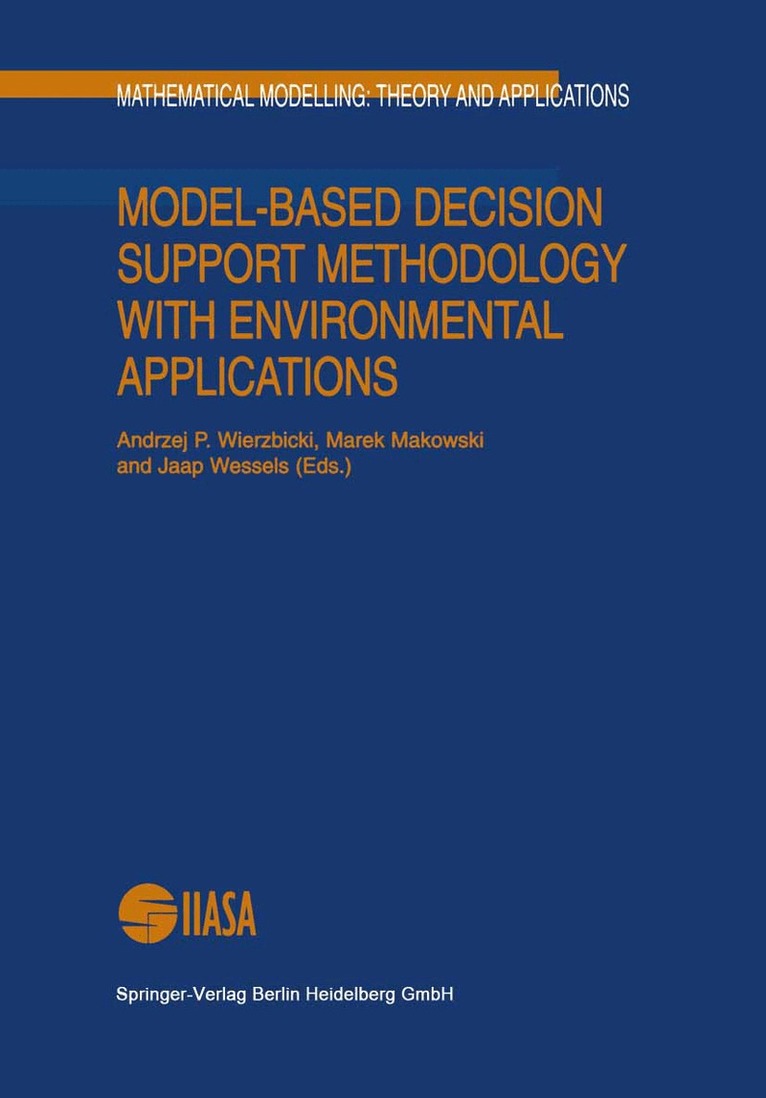
Model-Based Decision Support Methodology with Environmental Applications
Inbunden, Engelska, 2000
1 590 kr
Skickas inom 10-15 vardagar
This text develops a decision support methodology for strategic environmental decision problems and provides several generic as well as specific tools. The proposed methodology is based on modelling the underlying physical and economic processing. These substantial models are used for single criterion optimization and for multi-objective model analysis based on the reference point approach. It is shown that in this way, learning and decision processes may be supported, using concepts like soft constraints, inverse simulation and search for compromise solution. The last section consists of four chapters on applications. Each chapter treats an area of environmental decision making: water quality management in river basins, land use planning, cost-effective policies for improving air quality, and energy planning. For each area decision support systems are presented and it is shown how they are used for supporting decision making and negotiations.The applications as well as the methodology presented in this book have been developed at the International Institute for Applied Systems Analysis (IIASA) in Laxenburg, Austria, in close co-operation with several other institutes and organizations. It should be of use to researchers and practitioners in the fields of environmental modelling and analysis, decision support, mathematical programming and political analysis.
1 073 kr
Skickas inom 10-15 vardagar
Ongoing global changes bring fundamentally new scientific problems requiring new concepts and tools. A key issue concerns a vast variety of practically irreducible uncertainties, which challenge our traditional models and require new concepts and analytical tools. The uncertainty critically dominantes, e.g., the climate change debates. In short, the dilemma is concerned with enormous costs vs. massive uncertainties of potential extreme impacts. Traditional scientific approaches usually rely on real observations and experiments. Yet no sufficient observations exist for new problems, and "pure" experiments and learning by doing may be very expensive, dangerous, or simply impossible. In addition, available historical observations are contaminated by actions, policies. The complexity of new problems does not allow to achieve enough certainty by increasing the resolution of models or by bringing in more links. Hence, new tools for modeling and management of uncertainty are needed, as given in this book.
1 073 kr
Skickas inom 10-15 vardagar
Support for addressing the on-going global changes needs solutions for new scientific problems which in turn require new concepts and tools. A key issue concerns a vast variety of irreducible uncertainties, including extreme events of high multidimensional consequences, e.g., the climate change. The dilemma is concerned with enormous costs versus massive uncertainties of extreme impacts. Traditional scientific approaches rely on real observations and experiments. Yet no sufficient observations exist for new problems, and "pure" experiments, and learning by doing may be expensive, dangerous, or impossible. In addition, the available historical observations are often contaminated by past actions, and policies. Thus, tools are presented for the explicit treatment of uncertainties using "synthetic" information composed of available "hard" data from historical observations, the results of possible experiments, and scientific facts, as well as "soft" data from experts' opinions, and scenarios.
Social Informatics
Second International Conference, SocInfo 2010, Laxenburg, Austria, October 27-29, 2010, Proceedings
Häftad, Engelska, 2010
556 kr
Skickas inom 10-15 vardagar
As information technology became ubiquitous, it did not take long for prac- cally minded ICT specialists to realize the technology's potential for supporting and enhancing our social activities. Today, it is a truism to say that information technology has a social dimension and a social impact-it is enough to consider such applications as Facebook, LinkedIn, or Wikipedia. Proponents of the social applications of ICT will go further and claim that information technology is - shaping the way we are doing business, working, learning, playing, and making friends or enemies. They will say that, for example, Wikipedia has the pot- tial to completely change our economy (following Don Tapscott and Anthony Williams, the authors of Wikinomics). Computer science was slower than the social sciences to direct its interests towardthe social uses of its products. The concept of social informatics was ?rst invented by Rob Kling, who deemed it as an area of study of information and communication tools in cultural or institutional contexts. However, he was not the only one, as for example ethnographists quickly became interested in the ways ICT in?uences our culture (consider the studies of YouTube by Michael Wesch).Mediascienceandsociologyhavebeengearedupbytheseminalworksof McLuhan and are ready to tackle the new media created by ICT, as in the work of Manuel Castells. Psychologists quickly became interested in the Internet and computergames.Economistsrecognizedthequicklyrisingimpactofe-commerce and e-business and focused much e?ort on their analysis.
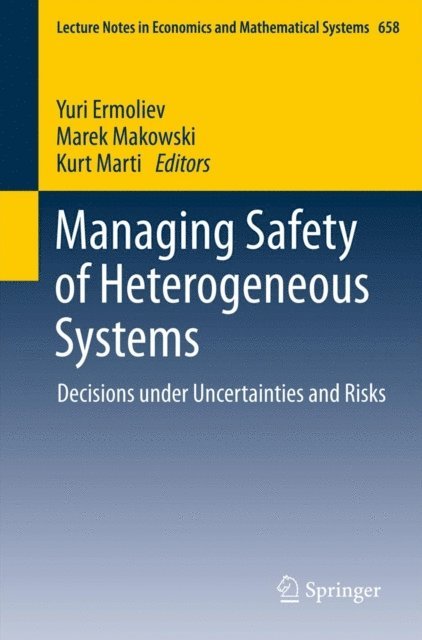
Managing Safety of Heterogeneous Systems
Decisions under Uncertainties and Risks
Häftad, Engelska, 2012
1 073 kr
Skickas inom 10-15 vardagar
Managing safety of diverse systems requires decision-making under uncertainties and risks. Such systems are typically characterized by spatio-temporal heterogeneities, inter-dependencies, externalities, endogenous risks, discontinuities, irreversibility, practically irreducible uncertainties, and rare events with catastrophic consequences. Traditional scientific approaches rely on data from real observations and experiments; yet no sufficient observations exist for new problems, and experiments are usually impossible. Therefore, science-based support for addressing such new class of problems needs to replace the traditional “deterministic predictions” analysis by new methods and tools for designing decisions that are robust against the involved uncertainties and risks. The new methods treat uncertainties explicitly by using “synthetic” information derived by integration of “hard” elements, including available data, results of possible experiments, and formal representations of scientific facts, with “soft” elements based on diverse representations of scenarios and opinions of public, stakeholders, and experts. The volume presents such effective new methods, and illustrates their applications in different problem areas, including engineering, economy, finance, agriculture, environment, and policy making.
Del 9 - Mathematical Modelling: Theory and Applications
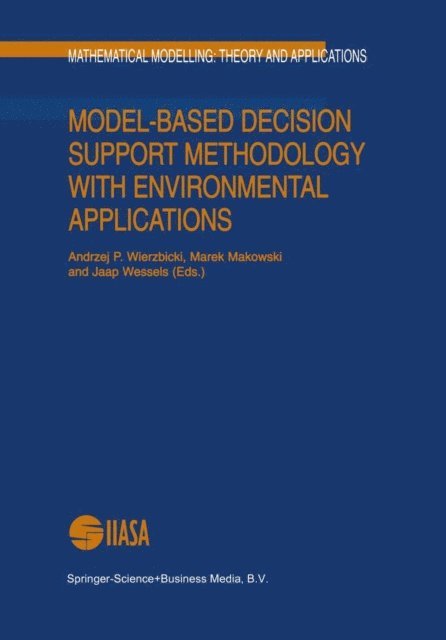
Model-Based Decision Support Methodology with Environmental Applications
Häftad, Engelska, 2010
1 590 kr
Skickas inom 10-15 vardagar
The complexity of issues requiring rational decision making grows and thus such decisions are becoming more and more difficult, despite advances in methodology and tools for decision support and in other areas of research. Globalization, interlinks between environmental, industrial, social and political issues, and rapid speed of change all contribute to the increase of this complexity. Specialized knowledge about decision-making processes and their support is increasing, but a large spectrum of approaches presented in the literature is typically illustrated only by simple examples. Moreover, the integration of model-based decision support methodologies and tools with specialized model-based knowledge developed for handling real problems in environmental, engineering, industrial, economical, social and political activities is often not satisfactory. Therefore, there is a need to present the state of art of methodology and tools for development of model-based decision support systems, and illustrate this state by applications to various complex real-world decision problems.The monograph reports many years of experience of many researchers, who have not only contributed to the developments in operations research but also succeeded to integrate knowledge and craft of various disciplines into several modern decision support systems which have been applied to actual complex decision-making processes in various fields of policy making. The experience presented in this book will be of value to researchers and practitioners in various fields. The issues discussed in this book gain in importance with the development of the new era of the information society, where information, knowledge, and ways of processing them become a decisive part of human activities. The examples presented in this book illustrate how how various methods and tools of model-based decision support can actually be used for helping modern decision makers that face complex problems. Overview of the contents: The first part of this three-part book presents the methodological background and characteristics of modern decision-making environment, and the value of model-based decision support thus addressing current challenges of decision support.It also provides the methodology of building and analyzing mathematical models that represent underlying physical and economic processes, and that are useful for modern decision makers at various stages of decision making. These methods support not only the analysis of Pareto-efficient solutions that correspond best to decision maker preferences but also allow the use of other modeling concepts like soft constraints, soft simulation, or inverse simulation. The second part describes various types of tools that are used for the development of decision support systems. These include tools for modeling, simulation, optimization, tools supporting choice and user interfaces. The described tools are both standard, commercially available, and nonstandard, public domain or shareware software, which are robust enough to be used also for complex applications.All four environmental applications (regional water quality management, land use planning, cost-effective policies aimed at improving the European air quality, energy planning with environmental implications) presented in the third part of the book rely on many years of cooperation between the authors of the book with several IIASA's projects, and with many researchers from the wide IIASA network of collaborating institutions. All these applications are characterized by an intensive use of model-based decision support. Finally, the appendix contains a short description of some of the tools described in the book that are available from IIASA, free of charge, for research and educational purposes. The experiences reported in this book indicate that the development of DSSs for strategic environmental decision making should be a joint effort involving experts in the subject area, modelers, and decision support experts. For the other experiences discussed in this book, the authors stress the importance of good data bases, and good libraries of tools. One of the most important requirements is a modular structure of a DSS that enhances the reusability of system modules.In such modular structures, user interfaces play an important role. The book shows how modern achievements in mathematical programming and computer sciences may be exploited for supporting decision making, especially about strategic environmental problems. It presents the methodological background of various methods for model-based decision support and reviews methods and tools for model development and analysis. The methods and tools are amply illustrated with extensive applications. Audience: This book will be of interest to researchers and practitioners in the fields of model development and analysis, model-based decision analysis and support, (particularly in the environment, economics, agriculture, engineering, and negotiations areas) and mathematical programming. For understanding of some parts of the text a background in mathematics and operational research is required but several chapters of the book will be of value also for readers without such a background. The monograph is also suitable for use as a text book for courses on advanced (Master and Ph.D.) levels for programs on Operations Research, decision analysis, decision support and various environmental studies (depending on the program different parts of the book may be emphasized).