Michael Kimmage - Böcker
Visar alla böcker från författaren Michael Kimmage. Handla med fri frakt och snabb leverans.
7 produkter
7 produkter
323 kr
Skickas inom 5-8 vardagar
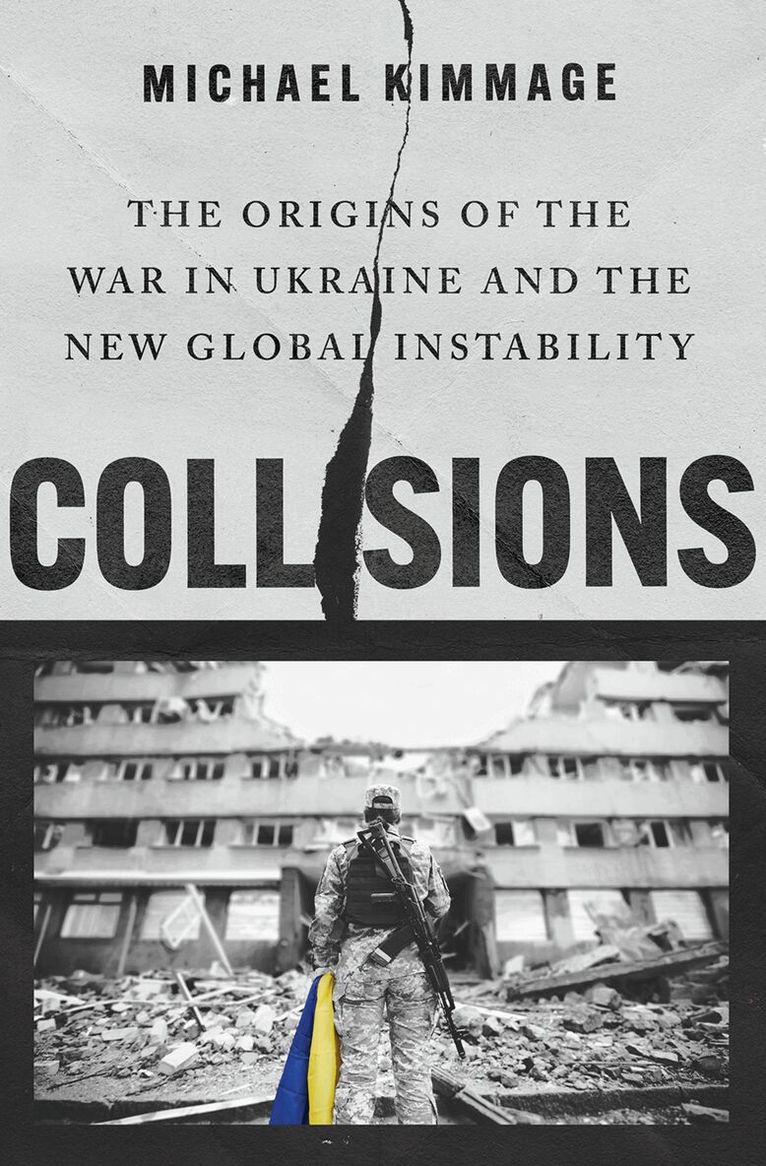
One war: three collisions--in this vividly written, narrative history of the war in Ukraine, Michael Kimmage puts together the pieces of a complicated international puzzle to understand the origins of the current conflict that has brought the world to the brink of a new Cold War.In Collisions, Michael Kimmage, a historian and former State Department official who focused on the Russia-Ukraine conflict, offers a wide-angle, historically informed account of the origins of the current Russia-Ukraine war. Tracing the development of Ukraine and Russia's fractious relationship back to the end of the Cold War, Kimmage takes readers through the central events that led to Vladimir Putin seizing a large portion of Ukraine--the Crimea--in 2014 and, eight years later, initiating arguably the most intensive military conflict of the entire post-World War II era.From the halls of power in Washington, Kyiv, and Moscow to the battlefields of Ukraine, Kimmage chronicles Putin's ascendancy to the Russian presidency, delves into multiple American presidencies and their dealings with Russia and Europe, and recounts Europe's efforts to bring Ukraine closer to the European Union. He tells the story of how Ukraine went from an embattled country on the edge of Europe to a formidable military power capable of pushing back the Russian military. Just as importantly, Kimmage captures how the current war has transformed multiple centers of power--from China to the United States--and dramatically altered the path of globalization itself. He makes the case that the war in Ukraine has shifted the direction of major macro-trends in world politics, contributing to the fragmentation of international politics, higher inflation, greater food insecurity, and the general collapse of arms control. These intersecting dangers amount to a new age of global instability, born in war and in the collision between Russia and the United States that has brought the world to the brink of a new Cold War.An authoritative interpretation of possibly the most important geopolitical event of the post-Cold War era, Collisions is essential reading for anyone interested in the origins of this epochal conflict and its ripple effects across the globe.
The Abandonment of the West
The History of an Idea in American Foreign Policy
Inbunden, Engelska, 2020
426 kr
Skickas
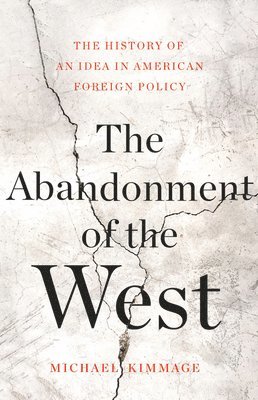
For much of the twentieth century, Americans saw their nation as part of a shared Western civilization rooted in European Enlightenment ideals of liberty and self-government and the heritage of classical Greece and Rome. And for much of the century, a vision of Western liberty guided America's foreign affairs, from the crusades of the world wars to its strategic alliances with Europe in the Cold War against the Communist East. But today, other ideas drive American foreign policy: on one side, the pursuit of a universal 'liberal international order,' and on the other, the illiberal nationalism of 'America First.' In The Abandonment of the West, historian Michael Kimmage traces the West's rise and its decline in American foreign policy since the 1890s - and argues that reviving the West today is essential to fostering national unity and resisting new geopolitical threats.The roots of America's affinity for the West run deep, from the embrace of Columbus as a national hero to the neoclassical design of the nation's capital. After the First World War, despite Woodrow Wilson's failed efforts to persuade Americans to take up leadership of the West, American universities advanced new Western civilization curricula. By 1945, after the Second World War, the West was the dominant American foreign-policy concept. Presidents Truman, Eisenhower, and Kennedy fostered the bipartisan project of saving the West from the Soviet East in the Cold War. Then this consensus unraveled. With the Vietnam War and the rights revolutions of the 1960s, the left raised new questions about the West's association with empire and white supremacy; American universities moved on to frameworks such as multiculturalism and ethnic studies. The right advanced a narrower, more religious vision of the West, almost as critical of liberals at home as it was of communists abroad. After the end of the Cold War, presidents Clinton, Bush, and Obama increasingly avoided invoking the West, seeking instead to create liberal democracies everywhere. Donald Trump has broadly rejected Western ideals of liberty, instead embracing authoritarian leaders and denigrating Western institutions such as NATO.The Abandonment of the West concludes with a defense of the West as a framework for American foreign affairs today. Despite its past shortcomings, Kimmage argues, reviving the West is essential to restoring a foreign policy rooted in liberty and self-governance and resisting the authoritarianism of Russia and China. Here at home, a revitalized and expansive West can offer an inspiring alternative to identity politics on the right and the left. Sweeping and full of rich insights, The Abandonment of the West is an urgent portrait of modern America's search for identity and its emergence as a superpower, revealing the crossroads at which the country now stands.
Del 165 - Harvard Historical Studies
Conservative Turn
Lionel Trilling, Whittaker Chambers, and the Lessons of Anti-Communism
Inbunden, Engelska, 2009
533 kr
Skickas inom 7-10 vardagar
The Conservative Turn tells the story of postwar America’s political evolution through two fascinating figures: Lionel Trilling and Whittaker Chambers. Born at the turn of the twentieth century, they were college classmates who went on to intellectual prominence, sharing the questions, crises, and challenges of their generation. A spy for the Soviet Union in the 1930s, Chambers became the main witness in the 1948 trial of Alger Hiss, which ended in Hiss’s conviction for perjury. The trial advanced the careers of Richard Nixon and Joseph McCarthy and marked the beginning of the Cold War mood in America. Chambers was also a major conservative thinker, a theorist of the postwar conservative movement.Meanwhile, in the 1940s and 1950s, the literary critic Trilling wrote important essays that encouraged liberals to disown their radical past and to embrace a balanced maturity. Trilling’s liberal anti-communism was highly influential, culminating politically in the presidency of John F. Kennedy. Kimmage argues that the divergent careers of these two men exemplify important developments in postwar American politics: the emergence of modern conservatism and the rise of moderate liberalism, crucially shaped by anti-communism. Taken together, these developments constitute a conservative turn in American political and intellectual life—a turn that continues to shape America’s political landscape.
929 kr
Skickas inom 10-15 vardagar
In History's Grip concentrates on the literature of Philip Roth, one of America's greatest writers, and in particular on American Pastoral, I Married a Communist, and The Human Stain. Each of these novels from the 1990s uses Newark, New Jersey, to explore American history and character. Each features a protagonist who grows up in and then leaves Newark, after which he is undone by a historically generated crisis. The city's twentieth-century decline from immigrant metropolis to postindustrial disaster completes the motif of history and its terrifying power over individual destiny.In History's Grip is the first critical study to foreground the city of Newark as the source of Roth's inspiration, and to scrutinize a subject Roth was accused of avoiding as a younger writer—history. In so doing, the book brings together the two halves of Roth's decades-long career: the first featuring characters who live outside of history's grip; the second, characters entrapped in historical patterns beyond their ken and control.
2 108 kr
Skickas inom 3-6 vardagar
Amerikafahrt by Wolfgang Koeppen is a masterpiece of observation, analysis, and writing, based on his 1958 trip to the United States. A major twentieth-century German writer, Koeppen presents a vivid and fascinating portrait of the US in the late 1950s: its major cities, its literary culture, its troubled race relations, its multi-culturalism and its vast loneliness, a motif drawn, in part, from Kafka’s Amerika. A modernist travelogue, the text employs symbol, myth, and image, as if Koeppen sought to answer de Tocqueville’s questions in the manner of Joyce and Kafka. Journey through America is also a meditation on America, intended for a German audience and mindful of the destiny of postwar Europe under many Americanizing influences.
1 235 kr
Skickas inom 5-8 vardagar
Is the Atlantic World in a state of crisis? At a time when many political observers perceive indeed a crisis in transatlantic relations, critical evaluation of past narratives and frameworks in Transatlantic Relations and Atlantic History alike become crucial. This volume provides an academic foundation to critically assess the Atlantic World and to rethink transatlantic relations in a transnational and global perspective.The TransAtlantic reconsidered brings together leading experts such as Harvard historians Charles S. Maier and Bernard Bailyn and former ERC scientific board member Nicholas Canny. All the scholars represented in this volume have helped to shape, re-shape, and challenge the narrative(s) of the Atlantic World and can thus (re-)evaluate its conceptual basis in view of historiographical developments and contemporary challenges.
354 kr
Skickas inom 5-8 vardagar
Is the Atlantic World in a state of crisis? At a time when many political observers perceive indeed a crisis in transatlantic relations, critical evaluation of past narratives and frameworks in Transatlantic Relations and Atlantic History alike become crucial. This volume provides an academic foundation to critically assess the Atlantic World and to rethink transatlantic relations in a transnational and global perspective.The TransAtlantic reconsidered brings together leading experts such as Harvard historians Charles S. Maier and Bernard Bailyn and former ERC scientific board member Nicholas Canny. All the scholars represented in this volume have helped to shape, re-shape, and challenge the narrative(s) of the Atlantic World and can thus (re-)evaluate its conceptual basis in view of historiographical developments and contemporary challenges.