Michael Pfister – författare
718 kr
Skickas inom 10-15 vardagar
2 238 kr
Skickas inom 5-8 vardagar
4 947 kr
Läs direkt efter köp
The behaviour of river systems is a result of the complex interaction between flow, sediments, morphology and habitats. Furthermore, rivers are often used as a source of water supply and energy production as well as a waterway for transportation. The main challenge faced by river engineers today, in collaboration with environmental and ecological scientists, is to restore the channelized rivers under the constraints of high urbanization and limited space, as well as sustainable water use.
During the seventh International Conference on Fluvial Hydraulics “River Flow 2014” at École Polytechnique Fédérale de Lausanne (EPFL), Switzerland, scientists and professionals from all over the world addressed this challenge and exchanged their knowledge regarding fluvial hydraulics and river morphology. This book comprises the proceedings of the high quality contributions of the participants, which reflect the state-of-the-art in the fields of river hydrodynamics, morphodynamics, sediment transport, river engineering and restoration. The conference was organized under the auspices of the Committee on Fluvial Hydraulics of the International Association for Hydro-Environment Engineering and Research (IAHR). Past River Flow conferences have witnessed a significant increase in participation of our community of river engineers and researchers, confirming the need for such a forum.
828 kr
Läs direkt efter köp
Hydraulic engineering of dams and their appurtenant structures counts among the essential tasks to successfully design safe water-retaining reservoirs for hydroelectric power generation, flood retention, and irrigation and water supply demands. In view of climate change, especially dams and reservoirs, among other water infrastructure, will and have to play an even more important role than in the past as part of necessary mitigation and adaptation measures to satisfy vital needs in water supply, renewable energy and food worldwide as expressed in the Sustainable Development Goals of the United Nations.
This book deals with the major hydraulic aspects of dam engineering considering recent developments in research and construction, namely overflow, conveyance and dissipations structures of spillways, river diversion facilities during construction, bottom and low-level outlets as well as intake structures. Furthermore, the book covers reservoir sedimentation, impulse waves and dambreak waves, which are relevant topics in view of sustainable and safe operation of reservoirs.
The book is richly illustrated with photographs, highlighting the various appurtenant structures of dams addressed in the book chapters, as well as figures and diagrams showing important relations among the governing parameters of a certain phenomenon. An extensive literature review along with an updated bibliography complete this book.
828 kr
Läs direkt efter köp
Hydraulic engineering of dams and their appurtenant structures counts among the essential tasks to successfully design safe water-retaining reservoirs for hydroelectric power generation, flood retention, and irrigation and water supply demands. In view of climate change, especially dams and reservoirs, among other water infrastructure, will and have to play an even more important role than in the past as part of necessary mitigation and adaptation measures to satisfy vital needs in water supply, renewable energy and food worldwide as expressed in the Sustainable Development Goals of the United Nations.
This book deals with the major hydraulic aspects of dam engineering considering recent developments in research and construction, namely overflow, conveyance and dissipations structures of spillways, river diversion facilities during construction, bottom and low-level outlets as well as intake structures. Furthermore, the book covers reservoir sedimentation, impulse waves and dambreak waves, which are relevant topics in view of sustainable and safe operation of reservoirs.
The book is richly illustrated with photographs, highlighting the various appurtenant structures of dams addressed in the book chapters, as well as figures and diagrams showing important relations among the governing parameters of a certain phenomenon. An extensive literature review along with an updated bibliography complete this book.
2 389 kr
Skickas inom 10-15 vardagar
4 260 kr
Skickas inom 5-8 vardagar
1 338 kr
Skickas inom 10-15 vardagar
2 809 kr
Skickas inom 10-15 vardagar
860 kr
Läs direkt efter köp
2 758 kr
Läs direkt efter köp
860 kr
Läs direkt efter köp
2 758 kr
Läs direkt efter köp
3 244 kr
Läs direkt efter köp
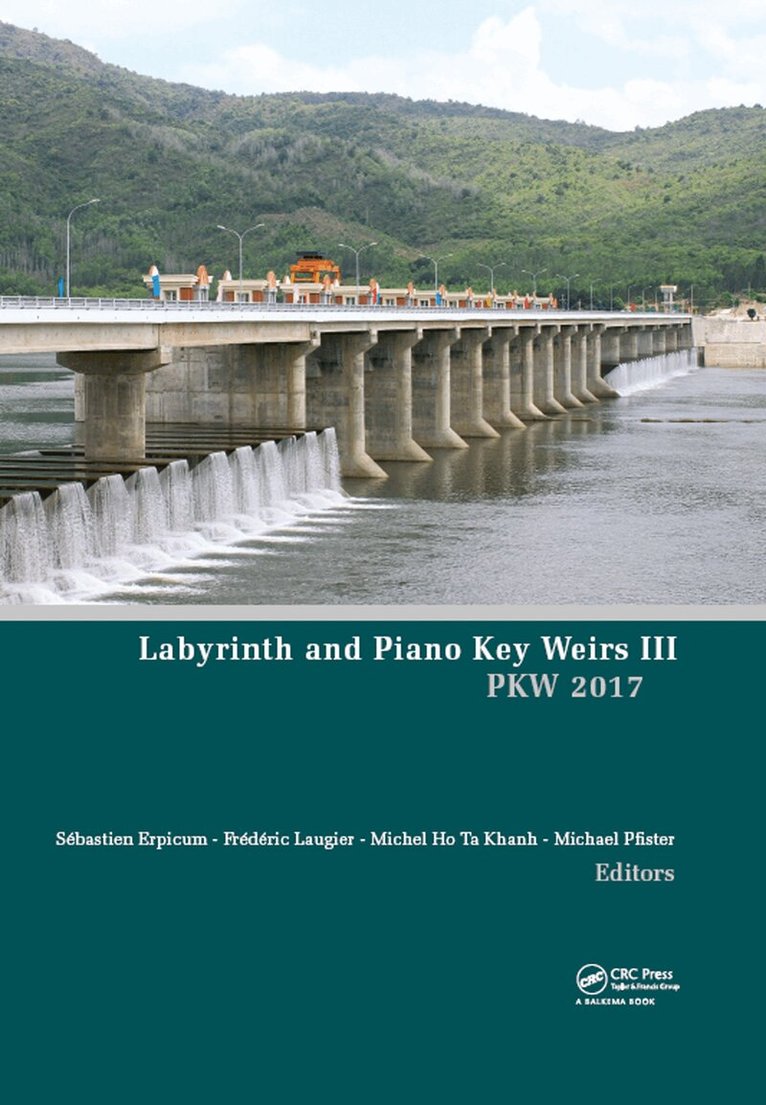
Since the first implementation by Electricité de France on the Goulours dam (France) in 2006, the Piano Key Weir has become a more and more applied solution to increase the discharge capacity of existing spillways. In parallel, several new large dam projects have been built with such a flood control structure, usually in combination with gates. Today, more than 25 Piano Key Weirs are in operation or under construction all over the world. More than 15 years of research and development have enabled detailed investigations of the hydraulic and structural behaviour of the Piano Key Weir complex structure and have provided more and more accurate design equations. Following the proceedings of the first two workshops held in Liege (Belgium – 2011) and Paris (France – 2013), Labyrinth and Piano Key Weirs III collects the contributions presented by people with varied background, from researchers to practitioners, at the 3rd International Workshop on Labyrinth and Piano Key Weirs - PKW 2017 (22-24 February 2017, Qui Nhon, Vietnam). The papers, reviewed and accepted by an International Scientific Committee, summarize the current state-of-the-art on Piano Key Weirs from a theoretical to a practical point of view, and present most of the main projects in operation or under construction.
Labyrinth and Piano Key Weirs III is thus a reference for students, practitioners and researchers interested in Dams Engineering.
3 244 kr
Läs direkt efter köp
Since the first implementation by Electricité de France on the Goulours dam (France) in 2006, the Piano Key Weir has become a more and more applied solution to increase the discharge capacity of existing spillways. In parallel, several new large dam projects have been built with such a flood control structure, usually in combination with gates. Today, more than 25 Piano Key Weirs are in operation or under construction all over the world. More than 15 years of research and development have enabled detailed investigations of the hydraulic and structural behaviour of the Piano Key Weir complex structure and have provided more and more accurate design equations. Following the proceedings of the first two workshops held in Liege (Belgium – 2011) and Paris (France – 2013), Labyrinth and Piano Key Weirs III collects the contributions presented by people with varied background, from researchers to practitioners, at the 3rd International Workshop on Labyrinth and Piano Key Weirs - PKW 2017 (22-24 February 2017, Qui Nhon, Vietnam). The papers, reviewed and accepted by an International Scientific Committee, summarize the current state-of-the-art on Piano Key Weirs from a theoretical to a practical point of view, and present most of the main projects in operation or under construction.
Labyrinth and Piano Key Weirs III is thus a reference for students, practitioners and researchers interested in Dams Engineering.
4 947 kr
Läs direkt efter köp
The behaviour of river systems is a result of the complex interaction between flow, sediments, morphology and habitats. Furthermore, rivers are often used as a source of water supply and energy production as well as a waterway for transportation. The main challenge faced by river engineers today, in collaboration with environmental and ecological scientists, is to restore the channelized rivers under the constraints of high urbanization and limited space, as well as sustainable water use.
During the seventh International Conference on Fluvial Hydraulics “River Flow 2014” at École Polytechnique Fédérale de Lausanne (EPFL), Switzerland, scientists and professionals from all over the world addressed this challenge and exchanged their knowledge regarding fluvial hydraulics and river morphology. This book comprises the proceedings of the high quality contributions of the participants, which reflect the state-of-the-art in the fields of river hydrodynamics, morphodynamics, sediment transport, river engineering and restoration. The conference was organized under the auspices of the Committee on Fluvial Hydraulics of the International Association for Hydro-Environment Engineering and Research (IAHR). Past River Flow conferences have witnessed a significant increase in participation of our community of river engineers and researchers, confirming the need for such a forum.
113 kr
Läs direkt efter köp