Michael Rys – författare
Visar alla böcker från författaren Michael Rys. Handla med fri frakt och snabb leverans.
8 produkter
8 produkter
Häftad, Engelska, 2003
561 kr
Skickas inom 10-15 vardagar
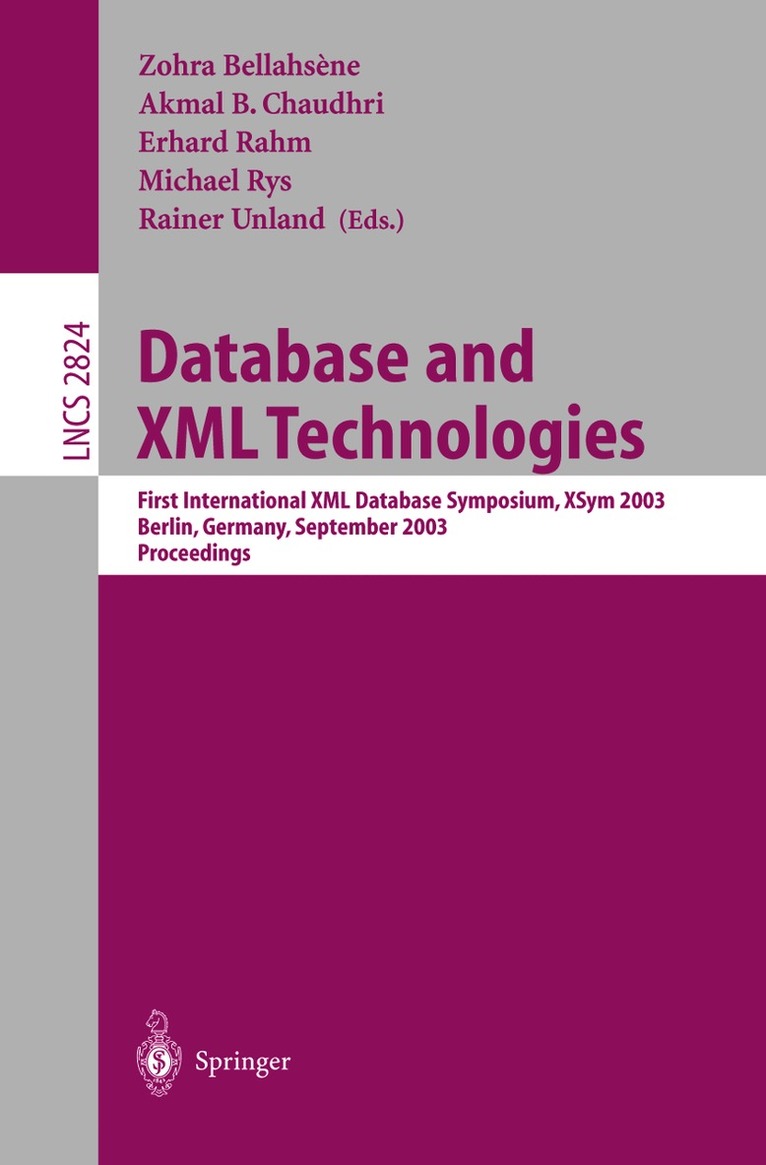
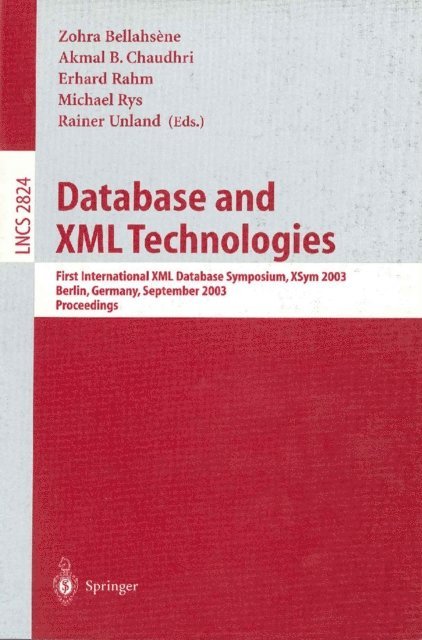
This book constitutes the refereed proceedings of the First International XML Database Symposium, XSym 2003, held in Berlin, Germany in September 2003.The 18 revised full papers presented were carefully reviewed and selected from 65 submissions. The papers are organized in topical sections on XML-relational database management systems, XML query processing, systems and tools for XML data processing, XML access structures, stream processing and updates, and design issues.
Häftad, Engelska, 2004
561 kr
Skickas inom 10-15 vardagar
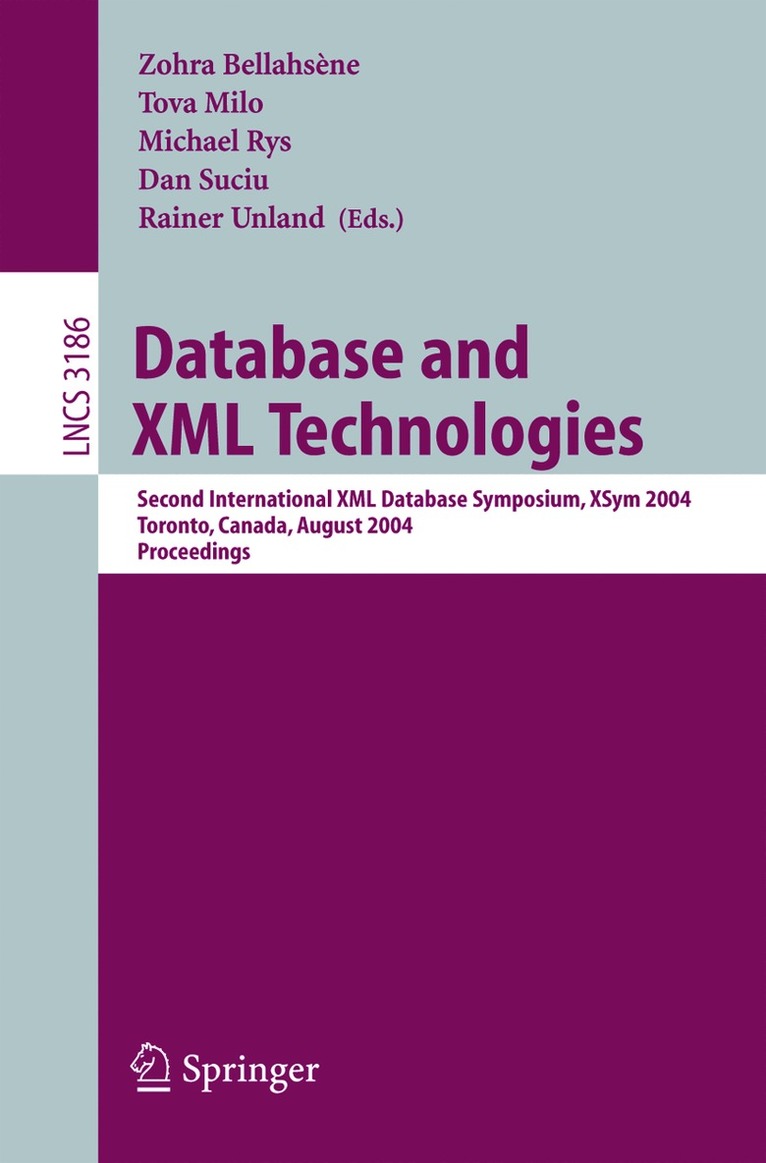
This book constitutes the refereed proceedings of the Second International XML Database Symposium, XSym 2004, held in Toronto, Canada in August 2004 in association with VLDB 2004. The 15 revised full papers presented were carefully reviewed and selected from around 60 submissions. The papers are organized in topical sections on Xquery processing, searching, ranking, and mapping XML documents; XML constraints checking and correcting; XML processing; and clustering, indexing, and statistics.
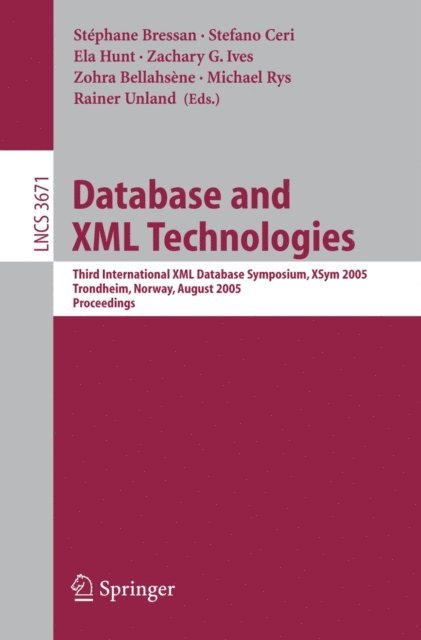
Häftad, Engelska, 2005
561 kr
Skickas inom 10-15 vardagar
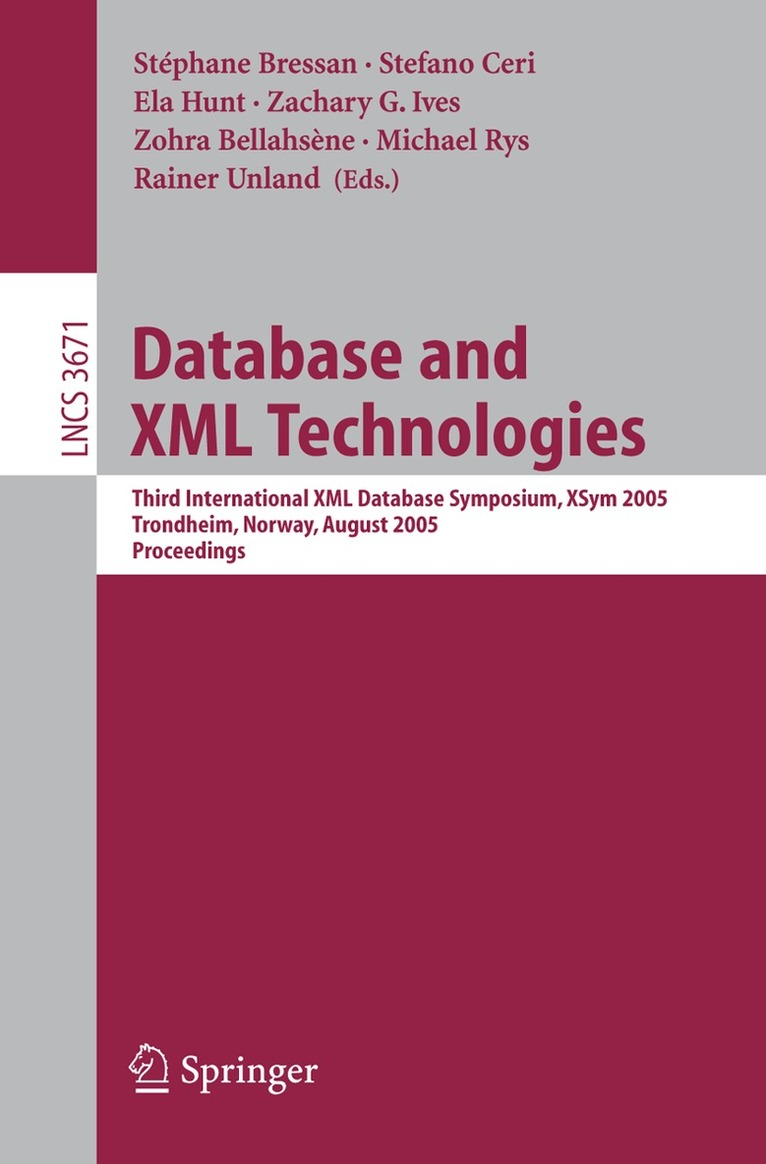
This yearmarks anexciting time in the XML-database space:XQueryis moving closer to becoming a full W3C Recommendation, and the "Big 3" database vendors (IBM, Oracle, Microsoft) are expected to release XQuery support in theirrelationalDBMSs,joininganumberofexistingopensourceandcommercial products. Thus, we are very pleased to feature an industrial paper (describing theXML-speci?cfeaturesofMicrosoftSQLServer)aswellas14researchpapers. XSym's focus this year was on building XML repositories, and papers discussed the following topics: indexing support for the evaluation of XPath and XQuery; benchmarks and algorithms for XQuery and XPath evaluation; algorithms for constraint satisfaction checking, information extraction, and subtree matching; and applications of XML in information systems. This year, XSym also coordinated its e?orts with the Database and P- gramming Languages Symposium, DBPL 2005. The resulting program included not only presentations of the papers in this proceedings, but also a joint DBPL- XSym keynote talk by Giuseppe Castagna, developer of the CDuce language for XML processing, and a joint panel on open XML research problems and challenges.The organizers would like to express their gratitude to the XSym Program Committee and external reviewers for their e?orts in providing very thorough evaluationsofthesubmittedpapersundersigni?canttimeconstraintsandto- crosoftfortheirsponsorshipandfortheuseoftheMicrosoftConferenceMana- ment Toolkit. We would also like to thank Gavin Bierman and Christoph Koch, the organizersof DBPL, for their e?orts andtheir willingness to coordinate with us. These proceedings are dedicated to Alberto Mendelzon who sadly passed awaythisyear.Asastrongsupporterofandactivecontributortothissymposium series he will always remain in our memory.
E-bok
PDF, Engelska, 2004708 kr
Läs direkt efter köp
Modern database systems enhance the capabilities of traditional database systems by their ability to handle any kind of data, including text, image, audio, and video. Today, databasesystemsareparticularlyrelevanttotheWeb,astheycanprovideinputtocontent generators for Web pages, and can handle queries issued over the Internet. The eXtensible Markup Language (XML) is used in applications running the gamut from content management through publishing to Web services and e-commerce. It is used as the universal communication language for exchanging music and graphics as well as purchase orders and technical documentation. As database systems increasingly talk to each other over the Web, there is a fa- growingdesiretouseXMLasthestandardexchangeformat.Asaresult,manyrelational database systems can export data as XML documents and import data from XML d- uments and provide query and update capabilities for XML data. In addition, so called native XML database and integration systems are appearing on the database market, whose claim is to be especially tailored to storing, maintaining, and easily accessing XML documents. After the huge success of the ?rst XML Database Symposium (XSym 2003) last year in Berlin (already then in conjunction withVLDB) it was decided to establish this symposiumasanannualeventthatissupposedtotakeplaceasanintegralpartofVLDB. Thegoalofthissymposiumistoprovideahigh-qualityplatformforthepresentationand discussion of new research results and system developments. It is targeted at scientists, practitioners, vendors and users of XML and database technologies.
E-bok
PDF, Engelska, 2005708 kr
Läs direkt efter köp
E-bok
PDF, Engelska, 2003718 kr
Läs direkt efter köp
The Extensible Markup Language (XML) is playing an increasingly important role in the exchange of a wide variety of data on the Web and elsewhere. The database c- munity is interested in XML because it can be used to represent a variety of data f- mats originating in different kinds of data repositories while providing structure and the possibility to add type information. The theme of this symposium is the combination of database and XML te- nologies. Today, we see growing interest in using these technologies together for many Web-based and database-centric applications. XML is being used to publish data from database systems on the Web by providing input to content generators for Web pages, and database systems are increasingly being used to store and query XML data, often by handling queries issued over the Internet. As database systems incre- ingly start talking to each other over the Web, there is a fast-growing interest in using XML as the standard exchange format for distributed query processing. As a result, many relational database systems export data as XML documents, import data from XML documents, provide query and update capabilities for XML data. In addition, so-called native XML database and integration systems are appearing on the database market, and it’s claimed that they are especially tailored to store, maintain and easily access XML documents.
Häftad, Engelska, 2009
561 kr
Skickas inom 10-15 vardagar
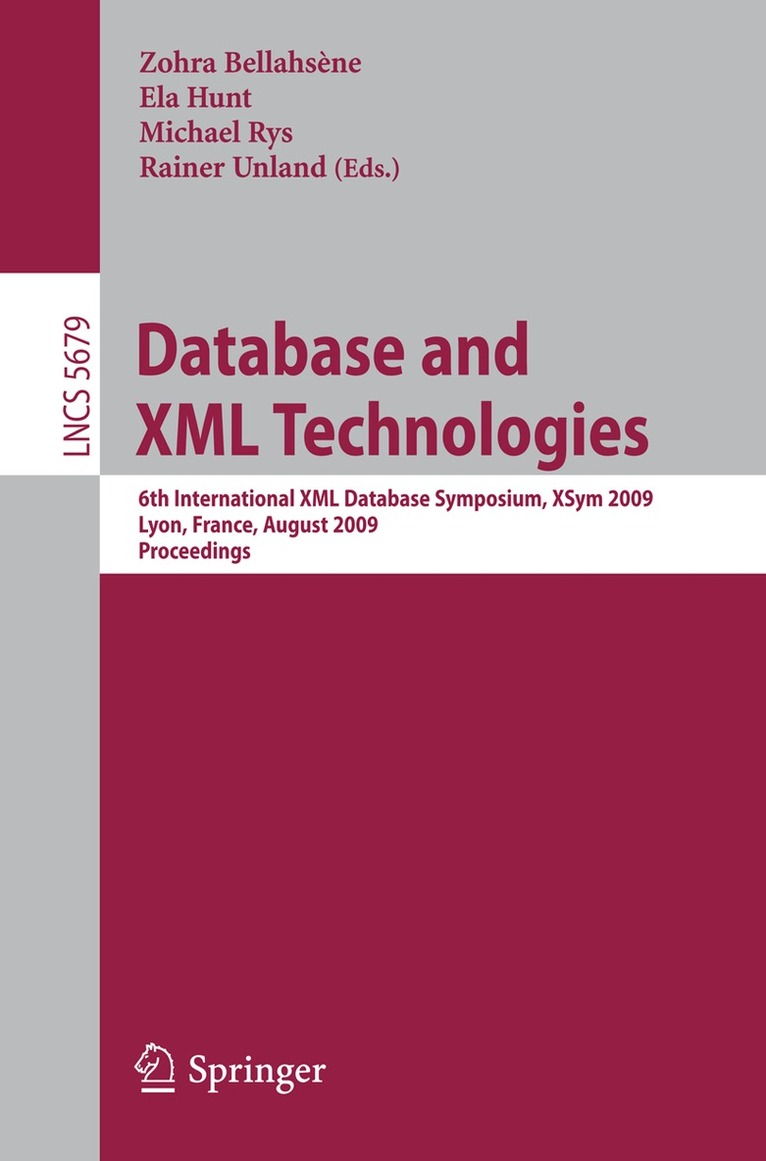
Since its first edition in 2003, the XML Database Symposium series (XSym) has been a forum for academics, practitioners, users and vendors, allowing all to discuss the use of and synergy between database management systems and XML. The previous symposia have provided opportunities for timely discussions on a broad range of topics pertaining to the theory and practice of XML data management and its applications. XSym 2009 continued this XSym tradition with a program consisting of 15 papers and a keynote shared with the 12th International Symposium on Database Programming Languages (DBPL 2009). We received 26 paper submissions, out of which eight papers were accepted as full papers, and seven as short/demo papers. Each submitted paper underwent a rigorous and careful review by four referees for long papers and three for the short ones. The contributions in these proceedings are a fine sample of the very best current - search in XML query processing, including full text, keyword and loosely structured queries, stream querying and joins, and materialized views. Among new theoretical advances we included work on a lambda-calculus model of XML and XPath, on m- ping from the enhanced entity-relationship conceptual model to the W3C XML Schema Language, on transactions, and extensions to XPath. Finally, work on data parallel algorithms, compression, and practical aspects of XQuery, including query forms and the use of Prolog are also part of this volume.
E-bok
PDF, Engelska, 2009708 kr
Läs direkt efter köp
Since its first edition in 2003, the XML Database Symposium series (XSym) has been a forum for academics, practitioners, users and vendors, allowing all to discuss the use of and synergy between database management systems and XML. The previous symposia have provided opportunities for timely discussions on a broad range of topics pertaining to the theory and practice of XML data management and its applications. XSym 2009 continued this XSym tradition with a program consisting of 15 papers and a keynote shared with the 12th International Symposium on Database Programming Languages (DBPL 2009). We received 26 paper submissions, out of which eight papers were accepted as full papers, and seven as short/demo papers. Each submitted paper underwent a rigorous and careful review by four referees for long papers and three for the short ones. The contributions in these proceedings are a fine sample of the very best current - search in XML query processing, including full text, keyword and loosely structured queries, stream querying and joins, and materialized views. Among new theoretical advances we included work on a lambda-calculus model of XML and XPath, on m- ping from the enhanced entity-relationship conceptual model to the W3C XML Schema Language, on transactions, and extensions to XPath. Finally, work on data parallel algorithms, compression, and practical aspects of XQuery, including query forms and the use of Prolog are also part of this volume.