Michael Uljens – författare
Visar alla böcker från författaren Michael Uljens. Handla med fri frakt och snabb leverans.
10 produkter
10 produkter
Inbunden, Engelska, 1997
2 090 kr
Skickas inom 10-15 vardagar
In this book a new theory on instruction is presented - a reflective theory of school didactics - uniquely incorporating continental German and Nordic research traditions in the theory of didactics (Didaktik), together with Anglo-American research on teaching (instructional research) and cognitivist theory. School didactics is defined as a field of research within general education. This field is limited to research and theory aiming at understanding the pedagogical practice which takes place in institutionalized educational settings guided by a curriculum collectively agreed upon. As the theory is designed to be valid for institutionalized education framed by a politically accepted curriculum, it is a culturally seen regional theory of education, not a universal one. According to this school theory the fundamental features of an institutionalized pedagogical process consist in the intentional, interactional, teaching-studying-learning process that is culturally and historically developed and situated. However, the present model does not explicitly formulate goals nor the means of educational practice. Rather, the model emphasizes the teacher and student as reflective and intentional subjects where the teacher is acting as the representative of the collective but also as the learners' advocate. Because of this the theory presented is not a normative or prescriptive theory, instead it is a reflective theory.
Häftad, Engelska, 1998
571 kr
Skickas inom 10-15 vardagar
In this book a new theory on instruction is presented - a reflective theory of school didactics - uniquely incorporating continental German and Nordic research traditions in the theory of didactics (Didaktik), together with Anglo-American research on teaching (instructional research) and cognitivist theory. School didactics is defined as a field of research within general education. This field is limited to research and theory aiming at understanding the pedagogical practice which takes place in institutionalized educational settings guided by a curriculum collectively agreed upon. As the theory is designed to be valid for institutionalized education framed by a politically accepted curriculum, it is a culturally seen regional theory of education, not a universal one. According to this school theory the fundamental features of an institutionalized pedagogical process consist in the intentional, interactional, teaching-studying-learning process that is culturally and historically developed and situated. However, the present model does not explicitly formulate goals nor the means of educational practice. Rather, the model emphasizes the teacher and student as reflective and intentional subjects where the teacher is acting as the representative of the collective but also as the learners' advocate. Because of this the theory presented is not a normative or prescriptive theory, instead it is a reflective theory.
Del 20 - Educational Governance Research
Non-affirmative Theory of Education and Bildung
Inbunden, Engelska, 2023
527 kr
Skickas inom 5-8 vardagar
Interpreting the modern heritage of ‘Bildung’ in connection to education theory, this open access volume explores non-affirmative theory of education and ‘Bildung’ as a language of education for the 21st century. In this ‘Bildung’-centered view of education, discerning thought on knowledge and values are critical objectives of education. To promote these aims, education practice must recognize but not affirm existing conditions or future ideals but instead pedagogically summon the student to self-directed critical treatment of the contents. Drawing on contemporary developments of modern education theory, especially as developed by Dietrich Benner in Berlin, the volume highlight how ‘educative teaching’ aims at supporting the growth of the individual as a person and citizen.The volume shows how it is possible to identify a position beyond education either as a mere transformative or a reproductive power. Instead of such an instrumentalism, education is seen as a critical societal practice, necessary for reflexive action and democracy. In different ways, the chapters demonstrate how non-affirmative theory offer an alternative to contemporary neo-liberal and conservative policies. The non-affirmative approach offers a strong education theory, relationally connecting the interactive level of teaching, studying and learning with the societal level and educational governance. Non-affirmative theory on education and ‘Bildung’ provides an elaborate point of departure for empirical research on teaching and educational leadership, teacher education and policy making.In five sections, the volume highlights how non-affirmative education theory relate to Didaktik, educative teaching, school didactics, democratic education and social justice. The approach is also analysed in relation to phenomenology, sociology, hermeneutics, cultural-historical activity theory, discursive institutionalism, empirical research, educational leadership and governance and 21st century competencies. Chapter “On Affirmativity and Non-affirmativity in the Context of Theories of Education and Bildung” is available open access under a Creative Commons Attribution-NonCommercial-NoDerivatives 4.0 International License via link.springer.com.
Engelska, 2023
608 kr
Skickas inom 5-8 vardagar
Del 20 - Educational Governance Research
Non-affirmative Theory of Education and Bildung
Häftad, Engelska, 2023
425 kr
Skickas inom 10-15 vardagar
Interpreting the modern heritage of ‘Bildung’ in connection to education theory, this open access volume explores non-affirmative theory of education and ‘Bildung’ as a language of education for the 21st century. In this ‘Bildung’-centered view of education, discerning thought on knowledge and values are critical objectives of education. To promote these aims, education practice must recognize but not affirm existing conditions or future ideals but instead pedagogically summon the student to self-directed critical treatment of the contents. Drawing on contemporary developments of modern education theory, especially as developed by Dietrich Benner in Berlin, the volume highlight how ‘educative teaching’ aims at supporting the growth of the individual as a person and citizen.The volume shows how it is possible to identify a position beyond education either as a mere transformative or a reproductive power. Instead of such an instrumentalism, education is seen as a critical societal practice, necessary for reflexive action and democracy. In different ways, the chapters demonstrate how non-affirmative theory offer an alternative to contemporary neo-liberal and conservative policies. The non-affirmative approach offers a strong education theory, relationally connecting the interactive level of teaching, studying and learning with the societal level and educational governance. Non-affirmative theory on education and ‘Bildung’ provides an elaborate point of departure for empirical research on teaching and educational leadership, teacher education and policy making.In five sections, the volume highlights how non-affirmative education theory relate to Didaktik, educative teaching, school didactics, democratic education and social justice. The approach is also analysed in relation to phenomenology, sociology, hermeneutics, cultural-historical activity theory, discursive institutionalism, empirical research, educational leadership and governance and 21st century competencies. Chapter “On Affirmativity and Non-affirmativity in the Context of Theories of Education and Bildung” is available open access under a Creative Commons Attribution-NonCommercial-NoDerivatives 4.0 International License via link.springer.com.
Inbunden, Engelska, 2024
527 kr
Skickas inom 5-8 vardagar
This Open Access book addresses the theoretical grounding of the pedagogical dimensions of higher education leadership and its empirical study. The book’s general point of departure is that educational leadership is a multi-level phenomenon, operating as policy work on a transnational and national level, as educational leadership on various organizational levels, and as supervision and teaching on an interactional level. It is in and through these discursive practices that policies are initiated, interpreted, translated and enacted. The volume demonstrates how Non Affirmative Theory (NAT) of education applies to understanding and dealing with the pedagogical dimensions of the multi-level and multi-actor phenomena of HE leadership in a coherent manner. It allows one to explore how the pedagogical scope of action at each level of leadership is framed or staged by the other levels, as well as how actors at different levels utilise their scope. The book starts out by exploring the pedagogical aspects of HE leadership as a multi-level and multi-actor phenomenon at a theoretical level. It continues to discuss nation state HE in a global perspective, and HE leadership in an organisational perspective. Next, the book looks at departmental leadership, management and development. Parallel with this, the volume critically explores the non-affirmative position itself by a contrasting dialogue with other theoretical approaches.
Del 25 - Educational Governance Research
Multilevel Pedagogical Leadership in Higher Education
A Non-Affirmative Approach
Häftad, Engelska, 2025
425 kr
Skickas inom 10-15 vardagar
This Open Access book addresses the theoretical grounding of the pedagogical dimensions of higher education leadership and its empirical study. The book’s general point of departure is that educational leadership is a multi-level phenomenon, operating as policy work on a transnational and national level, as educational leadership on various organizational levels, and as supervision and teaching on an interactional level. It is in and through these discursive practices that policies are initiated, interpreted, translated and enacted. The volume demonstrates how Non Affirmative Theory (NAT) of education applies to understanding and dealing with the pedagogical dimensions of the multi-level and multi-actor phenomena of HE leadership in a coherent manner. It allows one to explore how the pedagogical scope of action at each level of leadership is framed or staged by the other levels, as well as how actors at different levels utilise their scope. The book starts out by exploring the pedagogical aspects of HE leadership as a multi-level and multi-actor phenomenon at a theoretical level. It continues to discuss nation state HE in a global perspective, and HE leadership in an organisational perspective. Next, the book looks at departmental leadership, management and development. Parallel with this, the volume critically explores the non-affirmative position itself by a contrasting dialogue with other theoretical approaches.
Inbunden, Engelska, 2017
529 kr
Skickas inom 10-15 vardagar
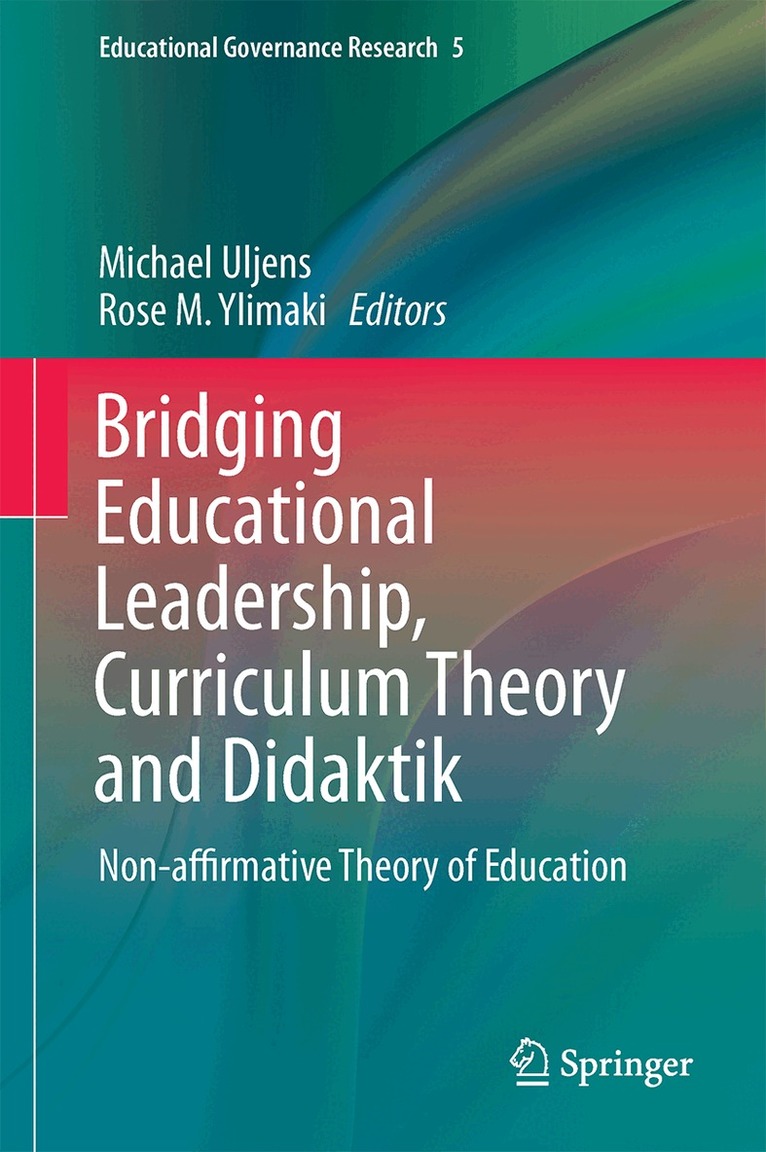
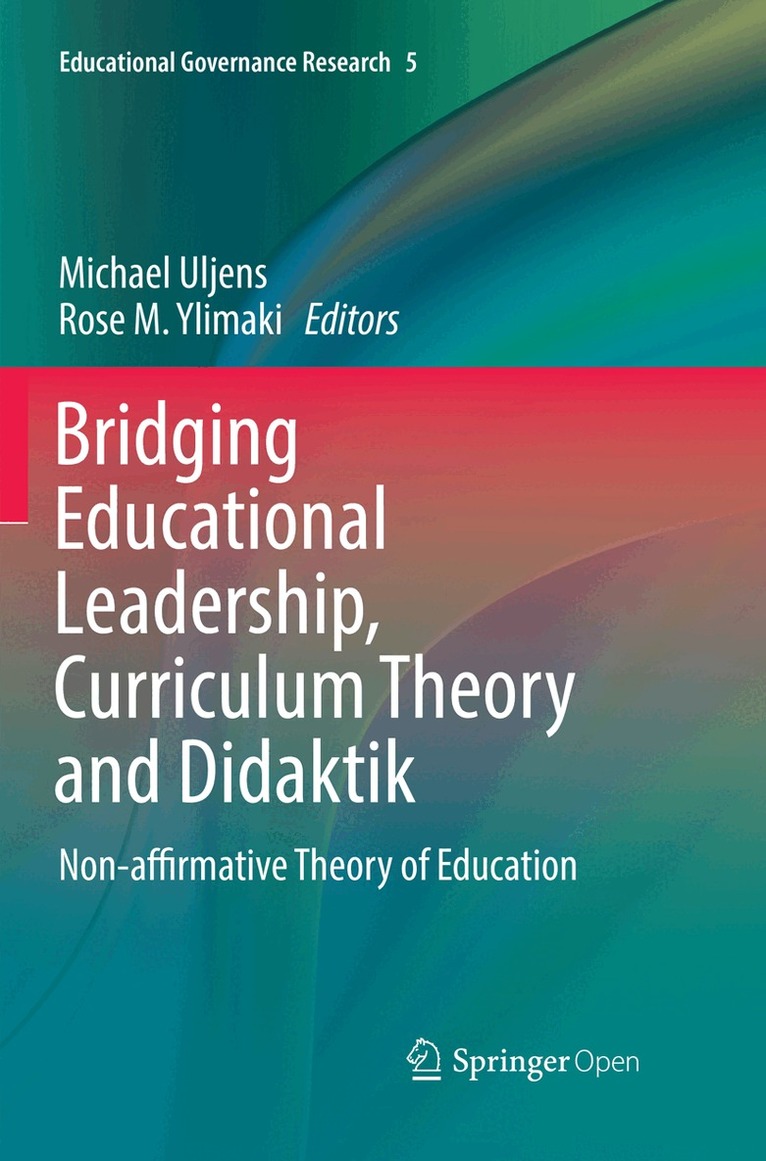
Yet, the traditionally disparate fields of educational leadership, curriculum theory and Didaktik have developed separately, both in terms of approaches to theory and theorizing in USA, Europe and Asia, and in the ways in which these theoretical traditions have informed empirical studies over time.
Häftad, Engelska, 2018
529 kr
Skickas inom 10-15 vardagar
Yet, the traditionally disparate fields of educational leadership, curriculum theory and Didaktik have developed separately, both in terms of approaches to theory and theorizing in USA, Europe and Asia, and in the ways in which these theoretical traditions have informed empirical studies over time.
Häftad, Svenska, 2021
466 kr
Tillfälligt slut
Utbildningsledarskap förstås ofta i ljuset av allmän ledarskapsteori, organisationsteori, socialpsykologi och policyforskning. Den här boken betonar särarten i pedagogisk verksamhet och utforskar utbildningsledarskap, pedagogiskt ledarskap och skolutveckling med utgångspunkt i pedagogisk handlingsteori.Bokens första del behandlar den icke-affirmativa pedagogikteorin och dess syn på ledarskap. Ledarskap definieras här som en uppfordran till självverksamhet och innebär en pedagogisk intervention som bjuder in, utmanar eller provocerar den lärande att reflektera kring sitt sätt att förstå sig själv och världen, med avsikt att få till stånd en förändring. Bokens andra del visar på utbildningsledarskapet som ett systemiskt flernivåfenomen, från klassrummet till den transnationella nivån, där det pedagogiska ledarskapet utövas inom och mellan nivåerna. Bokens tredje del beskriver skolförbättring som situerad mellan olika evidenstraditioner och olika koncept för forskningsunderstödd skolutveckling. Bokens fjärde och avslutande del diskuterar hur den icke-affirmativa teorin kan utvecklas genom nya perspektiv, såsom diskursiv institutionalism, posthumanism och global hållbarhet.Pedagogiskt ledarskap och skolutveckling är författad och empiriskt förankrad i en finländsk kontext. Den riktar sig till studerande med intresse för utbildningsledarskap samt till blivande och verksamma lärare, rektorer och skolledare.