Michèle Audin - Böcker
Visar alla böcker från författaren Michèle Audin. Handla med fri frakt och snabb leverans.
13 produkter
13 produkter
421 kr
Skickas inom 5-8 vardagar
1 064 kr
Skickas inom 10-15 vardagar
This book is an introduction to modern methods of symplectic topology. It is devoted to explaining the solution of an important problem originating from classical mechanics: the 'Arnold conjecture', which asserts that the number of 1-periodic trajectories of a non-degenerate Hamiltonian system is bounded below by the dimension of the homology of the underlying manifold.The first part is a thorough introduction to Morse theory, a fundamental tool of differential topology. It defines the Morse complex and the Morse homology, and develops some of their applications.Morse homology also serves a simple model for Floer homology, which is covered in the second part. Floer homology is an infinite-dimensional analogue of Morse homology. Its involvement has been crucial in the recent achievements in symplectic geometry and in particular in the proof of the Arnold conjecture. The building blocks of Floer homology are more intricate and imply the use of more sophisticated analytical methods, all of which are explained in this second part.The three appendices present a few prerequisites in differential geometry, algebraic topology and analysis.The book originated in a graduate course given at Strasbourg University, and contains a large range of figures and exercises. Morse Theory and Floer Homology will be particularly helpful for graduate and postgraduate students.
443 kr
Skickas inom 10-15 vardagar
176 kr
Tillfälligt slut
Longlisted for the 2017 PEN Translation Prize One of Publishers Weekly's Best Books of 2016 "...rich, tragic, yet playful novel..." -- Nancy Kline, New York Times Book Review "Formally dazzling, playful and affecting, a new Oulipian classic." -- Lauren Elkin, author of Flaneuse and The End of Oulipo? This debut novel by mathematician and Oulipo member Michele Audin retraces the lives of French mathematicians over several generations through World Wars I and II. The narrative oscillates stylistically from chapter to chapter--at times a novel, fable, historical research, or a diary--locking and unlocking codes, culminating in a captivating, original reading experience. Michele Audin is the author of several works of mathematical theory and history and also published a work on her anticolonialist father's torture, disappearance, and execution by the French during the Battle of Algiers.
1 381 kr
Skickas inom 10-15 vardagar
How I have (re-)written this book The book the reader has in hand was supposed to be a new edition of [14]. I have hesitated quite a long time before deciding to do the re-writing work-the first edition has been sold out for a few years. There was absolutely no question of just correcting numerous misprints and a few mathematical errors. When I wrote the first edition, in 1989, the convexity and Duistermaat-Heckman theorems together with the irruption of toric varieties on the scene of symplectic geometry, due to Delzant, around which the book was organized, were still rather recent (less than ten years). I myself was rather happy with a small contribution I had made to the subject. I was giving a post-graduate course on all that and, well, these were lecture notes, just lecture notes. By chance, the book turned out to be rather popular: during the years since then, I had the opportunity to meet quite a few people(1) who kindly pretended to have learnt the subject in this book. However, the older book does not satisfy at all the idea I have now of what a good book should be. So that this "new edition" is, indeed, another book.
535 kr
Skickas inom 10-15 vardagar
The school, the book This book is based on lectures given by the authors of the various chapters in a three week long CIMPA summer school, held in Sophia-Antipolis (near Nice) in July 1992. The first week was devoted to the basics of symplectic and Riemannian geometry (Banyaga, Audin, Lafontaine, Gauduchon), the second was the technical one (Pansu, Muller, Duval, Lalonde and Sikorav). The final week saw the conclusion ofthe school (mainly McDuffand Polterovich, with complementary lectures by Lafontaine, Audin and Sikorav). Globally, the chapters here reflect what happened there. Locally, we have tried to reorganise some ofthe material to make the book more coherent. Hence, for instance, the collective (Audin, Lalonde, Polterovich) chapter on Lagrangian submanifolds and the appendices added to some of the chapters. Duval was not able to write up his lectures, so that genuine complex analysis will not appear in the book, although it is a very current tool in symplectic and contact geometry (and conversely). Hamiltonian systems and variational methods were the subject of some of Sikorav's talks, which he also was not able to write up. On the other hand, F.Labourie, who could not be at the school, wrote a chapter on pseudo-holomorphic curves in Riemannian geometry.
747 kr
Skickas inom 10-15 vardagar
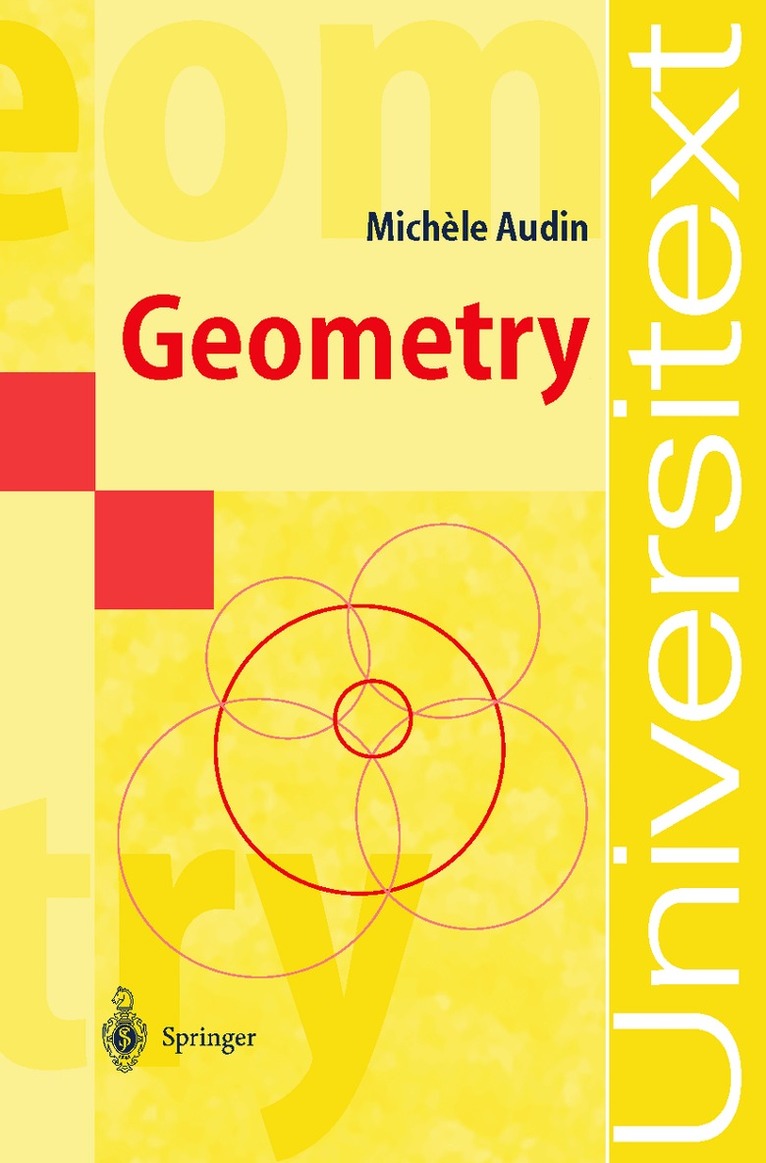
Geometry, this very ancient field of study of mathematics, frequently remains too little familiar to students. Michele Audin, professor at the University of Strasbourg, has written a book allowing them to remedy this situation and, starting from linear algebra, extend their knowledge of affine, Euclidean and projective geometry, conic sections and quadrics, curves and surfaces.It includes many nice theorems like the nine-point circle, Feuerbach's theorem, and so on. Everything is presented clearly and rigorously. Each property is proved, examples and exercises illustrate the course content perfectly. Precise hints for most of the exercises are provided at the end of the book. This very comprehensive text is addressed to students at upper undergraduate and Master's level to discover geometry and deepen their knowledge and understanding.
Fatou, Julia, Montel,
le grand prix des sciences mathématiques de 1918, et après...
Häftad, Franska, 2009
588 kr
Skickas inom 10-15 vardagar
Comment Fatou et Julia ont inventé ce que l’on appelle aujourd’hui les ensembles de Julia, avant, pendant et après la première guerre mondiale? L’histoire est racontée, avec ses mathématiques, ses conflits, ses personnalités. Elle est traitée à partir de sources nouvelles, et avec rigueur. On pourra s’y initier à l’itération des fractions rationnelles et à la dynamique complexe (ensembles de Julia, de Mandelbrot, ensembles-limites). Qui étaient Pierre Fatou, Gaston Julia, Paul Montel? On y trouvera en particulier des informations sur un mathématicien mal connu, Pierre Fatou. On découvrira aussi quelques incidences de la blessure reçue par Julia pendant la guerre sur la vie mathématique en France au vingtième siècle.How did Pierre Fatou and Gaston Julia create what we now call Complex Dynamics, in the context of the early twentieth century and especially of the First World War? The book is based partly on new, unpublished sources.Who were Pierre Fatou, Gaston Julia, Paul Montel? New biographical information is given on the little known mathematician that was Pierre Fatou. How did the serious injury of Julia during WWI influence mathematical life in France?
Del 2014 - Lecture Notes in Mathematics
Fatou, Julia, Montel
The Great Prize of Mathematical Sciences of 1918, and Beyond
Häftad, Engelska, 2011
535 kr
Skickas inom 10-15 vardagar
How did Pierre Fatou and Gaston Julia create what we now call Complex Dynamics, in the context of the early twentieth century and especially of the First World War? The book is based partly on new, unpublished sources. Who were Pierre Fatou, Gaston Julia, Paul Montel? New biographical information is given on the little known mathematician that was Pierre Fatou. How did the WW1 injury of Julia influence mathematical life in France? From the reviews of the French version: "Audin’s book is … filled with marvelous biographical information and analysis, dealing not just with the men mentioned in the book’s title but a large number of other players, too … [It] addresses itself to scholars for whom the history of mathematics has a particular resonance and especially to mathematicians active, or even with merely an interest, in complex dynamics. … presents it all to the reader in a very appealing form." (Michael Berg, The Mathematical Association of America, October 2009)
Jacques Feldbau, Topologe
Das Schicksal eines jüdischen Mathematikers (1914 - 1945)
Häftad, Tyska, 2012
353 kr
Skickas inom 10-15 vardagar
Mit seinen Arbeiten über Faserbündel und Homotopiegruppen gehört Jacques Feldbau zu den Wegbereitern der modernen Topologie. Michèle Audin zeichnet seine Geschichte, sein Leben und Werk nach. Als elsässischer Jude in Clermond-Ferrand verhaftet verstarb Feldbau zwei Wochen vor Ende des zweiten Weltkrieges während der Deportation nach Auschwitz.
429 kr
Skickas inom 10-15 vardagar
Among all the Hamiltonian systems, the integrable ones have special geometric properties; in particular, their solutions are very regular and quasi-periodic. The quasi-periodicity of the solutions of an integrable system is a result of the fact that the system is invariant under a (semi-global) torus action. It is thus natural to investigate the symplectic manifolds that can be endowed with a (global) torus action. This leads to symplectic toric manifolds (Part B of this book). Physics makes a surprising come-back in Part A: to describe Mirror Symmetry, one looks for a special kind of Lagrangian submanifolds and integrable systems, the special Lagrangians. Furthermore, integrable Hamiltonian systems on punctured cotangent bundles are a starting point for the study of contact toric manifolds (Part C of this book).
1 381 kr
Skickas inom 10-15 vardagar
This is an extended second edition of "The Topology of Torus Actions on Symplectic Manifolds" published in this series in 1991. The material and references have been updated. Symplectic manifolds and torus actions are investigated, with numerous examples of torus actions, for instance on some moduli spaces. Although the book is still centered on convexity theorems, it contains much more results, proofs and examples. Chapter I deals with Lie group actions on manifolds. In Chapters II and III, symplectic geometry and Hamiltonian group actions are introduced, especially torus actions and action-angle variables. The core of the book is Chapter IV which is devoted to applications of Morse theory to Hamiltonian group actions, including convexity theorems. As a family of examples of symplectic manifolds, moduli spaces of flat connections are discussed in Chapter V. Then, Chapter VI centers on the Duistermaat-Heckman theorem. In Chapter VII, a topological construction of complex toric varieties is presented, and the last chapter illustrates the introduced methods for Hamiltonian circle actions on 4-manifolds.
535 kr
Skickas inom 10-15 vardagar
The school, the book This book is based on lectures given by the authors of the various chapters in a three week long CIMPA summer school, held in Sophia-Antipolis (near Nice) in July 1992. The first week was devoted to the basics of symplectic and Riemannian geometry (Banyaga, Audin, Lafontaine, Gauduchon), the second was the technical one (Pansu, Muller, Duval, Lalonde and Sikorav). The final week saw the conclusion ofthe school (mainly McDuffand Polterovich, with complementary lectures by Lafontaine, Audin and Sikorav). Globally, the chapters here reflect what happened there. Locally, we have tried to reorganise some ofthe material to make the book more coherent. Hence, for instance, the collective (Audin, Lalonde, Polterovich) chapter on Lagrangian submanifolds and the appendices added to some of the chapters. Duval was not able to write up his lectures, so that genuine complex analysis will not appear in the book, although it is a very current tool in symplectic and contact geometry (and conversely). Hamiltonian systems and variational methods were the subject of some of Sikorav's talks, which he also was not able to write up. On the other hand, F.Labourie, who could not be at the school, wrote a chapter on pseudo-holomorphic curves in Riemannian geometry.