Monica Reggiani – författare
Visar alla böcker från författaren Monica Reggiani. Handla med fri frakt och snabb leverans.
4 produkter
4 produkter
Häftad, Engelska, 2008
561 kr
Skickas inom 10-15 vardagar
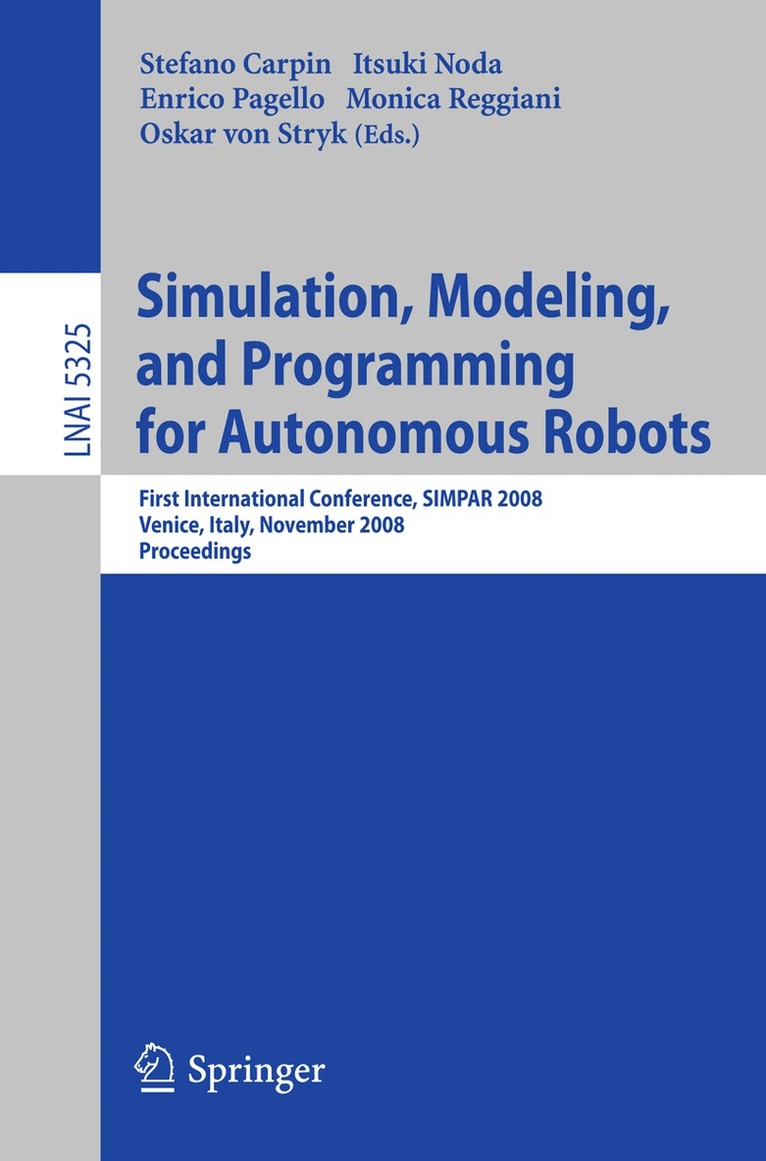
This book constitutes the refereed proceedings of the First International Conference on Simulation, Modeling, and Programming for Autonomous Robots, SIMPAR 2008, held in Venice, Italy, in November 2008. The 29 revised full papers and 21 revised poster papers presented were carefully reviewed and selected from 42 submissions. The papers address all current issues of robotics applications and simulation environments thereof, such as 3D robot simulation, reliability, scalability and validation of robot simulation, simulated sensors and actuators, offline simulation of robot design, online simulation with realtime constraints, simulation with software/hardware-in-the-loop, middleware for robotics, modeling framework for robots and environments, testing and validation of robot control software, standardization for robotic services, communication infrastructures in distributed robotics, interaction between sensor networks and robots, human robot interaction, and multirobot. The papers are organized in topical sections on simulation, programming, and applications.
E-bok
PDF, Engelska, 2008708 kr
Läs direkt efter köp
This book constitutes the refereed proceedings of the First International Conference on Simulation, Modeling, and Programming for Autonomous Robots, SIMPAR 2008, held in Venice, Italy, in November 2008. The 29 revised full papers and 21 revised poster papers presented were carefully reviewed and selected from 42 submissions. The papers address all current issues of robotics applications and simulation environments thereof, such as 3D robot simulation, reliability, scalability and validation of robot simulation, simulated sensors and actuators, offline simulation of robot design, online simulation with realtime constraints, simulation with software/hardware-in-the-loop, middleware for robotics, modeling framework for robots and environments, testing and validation of robot control software, standardization for robotic services, communication infrastructures in distributed robotics, interaction between sensor networks and robots, human robot interaction, and multirobot. The papers are organized in topical sections on simulation, programming, and applications.
Häftad, Engelska, 2010
558 kr
Skickas inom 5-8 vardagar
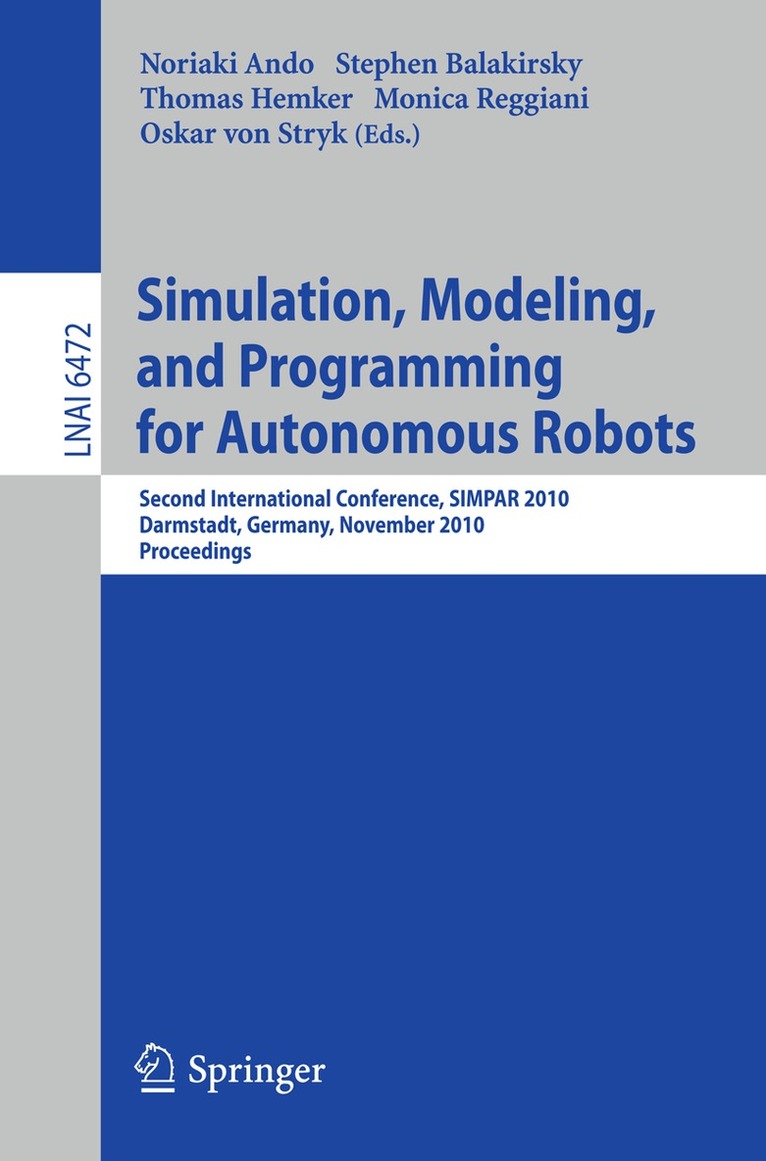
Why are the many highly capable autonomous robots that have been promised for novel applications driven by society, industry, and research not available - day despite the tremendous progress in robotics science and systems achieved during the last decades? Unfortunately, steady improvements in speci?c robot abilities and robot hardware have not been matched by corresponding robot performance in real world environments. This is mainly due to the lack of - vancements in robot software that master the development of robotic systems of ever increasing complexity. In addition, fundamental open problems are still awaiting sound answers while the development of new robotics applications s- fersfromthelackofwidelyusedtools,libraries,andalgorithmsthataredesigned in a modular and performant manner with standardized interfaces. Simulation environments are playing a major role not only in reducing development time and cost, e. g. , by systematic software- or hardware-in-the-loop testing of robot performance, but also in exploring new types of robots and applications. H- ever,their use may still be regardedwith skepticism. Seamless migrationof code using robot simulators to real-world systems is still a rare circumstance, due to the complexity of robot, world, sensor, and actuator modeling. These challenges drive the quest for the next generation of methodologies and tools for robot development. The objective of the International Conference on Simulation, Modeling, and ProgrammingforAutonomous Robots (SIMPAR) is to o?er a unique forum for these topics and to bring together researchersfrom academia and industry to identify and solve the key issues necessary to ease the development of increasingly complex robot software.
E-bok
PDF, Engelska, 2010708 kr
Läs direkt efter köp
Why are the many highly capable autonomous robots that have been promised for novel applications driven by society, industry, and research not available - day despite the tremendous progress in robotics science and systems achieved during the last decades? Unfortunately, steady improvements in speci?c robot abilities and robot hardware have not been matched by corresponding robot performance in real world environments. This is mainly due to the lack of - vancements in robot software that master the development of robotic systems of ever increasing complexity. In addition, fundamental open problems are still awaiting sound answers while the development of new robotics applications s- fersfromthelackofwidelyusedtools,libraries,andalgorithmsthataredesigned in a modular and performant manner with standardized interfaces. Simulation environments are playing a major role not only in reducing development time and cost, e. g. , by systematic software- or hardware-in-the-loop testing of robot performance, but also in exploring new types of robots and applications. H- ever,their use may still be regardedwith skepticism. Seamless migrationof code using robot simulators to real-world systems is still a rare circumstance, due to the complexity of robot, world, sensor, and actuator modeling. These challenges drive the quest for the next generation of methodologies and tools for robot development. The objective of the International Conference on Simulation, Modeling, and ProgrammingforAutonomous Robots (SIMPAR) is to o?er a unique forum for these topics and to bring together researchersfrom academia and industry to identify and solve the key issues necessary to ease the development of increasingly complex robot software.