Monika Holmeier – författare
660 kr
Skickas inom 10-15 vardagar
2 115 kr
Skickas inom 10-15 vardagar
757 kr
Läs direkt efter köp
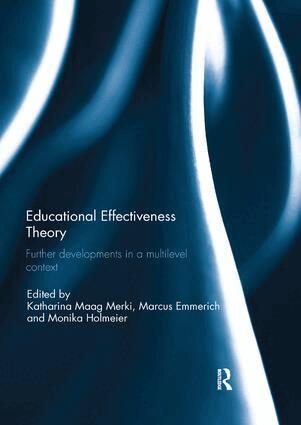
Despite the advances in educational effectiveness theory and methodology in the last 20 years, important questions and issues remain unresolved. In particular, existing theoretical frameworks of educational effectiveness are only able to describe the interrelationship among factors at the system, school, classroom, and student levels and their cross-level interdependency in a very general manner. Additionally, although a large number of studies provide empirical evidence of the impact of single factors and factor constellations on student learning, the embedding of the empirically identified results in theoretical models of educational effectiveness has to be carried out more systematically in order to develop more elaborated theories of educational effectiveness.
The aim of this book is to contribute to the advancement of educational effectiveness theory by discussing different strategies: including alternative theoretical models to understand educational in/effectiveness, extending the methodology to analyze processes and mechanisms of educational in/effectiveness, analyzing differential effects of processes and instruments on educational in/effectiveness, carrying out complex multivariate analyses considering manifest and latent variables, and combining theory and practice in real school situations. Taken together, the strategies presented in this book make it clear that the advancement of educational effectiveness theory depends on the advancement of educational effectiveness methodology, or in other words: from theory to methodology and from empirical evidence back to theory. This book was originally published as a special issue of School Effectiveness and School Improvement.
757 kr
Läs direkt efter köp
Despite the advances in educational effectiveness theory and methodology in the last 20 years, important questions and issues remain unresolved. In particular, existing theoretical frameworks of educational effectiveness are only able to describe the interrelationship among factors at the system, school, classroom, and student levels and their cross-level interdependency in a very general manner. Additionally, although a large number of studies provide empirical evidence of the impact of single factors and factor constellations on student learning, the embedding of the empirically identified results in theoretical models of educational effectiveness has to be carried out more systematically in order to develop more elaborated theories of educational effectiveness.
The aim of this book is to contribute to the advancement of educational effectiveness theory by discussing different strategies: including alternative theoretical models to understand educational in/effectiveness, extending the methodology to analyze processes and mechanisms of educational in/effectiveness, analyzing differential effects of processes and instruments on educational in/effectiveness, carrying out complex multivariate analyses considering manifest and latent variables, and combining theory and practice in real school situations. Taken together, the strategies presented in this book make it clear that the advancement of educational effectiveness theory depends on the advancement of educational effectiveness methodology, or in other words: from theory to methodology and from empirical evidence back to theory. This book was originally published as a special issue of School Effectiveness and School Improvement.
Leistungsbeurteilung im Zentralabitur
498 kr
Skickas inom 10-15 vardagar
505 kr
Läs direkt efter köp
Gemeinsames Prüfen
Eine Fallanalyse in Gymnasien der Schweiz
547 kr
Skickas inom 10-15 vardagar
534 kr
Läs direkt efter köp
Mit dem Ziel, die Vergleichbarkeit der Noten und damit der Abschlüsse zu erhöhen und eine Diskussion über gemeinsame Standards in Schulen anzuregen, wurden in einzelnen Schweizer Gymnasien ‚gemeinsame Prüfungen'' eingeführt. Diese werden in Zusammenarbeit mehrerer Lehrpersonen klassen- bzw. schulübergreifend durchgeführt.
Die hier präsentierte Studie untersucht erstmalig, welche Verfahren des gemeinsamen Prüfens in den untersuchten Gymnasien in der Schweiz realisiert wurden und über welche Veränderungen Lehrende und Lernende in den Schulen berichten. Sie identifiziert Spannungsfelder in der Implementation und Durchführung gemeinsamer Prüfungen und zeigt auf, wie gemeinsame Prüfungen für Schul- und Unterrichtsentwicklung nutzbar gemacht werden können.