Navneet Kaur – författare
752 kr
Läs direkt efter köp
Wireless sensor networks (WSNs) have attracted high interest over the last few decades in the wireless and mobile computing research community. Applications of WSNs are numerous and growing, including indoor deployment scenarios in the home and office to outdoor deployment in an adversary’s territory in a tactical background. However, due to their distributed nature and deployment in remote areas, these networks are vulnerable to numerous security threats that can adversely affect their performance.
This problem is more critical if the network is deployed for some mission-critical applications, such as in a tactical battlefield. Random failure of nodes is also very likely in real-life deployment scenarios. Due to resource constraints in the sensor nodes, a traditional security mechanism with high overhead of computation and communication is not feasible in WSNs. Design and implementation of secure WSNs is, therefore, a particularly challenging task.
This book covers a comprehensive discussion on state-of-the-art security technologies for WSNs. It identifies various possible attacks at different layers of the communication protocol stack in a typical WSN and presents their possible countermeasures. A brief discussion on the future direction of research in WSN security is also included.
752 kr
Läs direkt efter köp
Wireless sensor networks (WSNs) have attracted high interest over the last few decades in the wireless and mobile computing research community. Applications of WSNs are numerous and growing, including indoor deployment scenarios in the home and office to outdoor deployment in an adversary’s territory in a tactical background. However, due to their distributed nature and deployment in remote areas, these networks are vulnerable to numerous security threats that can adversely affect their performance.
This problem is more critical if the network is deployed for some mission-critical applications, such as in a tactical battlefield. Random failure of nodes is also very likely in real-life deployment scenarios. Due to resource constraints in the sensor nodes, a traditional security mechanism with high overhead of computation and communication is not feasible in WSNs. Design and implementation of secure WSNs is, therefore, a particularly challenging task.
This book covers a comprehensive discussion on state-of-the-art security technologies for WSNs. It identifies various possible attacks at different layers of the communication protocol stack in a typical WSN and presents their possible countermeasures. A brief discussion on the future direction of research in WSN security is also included.
413 kr
Skickas
638 kr
Skickas inom 10-15 vardagar
2 180 kr
Skickas inom 5-8 vardagar
2 436 kr
Läs direkt efter köp
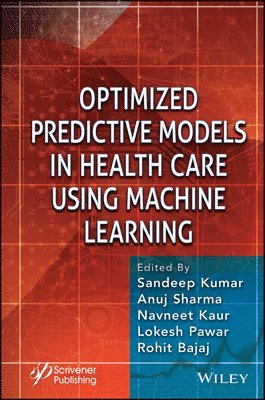
This book is a comprehensive guide to developing and implementing optimized predictive models in healthcare using machine learning and is a required resource for researchers, healthcare professionals, and students who wish to know more about real-time applications.
The book focuses on how humans and computers interact to ever-increasing levels of complexity and simplicity and provides content on the theory of optimized predictive model design, evaluation, and user diversity. Predictive modeling, a field of machine learning, has emerged as a powerful tool in healthcare for identifying high-risk patients, predicting disease progression, and optimizing treatment plans. By leveraging data from various sources, predictive models can help healthcare providers make informed decisions, resulting in better patient outcomes and reduced costs.
Other essential features of the book include:
provides detailed guidance on data collection and preprocessing, emphasizing the importance of collecting accurate and reliable data; explains how to transform raw data into meaningful features that can be used to improve the accuracy of predictive models; gives a detailed overview of machine learning algorithms for predictive modeling in healthcare, discussing the pros and cons of different algorithms and how to choose the best one for a specific application; emphasizes validating and evaluating predictive models; provides a comprehensive overview of validation and evaluation techniques and how to evaluate the performance of predictive models using a range of metrics; discusses the challenges and limitations of predictive modeling in healthcare; highlights the ethical and legal considerations that must be considered when developing predictive models and the potential biases that can arise in those models.Audience
The book will be read by a wide range of professionals who are involved in healthcare, data science, and machine learning.
2 436 kr
Läs direkt efter köp
This book is a comprehensive guide to developing and implementing optimized predictive models in healthcare using machine learning and is a required resource for researchers, healthcare professionals, and students who wish to know more about real-time applications.
The book focuses on how humans and computers interact to ever-increasing levels of complexity and simplicity and provides content on the theory of optimized predictive model design, evaluation, and user diversity. Predictive modeling, a field of machine learning, has emerged as a powerful tool in healthcare for identifying high-risk patients, predicting disease progression, and optimizing treatment plans. By leveraging data from various sources, predictive models can help healthcare providers make informed decisions, resulting in better patient outcomes and reduced costs.
Other essential features of the book include:
provides detailed guidance on data collection and preprocessing, emphasizing the importance of collecting accurate and reliable data; explains how to transform raw data into meaningful features that can be used to improve the accuracy of predictive models; gives a detailed overview of machine learning algorithms for predictive modeling in healthcare, discussing the pros and cons of different algorithms and how to choose the best one for a specific application; emphasizes validating and evaluating predictive models; provides a comprehensive overview of validation and evaluation techniques and how to evaluate the performance of predictive models using a range of metrics; discusses the challenges and limitations of predictive modeling in healthcare; highlights the ethical and legal considerations that must be considered when developing predictive models and the potential biases that can arise in those models.Audience
The book will be read by a wide range of professionals who are involved in healthcare, data science, and machine learning.
744 kr
Skickas inom 5-8 vardagar
744 kr
Skickas inom 5-8 vardagar
744 kr
Skickas inom 5-8 vardagar
744 kr
Skickas inom 5-8 vardagar
744 kr
Skickas inom 5-8 vardagar
471 kr
Skickas inom 5-8 vardagar
912 kr
Skickas inom 5-8 vardagar
751 kr
Skickas inom 5-8 vardagar
1 406 kr
Skickas inom 3-6 vardagar
1 006 kr
Skickas inom 5-8 vardagar
992 kr
Skickas inom 5-8 vardagar
992 kr
Skickas inom 5-8 vardagar
1 001 kr
Skickas inom 5-8 vardagar
992 kr
Skickas inom 5-8 vardagar
629 kr
Skickas inom 5-8 vardagar
629 kr
Skickas inom 5-8 vardagar
635 kr
Skickas inom 5-8 vardagar
629 kr
Skickas inom 5-8 vardagar
799 kr
Skickas inom 5-8 vardagar
1 175 kr
Skickas inom 5-8 vardagar
799 kr
Skickas inom 5-8 vardagar
799 kr
Skickas inom 5-8 vardagar
806 kr
Skickas inom 5-8 vardagar