Niall Livingstone - Böcker
Visar alla böcker från författaren Niall Livingstone. Handla med fri frakt och snabb leverans.
7 produkter
7 produkter
677 kr
Skickas inom 10-15 vardagar
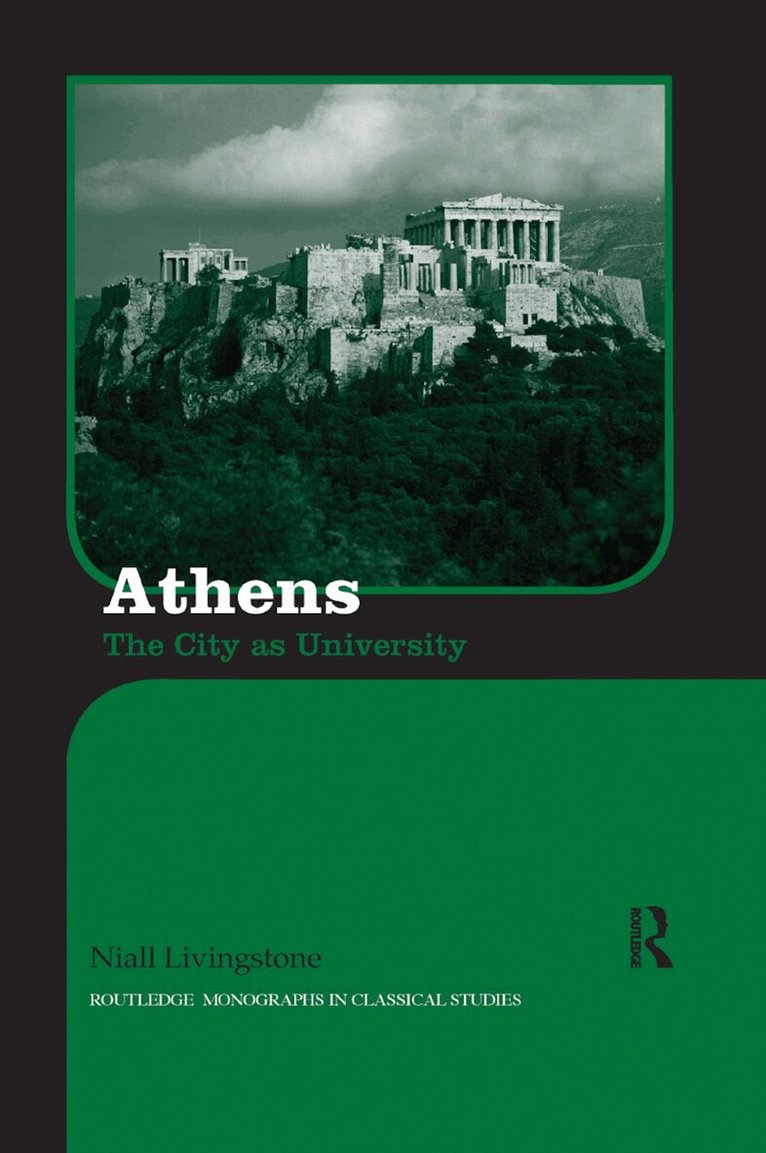
The citizens of ancient Athens were directly responsible for the development and power of its democracy; but how did they learn about politics and what their roles were within it? In this volume Livingstone argues that learning about political praxis (how to be a citizen) was an integral part of the everyday life of ancient Athenians. In the streets, shops and other meeting-places of the city people from all levels of society, from slaves to the very wealthy, exchanged knowledge and competed for power and status. The City as University explores the spaces and occasions where Athenians practised the arts of citizenship for which they and their city became famous.In the agora and on the pnyx, Athenian democracy was about performance and oratory; but the written word opened the way to ever-increasing sophistication in both the practice and theory of politics. As the arts of spin proliferated, spontaneous live debate in which the speaker’s authority came from being one of the many remained a core democratic value. Livingstone explores how ideas of democratic leadership evolved from the poetry of the legendary law-giver Solon to the writings of the sophist Alcidamas of Elaia. The volume offers a new approach to the study of ancient education and will be an invaluable tool to students of ancient politics and culture, and to all those studying the history of democracy.
2 288 kr
Skickas inom 10-15 vardagar
The citizens of ancient Athens were directly responsible for the development and power of its democracy; but how did they learn about politics and what their roles were within it? In this volume Livingstone argues that learning about political praxis (how to be a citizen) was an integral part of the everyday life of ancient Athenians. In the streets, shops and other meeting-places of the city people from all levels of society, from slaves to the very wealthy, exchanged knowledge and competed for power and status. The City as University explores the spaces and occasions where Athenians practised the arts of citizenship for which they and their city became famous.In the agora and on the pnyx, Athenian democracy was about performance and oratory; but the written word opened the way to ever-increasing sophistication in both the practice and theory of politics. As the arts of spin proliferated, spontaneous live debate in which the speaker’s authority came from being one of the many remained a core democratic value. Livingstone explores how ideas of democratic leadership evolved from the poetry of the legendary law-giver Solon to the writings of the sophist Alcidamas of Elaia. The volume offers a new approach to the study of ancient education and will be an invaluable tool to students of ancient politics and culture, and to all those studying the history of democracy.
690 kr
Skickas inom 7-10 vardagar
Pedagogy and Power is a volume of interdisciplinary essays which explores the political dimensions of Graeco-Roman education and of its subsequent models. Seeking to make the various structures and discourses of intellectual authority more apparent, the essays argue that there is a social context for the knowledge imparted by classical models of pedagogy. They examine how such pedagogues instruct their pupils to function as citizens who rule or are ruled, privileging certain knowledge over others, and including some individuals while excluding others. Overall the book shows that the complex and plural authorities and power that have been associated with classical learning and knowledge are not part of a legacy to be unproblematically inherited or reproduced.
341 kr
Skickas inom 7-10 vardagar
This is an introduction to the ancient genre of epigram, short poems literally written or inscribed 'on' an object or figuratively 'on' a topic. The authors set out what epigram means and why it matters, exploring its roots in inscriptions on stone and its literary flourishing in the Hellenistic world after Alexander. They trace its migration from Greece to Rome, where its most famous exponent was Martial, and consider the continuation of Greek epigram under the Roman empire in the so-called 'Second Sophistic'. The final chapter shows how Greek epigram achieved new importance in the nineteenth century as raw material for stories about the classical past.
1 583 kr
Skickas inom 7-10 vardagar
Pedagogy and Power is a volume of interdisciplinary essays which explores the political dimensions of Graeco-Roman education and of its subsequent models. Seeking to make the various structures and discourses of intellectual authority more apparent, the essays argue that there is a social context for the knowledge imparted by classical models of pedagogy. They examine how such pedagogues instruct their pupils to function as citizens who rule or are ruled, privileging certain knowledge over others, and including some individuals while excluding others. Overall the book shows that the complex and plural authorities and power that have been associated with classical learning and knowledge are not part of a legacy to be unproblematically inherited or reproduced.
494 kr
Skickas inom 7-10 vardagar
A Companion to Greek Mythology presents a series of essays that explore the phenomenon of Greek myth from its origins in shared Indo-European story patterns and the Greeks’ contacts with their Eastern Mediterranean neighbours through its development as a shared language and thought-system for the Greco-Roman world. Features essays from a prestigious international team of literary expertsIncludes coverage of Greek myth’s intersection with history, philosophy and religionIntroduces readers to topics in mythology that are often inaccessible to non-specialistsAddresses the Hellenistic and Roman periods as well as Archaic and Classical Greece
Del 87 - Blackwell Companions to the Ancient World
Companion to Greek Mythology
Inbunden, Engelska, 2011
2 206 kr
Skickas inom 7-10 vardagar
A Companion to Greek Mythology presents a series of essays that explore the phenomenon of Greek myth from its origins in shared Indo-European story patterns and the Greeks’ contacts with their Eastern Mediterranean neighbours through its development as a shared language and thought-system for the Greco-Roman world. Features essays from a prestigious international team of literary expertsIncludes coverage of Greek myth’s intersection with history, philosophy and religionIntroduces readers to topics in mythology that are often inaccessible to non-specialistsAddresses the Hellenistic and Roman periods as well as Archaic and Classical Greece