Nicola Bellini – författare
670 kr
Skickas inom 10-15 vardagar
2 264 kr
Skickas inom 10-15 vardagar
2 266 kr
Skickas inom 10-15 vardagar
925 kr
Läs direkt efter köp
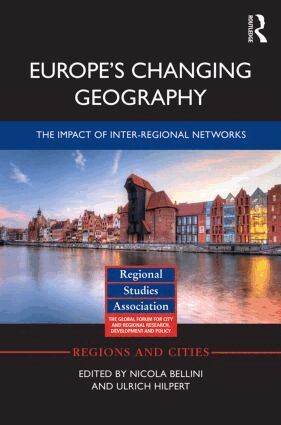
European macro-regions, Euroregions and other forms of inter-regional, cross-border cooperation have helped to shape new scenarios and new relational spaces which may generate opportunities for economic development, while redefining the political and economic meaning of national borders. This book is based on a number of key case studies which are crucial to understanding the complex web of political, economic and cultural factors that shape the heterogeneous picture of Europe’s new geography.
This book provides a fresh view on this phenomenon, with a realistic approach shedding light on its complexity as well as on its ambiguities. The new macro-regions are interpreted with an approach recognizing the importance of institutionalization, but also their flexible configuration and "blurred" borders. The book also raises the issue of credibility and legitimacy, arguing that inter-regional cooperation has to be removed from the foggy realm of the exchanges between local political and bureaucratic elites in order to be clearly and concretely motivated, and functional to key strategic objectives of the regions. Finally, the authors suggest a complementarity between relations based on proximity and wider (possibly global) networks where some territories, and especially metropolises, find opportunities based on "virtual" proximity.
Europe''s Changing Geography provides a substantial re-appraisal of a key phenomenon in the process of European integration today. It will be of interest both to scholars of the political economy of European regionalism and to practitioners.
925 kr
Läs direkt efter köp
European macro-regions, Euroregions and other forms of inter-regional, cross-border cooperation have helped to shape new scenarios and new relational spaces which may generate opportunities for economic development, while redefining the political and economic meaning of national borders. This book is based on a number of key case studies which are crucial to understanding the complex web of political, economic and cultural factors that shape the heterogeneous picture of Europe’s new geography.
This book provides a fresh view on this phenomenon, with a realistic approach shedding light on its complexity as well as on its ambiguities. The new macro-regions are interpreted with an approach recognizing the importance of institutionalization, but also their flexible configuration and "blurred" borders. The book also raises the issue of credibility and legitimacy, arguing that inter-regional cooperation has to be removed from the foggy realm of the exchanges between local political and bureaucratic elites in order to be clearly and concretely motivated, and functional to key strategic objectives of the regions. Finally, the authors suggest a complementarity between relations based on proximity and wider (possibly global) networks where some territories, and especially metropolises, find opportunities based on "virtual" proximity.
Europe''s Changing Geography provides a substantial re-appraisal of a key phenomenon in the process of European integration today. It will be of interest both to scholars of the political economy of European regionalism and to practitioners.
824 kr
Läs direkt efter köp
Across Europe, regional development agencies (RDAs) have become a central feature of regional policy, both as innovative policy-makers and as the implementers of programmes and initiatives originating from the national or European level. By drawing on a combination of conceptual reflection, surveys, comparative research, and systematic use of critical case studies, this book provides a new point of reference by identifying key features of the current, and, indeed next, generation of regionally-based economic development organisations.
824 kr
Läs direkt efter köp
Across Europe, regional development agencies (RDAs) have become a central feature of regional policy, both as innovative policy-makers and as the implementers of programmes and initiatives originating from the national or European level. By drawing on a combination of conceptual reflection, surveys, comparative research, and systematic use of critical case studies, this book provides a new point of reference by identifying key features of the current, and, indeed next, generation of regionally-based economic development organisations.
783 kr

Skickas inom 10-15 vardagar
2 195 kr
Skickas inom 10-15 vardagar
699 kr
Skickas inom 10-15 vardagar
142 kr
Skickas inom 5-8 vardagar
624 kr
Skickas inom 5-8 vardagar
802 kr
Skickas inom 5-8 vardagar
790 kr
Läs direkt efter köp
Gastronomy, particularly gourmet tourism, is widely acknowledged as having a powerful impact on local development. Public policies have developed in response to research, highlighting gastronomy as key in a successful tourism economy.
However, research thus far has not fully explored the underlying mechanisms of gastronomic tourism, in particular the marketing and perception of quality, on economic development. This book considers how the quality of products, places, and experiences contributes to the desirability and competitiveness of gourmet touristic destinations. The contributors present theoretical and empirical studies to create an original conceptual framework for regional development based on the quality of products, of places, and of touristic experience. It also examines the ways in which quality is linked to identity, diversity, innovation, and creativity.
With an interdisciplinary approach, this book will be of interest to researchers in tourism and hospitality, regional studies, and human geography, as well as to tourism development professionals and policymakers in the areas of rural and local development.
790 kr
Läs direkt efter köp
Gastronomy, particularly gourmet tourism, is widely acknowledged as having a powerful impact on local development. Public policies have developed in response to research, highlighting gastronomy as key in a successful tourism economy.
However, research thus far has not fully explored the underlying mechanisms of gastronomic tourism, in particular the marketing and perception of quality, on economic development. This book considers how the quality of products, places, and experiences contributes to the desirability and competitiveness of gourmet touristic destinations. The contributors present theoretical and empirical studies to create an original conceptual framework for regional development based on the quality of products, of places, and of touristic experience. It also examines the ways in which quality is linked to identity, diversity, innovation, and creativity.
With an interdisciplinary approach, this book will be of interest to researchers in tourism and hospitality, regional studies, and human geography, as well as to tourism development professionals and policymakers in the areas of rural and local development.
70 kr
Läs direkt efter köp
295 kr
Skickas inom 5-8 vardagar
322 kr
Skickas inom 5-8 vardagar
364 kr
Skickas inom 5-8 vardagar
296 kr
Skickas inom 5-8 vardagar
468 kr
Skickas inom 5-8 vardagar
374 kr
Skickas inom 5-8 vardagar
303 kr
Skickas inom 5-8 vardagar
245 kr
Skickas inom 5-8 vardagar
259 kr
Skickas inom 5-8 vardagar
285 kr
Skickas inom 5-8 vardagar
398 kr
Skickas inom 5-8 vardagar
1 835 kr
Skickas inom 10-15 vardagar
2 283 kr
Läs direkt efter köp
1 597 kr
Skickas inom 5-8 vardagar