Nicolas Guelfi – författare
Visar alla böcker från författaren Nicolas Guelfi. Handla med fri frakt och snabb leverans.
6 produkter
6 produkter
Häftad, Engelska, 2003
558 kr
Skickas inom 10-15 vardagar
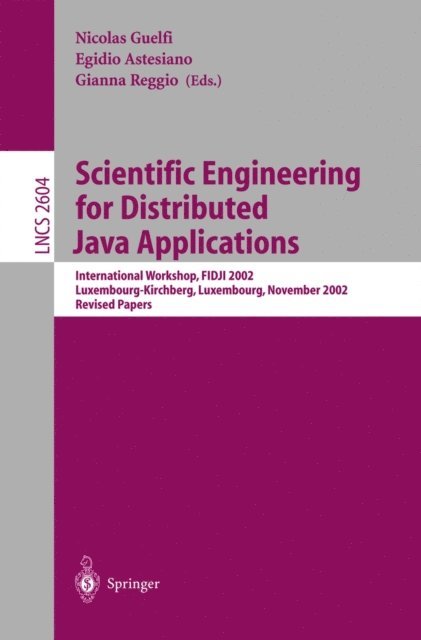
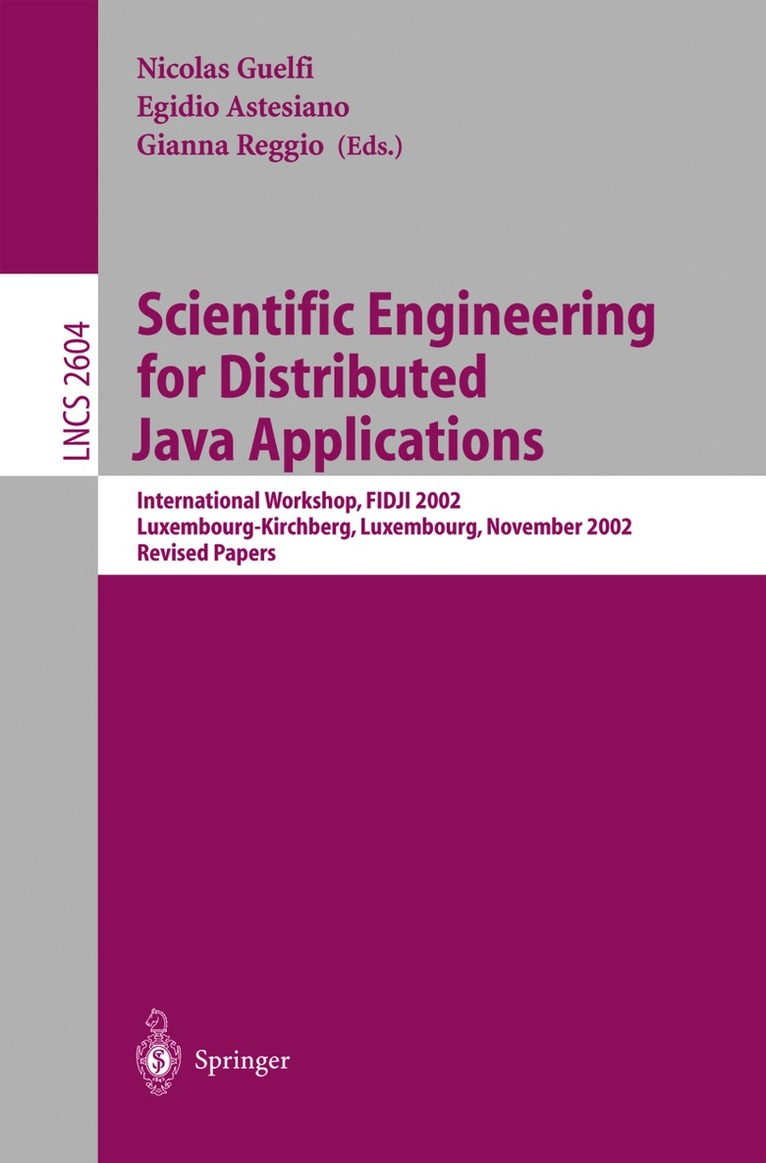
This book constitutes the thoroughly refereed postproceedings of the International Workshop on Scientific Engineering for Distributed Java Applications, FIDJI 2002, held in Luxembourg-Kirchberg, Luxembourg in November 2002. The 16 revised full papers presented together with a keynote paper and 3 abstracts were carefully selected from 33 submissions during two rounds of reviewing and improvement. Among the topics addressed are Java coordination, Web service architectures, transaction models, CORBA-based distributed systems, mobile objects, Java group toolkits, distributed process management systems, active objects in J2EE, Java frameworks, Jini, component-based distributed applications, Java middleware, fault-tolerant mobile systems.
Häftad, Engelska, 2005
558 kr
Skickas inom 10-15 vardagar
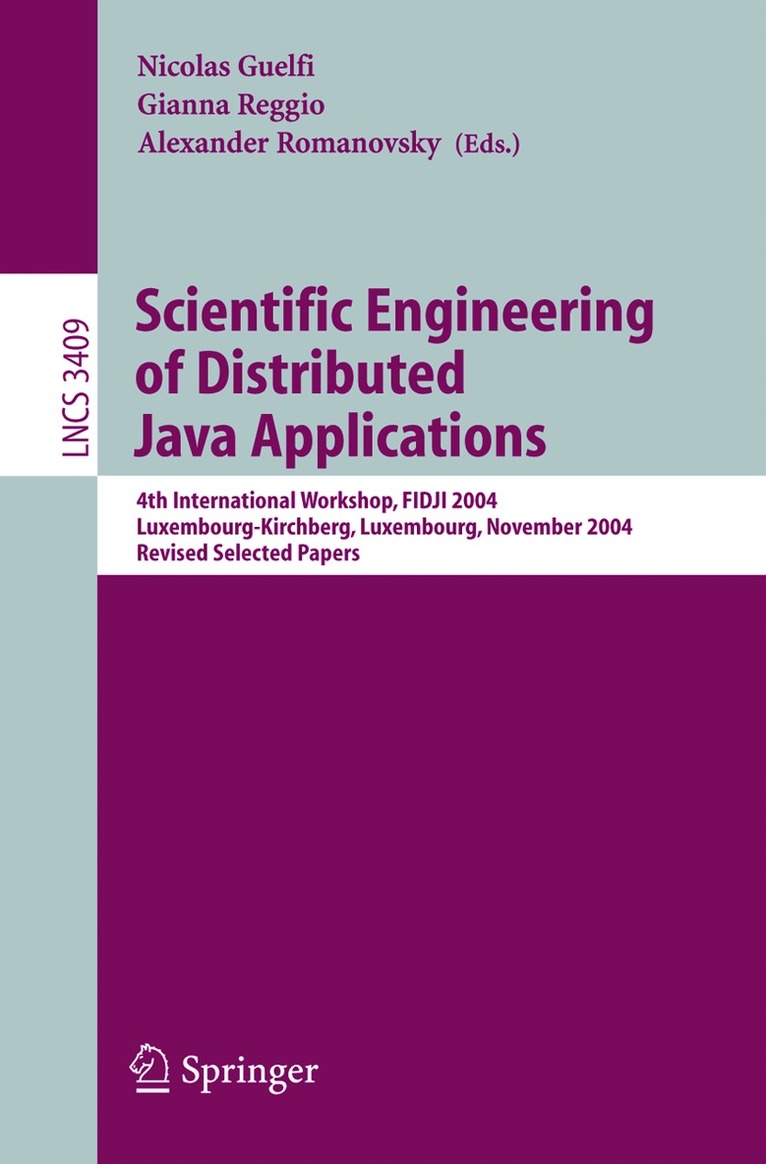
FIDJI 2004 was an international forum for researchers and practitioners int- estedinthe advancesin,andapplicationsof,softwareengineeringfordistributed application development. Concerning the technologies, the workshop focused on “Java-related” technologies. It was an opportunity to present and observe the latest research, results, and ideas in these areas. Allpaperssubmittedtothisworkshopwerereviewedbyatleasttwomembers of the International Program Committee. Acceptance was based primarily on originality and contribution. We selected, for these post-workshop proceedings, 11 papers amongst 22 submitted, a tutorial and two keynotes. FIDJI2004aimedatpromotingascienti?capproachtosoftwareengineering. The scope of the workshop included the following topics: – design of distributed applications – development methodologies for software and system engineering – UML-based development methodologies – development of reliable and secure distributed systems – component-based development methodologies – dependability support during system life cycle – fault tolerance re?nement, evolution and decomposition – atomicity and exception handling in system development – software architectures, frameworks and design patterns for developing d- tributed systems – integration of formal techniques in the development process – formal analysis and grounding of modelling notation and techniques (e. g. , UML, metamodelling) – supporting the security and dependability requirements of distributed app- cations in the development process – distributed software inspection – refactoring methods – industrial and academic case studies – development and analysis tools The organization of such a workshop represents an important amount of work.
Häftad, Engelska, 2005
558 kr
Skickas inom 10-15 vardagar
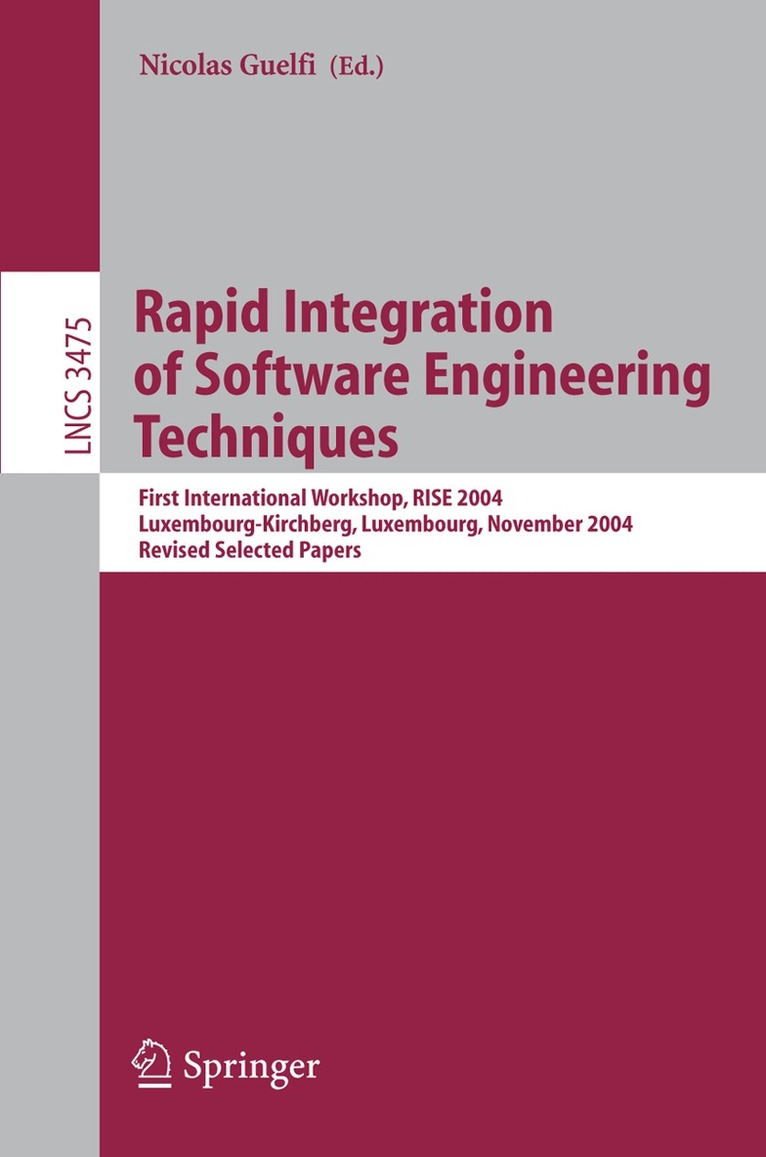
RISE 2004 was an international forum for researchers and practitioners int- ested in integrated and practical software engineering approaches that are part of a methodological framework and which apply to both new and evolving app- cations, technologies and systems. The ERCIM (European Research Consortium forInformaticsandMathematics)RISEworkinggroupselectedapplicationareas such as the Web, mobility, high availability approaches, embedded approaches and user interfaces in speci?c industry sectors comprising ?nance, telecom- nications, transportation (avionics, the automotive industry) and e-government. Considered research issues in these areas pertain to the following software en- neering domains: - software/system architectures - reuse - testing - model transformation/model-driven engineering - requirements engineering - lightweight formal methods - ASE tools All papers submitted to this workshop were reviewed by at least two m- bers of the International Program Committee. Acceptance was based primarily on originality and contribution. We selected for these proceedings 12 papers amongst 28 submitted, and an invited paper.The organization of such a workshop represents an important amount of work. We would like to acknowledge all the Program Committee members, all the additional referees,all the Organization Committee members, the University of Luxembourg, Faculty of Science, Technology and Communication administ- tive, scienti?c and technical sta?, and the Henri Tudor Public Research Center.
Häftad, Engelska, 2006
558 kr
Skickas inom 10-15 vardagar
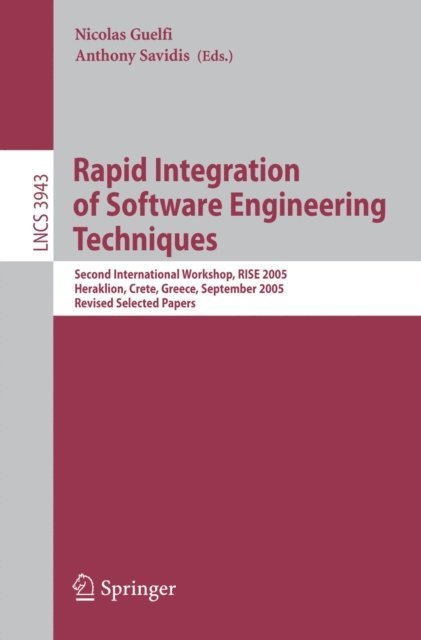
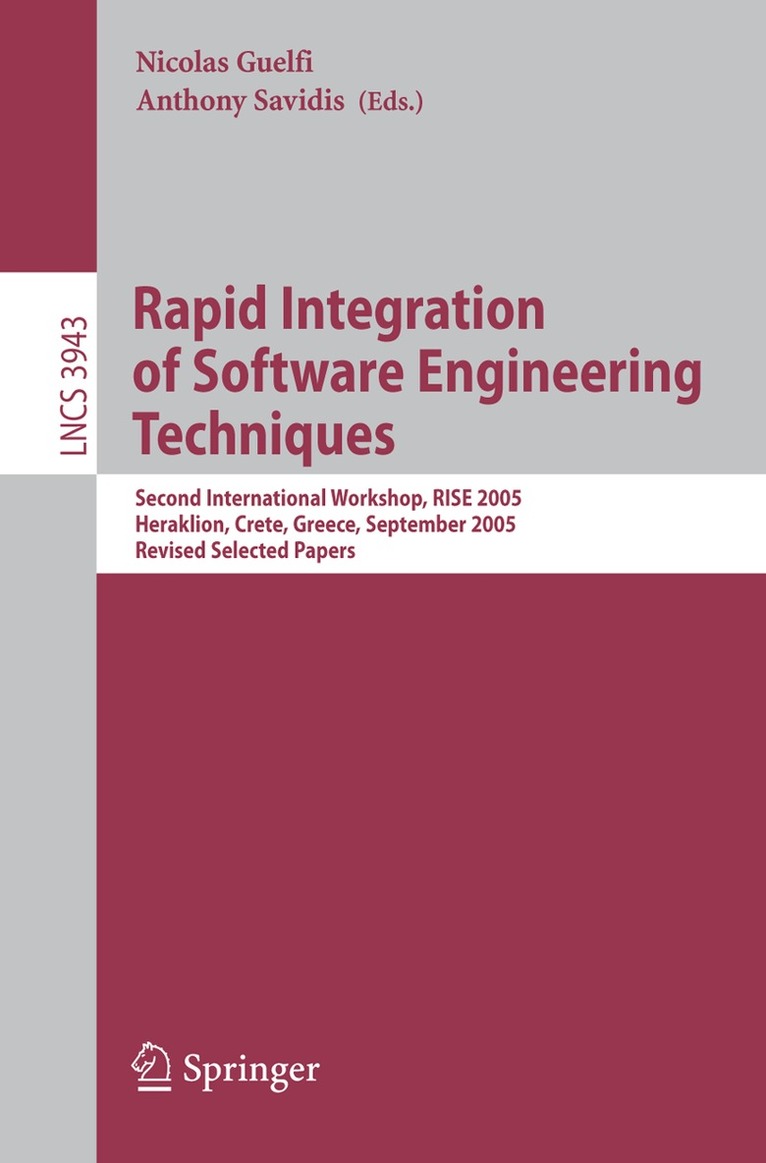
RISE 2005 (http://rise2005.ics.forth.gr/) was the second annual inter-national workshop of the ERCIM (European Research Consortium for Informatics and Mathematics - http://www.ercim.org/) Working Group on Rapid Integration of Software Engineering techniques (RISE - http://rise.uni.lu/). RISE is an international forum for researchers and practitioners interested in the advancement and rapid application of novel, integrated, or practical software engineering approaches being part of a methodological framework, which apply to the development of new or evolving applications and systems. RISE provides an opportunity to present and discuss the latest research results and ideas in the rapid and effective integration of software engineering techniques. Target application domains of interest to RISE include: • Web-based software systems • Mobile communication systems • High-availability or mission-critical systems • Resilient business and grid applications • Ambient intelligence environments • Embedded systems and applications • User interface development • Development environments • Electronic entertainment • Enterprise computing and applications In particular, RISE 2005 focused on an open and inclusive set of key software engineering domains, which formed the focal point of the workshop, including, but not limited to: • Software and system architectures • Software reuse • Software testing • Software model checking • Model-driven design and testing techniques • Model transformation • Requirements engineering • Lightweight or practice-oriented formal methods • Software processes and software metrics • Automated software engineering • Design patterns • Design by contract • Defensive programming
Häftad, Engelska, 2007
558 kr
Skickas inom 10-15 vardagar
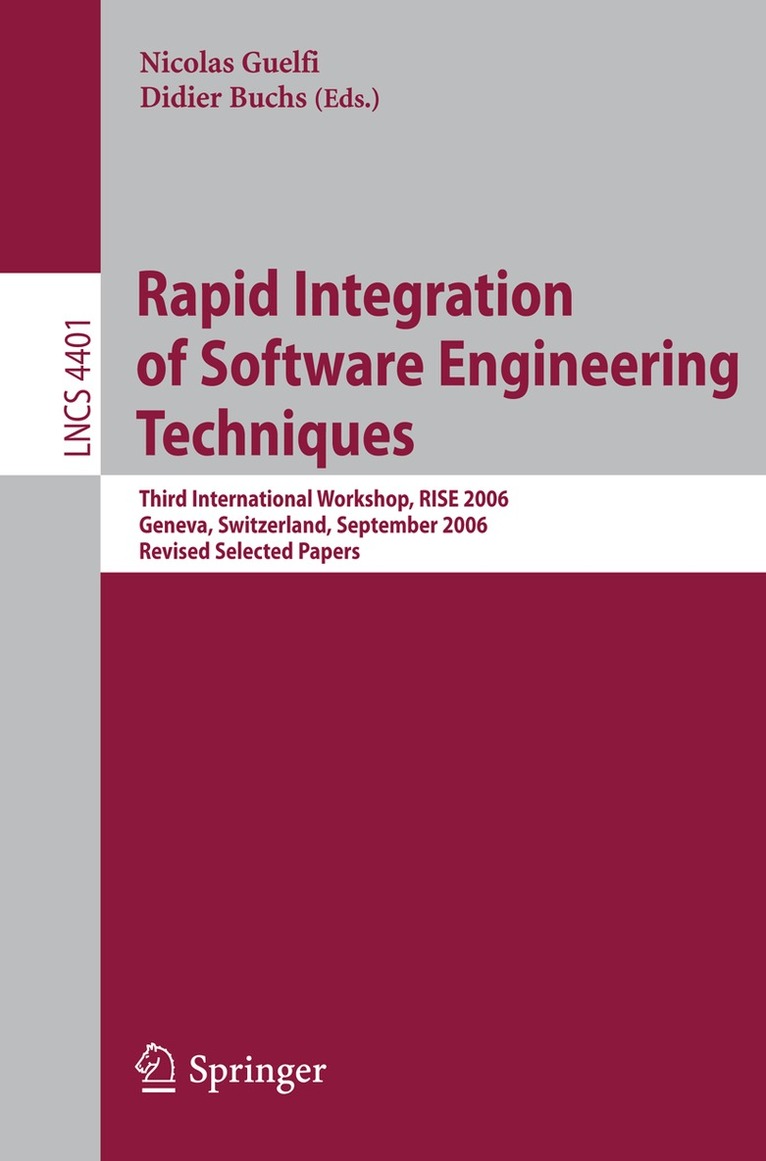
RISE 2006 constituted an international forum for researchers and practitioners interestedintheadvancementandrapidapplicationofnovel,integrated,orpr- ticalsoftwareengineeringapproaches,beingpartofamethodologicalframework, that apply to the development of either new or evolving applications and s- tems. It provided a good opportunity to present and discuss the latest research results and ideas in the rapid and e?ective integration of software engineering techniques. The ERCIM (European Research Consortium for Informatics and Mathematics) RISE working group selected application areas such as the Web, mobility, high availability, and embedded and user-interface software in speci?c industry sectors comprising ?nance, telecommunications, transportation (avi- ics, automotive) and eGovernment. The research issues covered stemmed from the following software engineering domains: – software and system architectures – software reuse – software testing – software model checking – model driven design and testing techniques – model transformation – requirements engineering – lightweight or practice-oriented formal methods – software processes and software metrics – automated software engineering – software patterns – design by contract – defensive programming – software entropy and software re-factoring – extreme programming – agile software development – programming languages – software dependability and trustworthiness All papers submitted to this workshop were reviewed by at least two m- bers of the International Program Committee. Acceptance was based primarily on originality and contribution. We have selected, for these proceedings, 10 - pers amongst 30 submitted and an invited paper. The organization of such a workshop requires a lot ofwork.
Del 19 - Series On Software Engineering And Knowledge Engineering
Software Engineering Of Fault Tolerant Systems
Inbunden, Engelska, 2007
2 621 kr
Skickas inom 5-8 vardagar
In architecting dependable systems, what is required to improve the overall system robustness is fault tolerance. Many methods have been proposed to this end, the solutions are usually considered late during the design and implementation phases of the software life-cycle (e.g., Java and Windows NT exception handling), thus reducing the effectiveness error and fault handling. Since the system design typically models only normal behaviour of the system while ignoring exceptional ones, the implementation of the system is unable to handle abnormal events. Consequently, the system may fail in unexpected ways due to faults.It has been argued that fault tolerance management during the entire life-cycle improves the overall system robustness and that different classes of threats need to be identified for and dealt with at each distinct phase of software development, depending on the abstraction level of the software system being modelled.This book builds on this trend and investigates how fault tolerance mechanisms can be applied when engineering a software system. In particular, it identifies the new problems arising in this area, introduces the new models to be applied at different abstraction levels, defines methodologies for model-driven engineering of such systems and outlines the new technologies and validation and verification environments supporting this.