Gianna Reggio – författare
Visar alla böcker från författaren Gianna Reggio. Handla med fri frakt och snabb leverans.
11 produkter
11 produkter
Häftad, Engelska, 2003
562 kr
Skickas inom 10-15 vardagar
FIDJI 2002 was an international forum for researchers and practitioners in- rested in the advances in, and applications of, software engineering for distri- ted application development. Concerning the technologies, the workshop focused on “Java-related” technologies. It was an opportunity to present and observe the latest research, results, and ideas in these areas. All papers submitted to this workshop were reviewed by at least two members of the International Program Committee. Acceptance was based primarily on the originality and contribution. We selected for these postworkshop proceedings 16 papers amongst 33 submitted, two tutorials, and two keynotes. FIDJI 2002 was aimed at promoting a scienti?c approach to software engin- ring. The scope of the workshop included the following topics: – design of distributed Java applications – Java-related technologies – software and system architecture engineering and development methodo- gies – development methodologies for UML – development methodologies for reliable distributed systems – component-based development methodologies – management of evolutions/iterations in the analysis, design, implementation, and test phases – dependability support during system lifecycle – managing inconsistencies during application development – atomicity and exception handling in system development – software architectures, frameworks, and design patterns for developing d- tributed systems – integration of formal techniques in the development process – formal analysis and grounding of modeling notation and techniques (e. g.
Häftad, Engelska, 2004
562 kr
Skickas inom 10-15 vardagar
FIDJI 2003 was an international forum for researchers and practitioners in- rested in the advances in, and applications of, software engineering for distri- ted applicationdevelopment. Concerningthe technologies,the workshopfocused on “Java-related” technologies. It was an opportunity to present and observe the latest research, results, and ideas in these areas. Allpaperssubmittedtothisworkshopwerereviewedbyatleasttwomembers of the International Program Committee. Acceptance was based primarily on originality and contribution. We selected, for these post-workshop proceedings, 14 papers, amongst 29 submitted, two tutorials, and one keynote talk. FIDJI2003aimedatpromotingascienti?capproachtosoftwareengineering. The scope of the workshop included the following topics: – design of distributed Java applications – Java-related technologies – software and system architecture engineering and development methodo- gies – development methodologies for UML – development methodologies for reliable distributed systems – component-based development methodologies – managementofevolutions/iterationsintheanalysis,design,implementation, and test phases – dependability support during system life-cycles – managing inconsistencies during application development – atomicity and exception handling in system development – software architectures, frameworks, and design patterns for developing d- tributed systems – integration of formal techniques in the development process – formal analysis and grounding of modeling notation and techniques (e. g. , UML, metamodeling) – supporting the security requirements of distributed applications in the - velopment process – refactoring methods – industrial and academic case studies – development and analysis tools Theorganization of such a workshop represents an important amount of work.
E-bok
PDF, Engelska, 2004734 kr
Läs direkt efter köp
FIDJI 2003 was an international forum for researchers and practitioners in- rested in the advances in, and applications of, software engineering for distri- ted applicationdevelopment. Concerningthe technologies,the workshopfocused on “Java-related” technologies. It was an opportunity to present and observe the latest research, results, and ideas in these areas. Allpaperssubmittedtothisworkshopwerereviewedbyatleasttwomembers of the International Program Committee. Acceptance was based primarily on originality and contribution. We selected, for these post-workshop proceedings, 14 papers, amongst 29 submitted, two tutorials, and one keynote talk. FIDJI2003aimedatpromotingascienti?capproachtosoftwareengineering. The scope of the workshop included the following topics: – design of distributed Java applications – Java-related technologies – software and system architecture engineering and development methodo- gies – development methodologies for UML – development methodologies for reliable distributed systems – component-based development methodologies – managementofevolutions/iterationsintheanalysis,design,implementation, and test phases – dependability support during system life-cycles – managing inconsistencies during application development – atomicity and exception handling in system development – software architectures, frameworks, and design patterns for developing d- tributed systems – integration of formal techniques in the development process – formal analysis and grounding of modeling notation and techniques (e. g. , UML, metamodeling) – supporting the security requirements of distributed applications in the - velopment process – refactoring methods – industrial and academic case studies – development and analysis tools Theorganization of such a workshop represents an important amount of work.
Häftad, Engelska, 2005
562 kr
Skickas inom 10-15 vardagar
FIDJI 2004 was an international forum for researchers and practitioners int- estedinthe advancesin,andapplicationsof,softwareengineeringfordistributed application development. Concerning the technologies, the workshop focused on “Java-related” technologies. It was an opportunity to present and observe the latest research, results, and ideas in these areas. Allpaperssubmittedtothisworkshopwerereviewedbyatleasttwomembers of the International Program Committee. Acceptance was based primarily on originality and contribution. We selected, for these post-workshop proceedings, 11 papers amongst 22 submitted, a tutorial and two keynotes. FIDJI2004aimedatpromotingascienti?capproachtosoftwareengineering. The scope of the workshop included the following topics: – design of distributed applications – development methodologies for software and system engineering – UML-based development methodologies – development of reliable and secure distributed systems – component-based development methodologies – dependability support during system life cycle – fault tolerance re?nement, evolution and decomposition – atomicity and exception handling in system development – software architectures, frameworks and design patterns for developing d- tributed systems – integration of formal techniques in the development process – formal analysis and grounding of modelling notation and techniques (e. g. , UML, metamodelling) – supporting the security and dependability requirements of distributed app- cations in the development process – distributed software inspection – refactoring methods – industrial and academic case studies – development and analysis tools The organization of such a workshop represents an important amount of work.
E-bok
PDF, Engelska, 2008734 kr
Läs direkt efter köp
FIDJI 2004 was an international forum for researchers and practitioners int- estedinthe advancesin,andapplicationsof,softwareengineeringfordistributed application development. Concerning the technologies, the workshop focused on “Java-related” technologies. It was an opportunity to present and observe the latest research, results, and ideas in these areas. Allpaperssubmittedtothisworkshopwerereviewedbyatleasttwomembers of the International Program Committee. Acceptance was based primarily on originality and contribution. We selected, for these post-workshop proceedings, 11 papers amongst 22 submitted, a tutorial and two keynotes. FIDJI2004aimedatpromotingascienti?capproachtosoftwareengineering. The scope of the workshop included the following topics: – design of distributed applications – development methodologies for software and system engineering – UML-based development methodologies – development of reliable and secure distributed systems – component-based development methodologies – dependability support during system life cycle – fault tolerance re?nement, evolution and decomposition – atomicity and exception handling in system development – software architectures, frameworks and design patterns for developing d- tributed systems – integration of formal techniques in the development process – formal analysis and grounding of modelling notation and techniques (e. g. , UML, metamodelling) – supporting the security and dependability requirements of distributed app- cations in the development process – distributed software inspection – refactoring methods – industrial and academic case studies – development and analysis tools The organization of such a workshop represents an important amount of work.
E-bok
PDF, Engelska, 2003734 kr
Läs direkt efter köp
FIDJI 2002 was an international forum for researchers and practitioners in- rested in the advances in, and applications of, software engineering for distri- ted application development. Concerning the technologies, the workshop focused on “Java-related” technologies. It was an opportunity to present and observe the latest research, results, and ideas in these areas. All papers submitted to this workshop were reviewed by at least two members of the International Program Committee. Acceptance was based primarily on the originality and contribution. We selected for these postworkshop proceedings 16 papers amongst 33 submitted, two tutorials, and two keynotes. FIDJI 2002 was aimed at promoting a scienti?c approach to software engin- ring. The scope of the workshop included the following topics: – design of distributed Java applications – Java-related technologies – software and system architecture engineering and development methodo- gies – development methodologies for UML – development methodologies for reliable distributed systems – component-based development methodologies – management of evolutions/iterations in the analysis, design, implementation, and test phases – dependability support during system lifecycle – managing inconsistencies during application development – atomicity and exception handling in system development – software architectures, frameworks, and design patterns for developing d- tributed systems – integration of formal techniques in the development process – formal analysis and grounding of modeling notation and techniques (e. g.
Häftad, Engelska, 2002
546 kr
Skickas inom 10-15 vardagar
Thealgebraicapproachtosystemspeci?cationanddevelopment,borninthe early1970sasaformalmethodforabstractdatatypes,encompassestoday,atthe beginningofthethirdmillennium,theformaldesignofintegratedhardwareand softwaresystems,newspeci?cationframeworksandprogrammingparadigms, andawiderangeofapplicationareas. TheworkshopsonAlgebraicDevelopment Techniques,initiatedin1982astheworkshoponAbstractDataTypes,area prominentforumtopresentanddiscusscurrentresearchinthatarea. The15thInternationalWorkshoponAlgebraicDevelopmentTechniques (WADT2001)tookplaceinGenova,asasatelliteofETAPS2001,onApril 1-3,2001,andwasorganizedbyMauraCerioliandGiannaReggio. From1991to1995WADTworkshopswereheldjointlywiththeGeneral WorkshopoftheESPRITBasicResearchWorkingGroupCOMPASS. Following thistradition,theWADT2001washeldjointlywiththeGeneralWorkshopof theESPRITWorkingGroupCoFI. TheCommonFrameworkInitiative,started in1995andfundedsince1998asCoFIWG,iscenteredaroundthede?nitionof theCommonAlgebraicSpeci?cationLanguage(CASL). TheprogramstartedwithafulldaytutorialontheCASL,followedby32 presentations,severalofthemontheCASLaswell,organizedinparallelsessions duringthefollowingtwodays.Theparallelsessionsweredevotedto:logicsand proofs,concurrentprocesses,institutionsandcategories,applicationsandcase studies,higher-orderandparameterizedspeci?cations,staticanalysis,software architectures,graphandtransformationrules. Themaintopicsoftheworkshopwere: -algebraicspeci?cation -otherapproachestoformalspeci?cation -speci?cationlanguagesandmethods -termrewritingandproofsystems -speci?cationdevelopmentsystems(concepts,tools,etc. ) Theprogramcommitteeinvitedsubmissionsoffullpapersforpossibleinclusion inthisvolume,onthebasisoftheabstractsandthepresentationsatWADT 2001. Allthesubmissionsweresubjecttocarefulrefereeing,andtheselectionof paperswasmadefollowingfurtherdiscussionbythefullprogramcommittee. Weareextremelygratefultoallworkshopparticipants,tothe(other)m- bersoftheprogramcommittee,andtotheexternalrefereesfortheircontribution tothescienti?cqualityoftheworkshopandofthisvolume. TheWADTseriesissponsoredbyIFIPWG1. 3onFoundationsofSystem Speci?cation(seehttp://www. brics. dk/"pdm/IFIP-WG1. 3).November2001 MauraCerioliandGiannaReggio Organization ProgramCommittee MichelBidoit (Cachan,France) MauraCerioli (Genova,Italy) Hans-JorgKreowski (Bremen,Germany) PeterMosses,chair (Aarhus,Denmark) FernandoOrejas (Barcelona,Spain) FrancescoParisi-Presicce (Roma,Italy) GiannaReggio (Genova,Italy) DonaldSannella (Edinburgh,Scotland) AndrzejTarlecki (Warsaw,Poland) ExternalReferees EgidioAstesiano ManuelKoch MarekBednarczyk MikolajKonarski BenjaminBlanc AlexanderKurz AlexandreBoisseau SabineKuske TomaszBorzyszkowski SlawomirLasota PaoloBottoni ChristophLuth .. PaoloCenciarelli DirkPattinson HartmutEhrig Wies lawPawlo wski StevenEker Jean-ClaudeReynaud JeanGoubault-Larrecq MarkusRoggenbach PiotrHo?man SponsoringInstitutions CoFI(CommonFrameworkInitiative),ESPRITWorkingGroup29432. DISI,Universit'adegliStudidiGenova. IFIPWG1. 3onFoundationsofSystemSpeci?cation. TableofContents InteractiveRule-BasedSpeci?cationwithanApplication toVisualLanguageDe?nition ...1 R. Bardohl,M. Grosse-Rhode,andM. Simeoni AlgebraicAbstractions ...21 M. BidoitandA. Boisseau CombiningLogics:ParchmentsRevisited...48 C. Caleiro,P. Mateus,J. Ramos,A. Sernadas CanonicalInstitutionsofBehaviour ...71 J. F. CostaandH.Louren,co TheLub Thealgebraicapproachtosystemspeci?cationanddevelopment,borninthe early1970sasaformalmethodforabstractdatatypes,encompassestoday,atthe beginningofthethirdmillennium,theformaldesignofintegratedhardwareand softwaresystems,newspeci?cationframeworksandprogrammingparadigms, andawiderangeofapplicationareas. TheworkshopsonAlgebraicDevelopment Techniques,initiatedin1982astheworkshoponAbstractDataTypes,area prominentforumtopresentanddiscusscurrentresearchinthatarea. The15thInternationalWorkshoponAlgebraicDevelopmentTechniques (WADT2001)tookplaceinGenova,asasatelliteofETAPS2001,onApril 1-3,2001,andwasorganizedbyMauraCerioliandGiannaReggio. From1991to1995WADTworkshopswereheldjointlywiththeGeneral WorkshopoftheESPRITBasicResearchWorkingGroupCOMPASS. Following thistradition,theWADT2001washeldjointlywiththeGeneralWorkshopof theESPRITWorkingGroupCoFI. TheCommonFrameworkInitiative,started in1995andfundedsince1998asCoFIWG,iscenteredaroundthede?nitionof theCommonAlgebraicSpeci?cationLanguage(CASL). TheprogramstartedwithafulldaytutorialontheCASL,followedby32 presentations,severalofthemontheCASLaswell,organizedinparallelsessions duringthefollowingtwodays.Theparallelsessionsweredevotedto:logicsand proofs,concurrentprocesses,institutionsandcategories,applicationsandcase studies,higher-orderandparameterizedspeci?cations,staticanalysis,software architectures,graphandtransformationrules. Themaintopicsoftheworkshopwere: -algebraicspeci?cation -otherapproachestoformalspeci?cation -speci?cationlanguagesandmethods -termrewritingandproofsystems -speci?cationdevelopmentsystems(concepts,tools,etc. ) Theprogramcommitteeinvitedsubmissionsoffullpapersforpossibleinclusion inthisvolume,onthebasisoftheabstractsandthepresentationsatWADT 2001. Allthesubmissionsweresubjecttocarefulrefereeing,andtheselectionof paperswasmadefollowingfurtherdiscussionbythefullprogramcommittee. Weareextremelygratefultoallworkshopparticipants,tothe(other)m- bersoftheprogramcommittee,andtotheexternalrefereesfortheircontribution tothescienti?cqualityoftheworkshopandofthisvolume. TheWADTseriesissponsoredbyIFIPWG1. 3onFoundationsofSystem Speci?cation(seehttp://www. brics. dk/"pdm/IFIP-WG1. 3).November2001 MauraCerioliandGiannaReggio Organization ProgramCommittee MichelBidoit (Cachan,France) MauraCerioli (Genova,Italy) Hans-JorgKreowski (Bremen,Germany) PeterMosses,chair (Aarhus,Denmark) FernandoOrejas (Barcelona,Spain) FrancescoParisi-Presicce (Roma,Italy) GiannaReggio (Genova,Italy) DonaldSannella (Edinburgh,Scotland) AndrzejTarlecki (Warsaw,Poland) ExternalReferees EgidioAstesiano ManuelKoch MarekBednarczyk MikolajKonarski BenjaminBlanc AlexanderKurz AlexandreBoisseau SabineKuske TomaszBorzyszkowski SlawomirLasota PaoloBottoni ChristophLuth .. PaoloCenciarelli DirkPattinson HartmutEhrig Wies lawPawlo wski StevenEker Jean-ClaudeReynaud JeanGoubault-Larrecq MarkusRoggenbach PiotrHo?man SponsoringInstitutions CoFI(CommonFrameworkInitiative),ESPRITWorkingGroup29432. DISI,Universit'adegliStudidiGenova. IFIPWG1. 3onFoundationsofSystemSpeci?cation. TableofContents InteractiveRule-BasedSpeci?cationwithanApplication toVisualLanguageDe?nition ...1 R. Bardohl,M. Grosse-Rhode,andM. Simeoni AlgebraicAbstractions ...21 M. BidoitandA. Boisseau CombiningLogics:ParchmentsRevisited...48 C. Caleiro,P. Mateus,J. Ramos,A. Sernadas CanonicalInstitutionsofBehaviour ...71 J. F. CostaandH.Lourencco TheLub eckTransformationSystem:ATransformationSystem forEquationalHigherOrderAlgebraicSpeci?cations ...85 W. DoschandS. Magnussen OntheCompatibilityofModelandModel-ClassTransformations ...109 M. GajewskyandF. Parisi-Presicce VerifyingaSimplePipelinedMicroprocessorUsingMaude ...128 N. A. Harman VerifyingArchitecturalSpeci?cations...152 P. Ho?man GeometricModellingwithCASL...176 F. Ledoux,A. Arnould,P. LeGall,andY. Bertrand ACompositionalApproachtoConnectorConstruction ...201 A. Lopes,M. Wermelinger,andJ. L. Fiadeiro InstitutionIndependentStaticAnalysisforCasl ...221 T. MossakowskiandB. Klin TightandLooseSemanticsforTransformationSystems...238 F. Orejas,H. Ehrig,andE. Pino PresentationsforAbstractContextInstitutions...256 W. Paw lowski Programs,ProofsandParametrizedSpeci?cations...280 I. Poernomo,J. N. Crossley,andM. Wirsing TowardsTrustworthySpeci?cationsI:ConsistencyChecks ...305 M. RoggenbachandL. Schroder X TableofContents TheCommonFrameworkInitiativeforAlgebraicSpeci?cation andDevelopmentofSoftware:RecentProgress...328 D. Sannella AuthorIndex ...345 InteractiveRule-BasedSpeci?cationwithan ApplicationtoVisualLanguageDe?nition 1 1 2 Roswitha Bardohl , Martin Grosse-Rhode , and Marta Simeoni 1 Institutfur .. SoftwaretechnikundTheoretischeInformatik,TUBerlin, {rosi,mgr}@cs. tu-berlin. de 2 DipartimentodiInformatica,Universit'aCa'FoscaridiVenezia, simeoni@dsi. unive. it Abstract. Inarule-basedapproachthecomputationstepsofasystem arespeci?edbyrulesthatcompletelyde?nehowthesystem'sstatemay change. Foropensystemsamoreliberalapproachisrequired,wherethe statechangesareonlypartlyspeci?ed,and-interactively-otherc- ponents may contribute further information on how the transformation isde?nedcompletely.
E-bok
PDF, Engelska, 2003708 kr
Läs direkt efter köp
Häftad, Engelska, 2006
1 116 kr
Skickas inom 10-15 vardagar
This book constitutes the refereed proceedings of the 9th International Conference on Model Driven Engineering Languages and Systems (formerly the UML series of conferences), MoDELS 2006, held in Genova, Italy, in October 2006. The 51 revised full papers and 2 invited papers presented were carefully reviewed and selected from 178 initial submissions. The papers are organized in topical sections on evaluating UML, MDA in software development, concrete syntax, applying UML to interaction and coordination, aspects, model integration, formal semantics of UML, security, model transformation tools and implementation, analyzing dynamic models, specifying transformations, MOF, bridging models, risk, trust and dependability, tool environments, OCL, roundtrip engineering, real time and embedded systems, as well as workshops, tutorials and panels.
E-bok
PDF, Engelska, 20061 408 kr
Läs direkt efter köp
Häftad, Engelska, 1995
562 kr
Skickas inom 10-15 vardagar
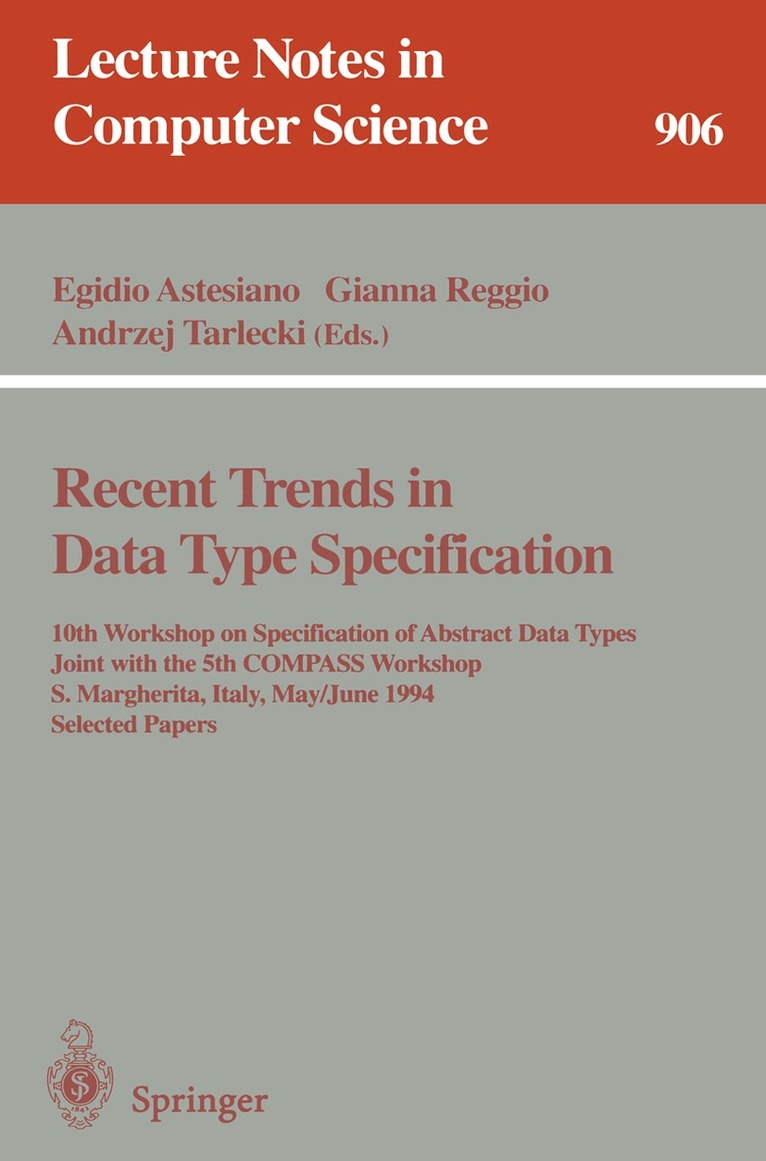
This volume comprises the invited surveys and revised versions of the submitted papers selected for presentation at the 10th Workshop on Specification of Abstract Data Types, held jointly with the 4th COMPASS Workshop in S. Margherita, Italy in June 1994.The volume gives a comprehensive state-of-the-art report of the research activities: besides classical algebraic techniques, other relevant topics are investigated, such as formalisms based on general logics and category theory, type systems for specification languages and new structures for modelling dynamic systems. In addition to four surveys by prominent leaders in the area and 23 papers presenting original research, the book contains an annotated bibliography covering all contributions to the ten editions of the workshop.