Oscar Nierstrasz – författare
Visar alla böcker från författaren Oscar Nierstrasz. Handla med fri frakt och snabb leverans.
9 produkter
9 produkter
E-bok
PDF, Engelska, 2002815 kr
Läs direkt efter köp
The documentation is missing or obsolete, and the original developers have departed. Your team has limited understanding of the system, and unit tests are missing for many, if not all, of the components. When you fix a bug in one place, another bug pops up somewhere else in the system. Long rebuild times make any change difficult. All of these are signs of software that is close to the breaking point.Many systems can be upgraded or simply thrown away if they no longer serve their purpose. Legacy software, however, is crucial for operations and needs to be continually available and upgraded. How can you reduce the complexity of a legacy system sufficiently so that it can continue to be used and adapted at acceptable cost?Based on the authors'' industrial experiences, this book is a guide on how to reverse engineer legacy systems to understand their problems, and then reengineer those systems to meet new demands. Patterns are used to clarify and explain the process of understanding large code bases, hence transforming them to meet new requirements. The key insight is that the right design and organization of your system is not something that can be evident from the initial requirements alone, but rather as a consequence of understanding how these requirements evolve.* Describes how to reverse engineer a monolithic system to understand how it really works and how to identify potential problems.* Includes reengineering patterns that tackle well-known reengineering techniques often encountered in object-oriented programming, such as introducing polymorphism, factoring out common behavior, detecting duplicated code, and understanding design.* Shows how to build a culture of continuous reengineering for achieving flexible and maintainable object-oriented systems.
Häftad, Engelska, 2005
562 kr
Skickas inom 10-15 vardagar
Component-based software development is the next step after object-oriented programmingthatpromisesto reducecomplexityandimprovereusability.These advantages have also been identi?ed by the industry, and consequently, over the past years, a large number of component-based techniques and processes have been adopted in many of these organizations. A visible result of this is the number ofcomponentmodels thathavebeendevelopedandstandardized.These models de?ne how individual software components interact with each other and simplify the design process of software systems by allowing developers to choose from previously existing components. The development of component models is a ?rst step in the right direction, but there are many challenges that cannot be solved by the development of a new component model alone. Such challengesare the adaptation of components, and their development and veri?cation. Software Composition is the premiere workshop to advance the research in component-based software engineering and its related ?elds. SC 2005 was the fourth workshop in this series. As in previous years, SC 2005 was organized as an event co-located with the ETAPS conference. This year’s program consisted of a keynote on the revival of dynamic l- guages given by Prof. Oscar Nierstrasz and 13 technical paper presentations (9 full and 4 short papers). The technical papers were carefully selected from a total of 41 submitted papers. Each paper was thoroughly peer reviewed by at leastthreemembers oftheprogramcommittee andconsensusonacceptancewas achieved by means of an electronic PC discussion. This LNCS volume contains the revised versions of the papers presented at SC 2005.
E-bok
PDF, Engelska, 2005734 kr
Läs direkt efter köp
Component-based software development is the next step after object-oriented programmingthatpromisesto reducecomplexityandimprovereusability.These advantages have also been identi?ed by the industry, and consequently, over the past years, a large number of component-based techniques and processes have been adopted in many of these organizations. A visible result of this is the number ofcomponentmodels thathavebeendevelopedandstandardized.These models de?ne how individual software components interact with each other and simplify the design process of software systems by allowing developers to choose from previously existing components. The development of component models is a ?rst step in the right direction, but there are many challenges that cannot be solved by the development of a new component model alone. Such challengesare the adaptation of components, and their development and veri?cation. Software Composition is the premiere workshop to advance the research in component-based software engineering and its related ?elds. SC 2005 was the fourth workshop in this series. As in previous years, SC 2005 was organized as an event co-located with the ETAPS conference. This year’s program consisted of a keynote on the revival of dynamic l- guages given by Prof. Oscar Nierstrasz and 13 technical paper presentations (9 full and 4 short papers). The technical papers were carefully selected from a total of 41 submitted papers. Each paper was thoroughly peer reviewed by at leastthreemembers oftheprogramcommittee andconsensusonacceptancewas achieved by means of an electronic PC discussion. This LNCS volume contains the revised versions of the papers presented at SC 2005.
Häftad, Engelska, 2006
1 115 kr
Skickas inom 10-15 vardagar
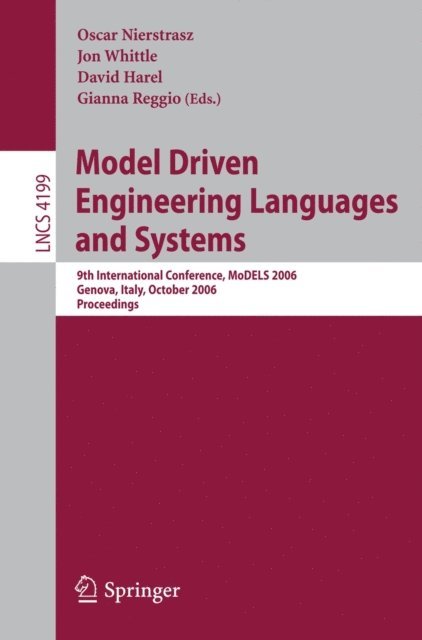
This book constitutes the refereed proceedings of the 9th International Conference on Model Driven Engineering Languages and Systems (formerly the UML series of conferences), MoDELS 2006, held in Genova, Italy, in October 2006. The 51 revised full papers and 2 invited papers presented were carefully reviewed and selected from 178 initial submissions. The papers are organized in topical sections on evaluating UML, MDA in software development, concrete syntax, applying UML to interaction and coordination, aspects, model integration, formal semantics of UML, security, model transformation tools and implementation, analyzing dynamic models, specifying transformations, MOF, bridging models, risk, trust and dependability, tool environments, OCL, roundtrip engineering, real time and embedded systems, as well as workshops, tutorials and panels.
E-bok
PDF, Engelska, 20061 408 kr
Läs direkt efter köp
Häftad, Engelska, 1992
562 kr
Skickas inom 10-15 vardagar
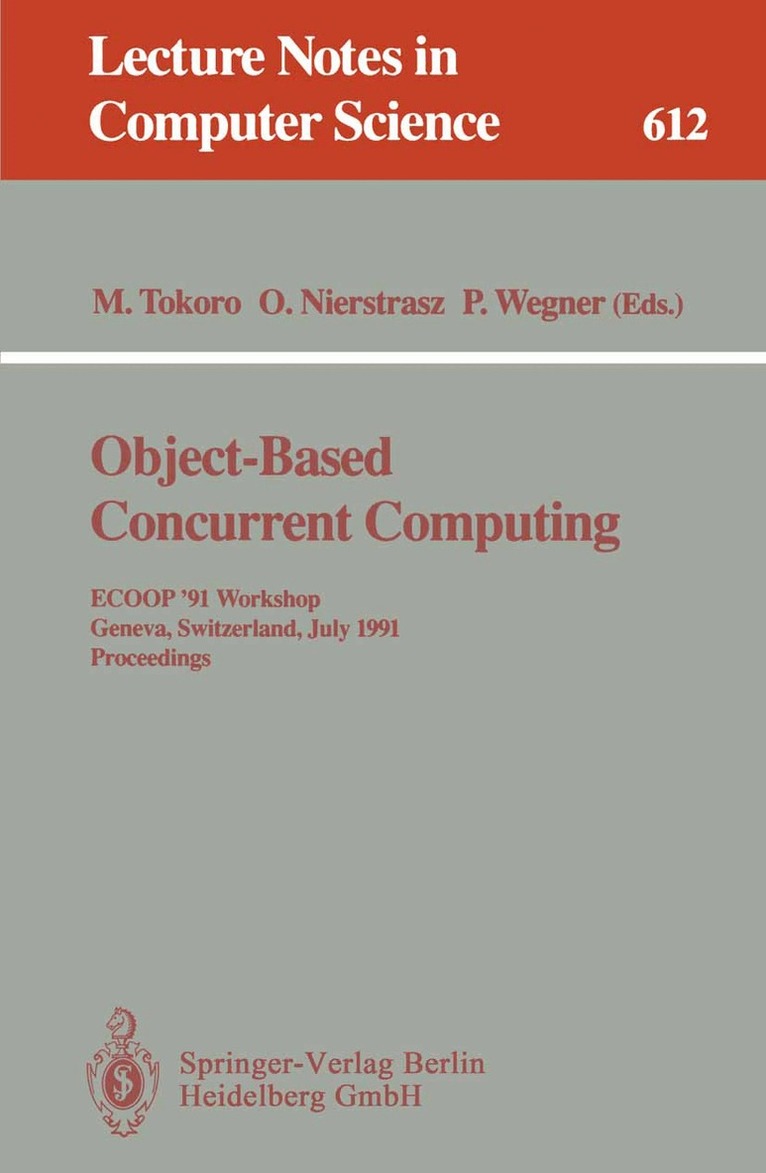
The ECOOP '91 Workshop on Object-Based Concurrent Computingwas organized toprovide a forum on concurrent, distributedand open-ended computing. The emphasis was on conceptual,theoretical and formal aspects, as well as practical aspectsand sound experience, since such a viewpoint was deemedindispensible to investigate and establish a basis forfuture development.This volume contains 12 papers selected from 25 presented atthe workshop, together with a paper by J.A. Goguen, who wasan invited speaker at the workshop. The papers areclassified into four categories:Formal methods (1): three papers are concerned with theformal semantics of concurrent objects based on processcalculi.Formal methods (2): four papers are concerned with variousformal approaches to the semantics of concurrent programs.Concurrent programming: three papers.Models: three papers areconcerned with models forconcurrent systems.
Häftad, Engelska, 1994
562 kr
Skickas inom 10-15 vardagar
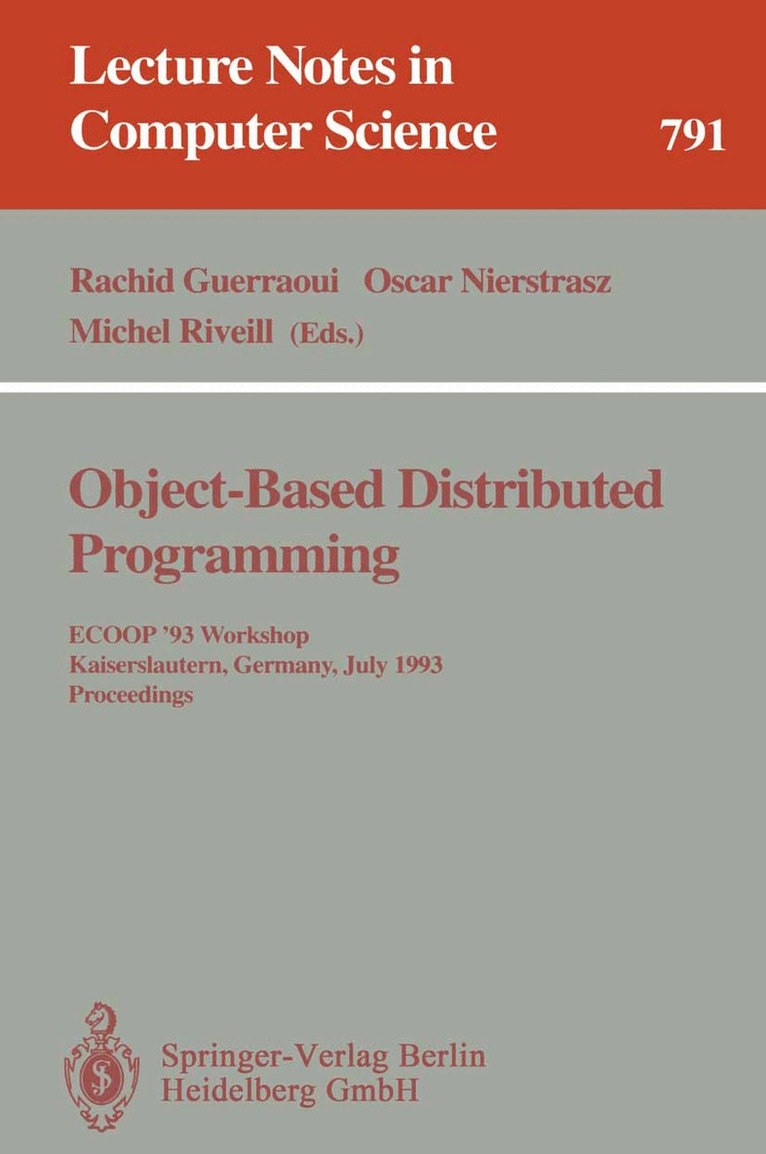
Interest has grown rapidly over the past dozen years in the application of object-oriented programming and methods to the development of distributed, open systems. This volume presents the proceedings of a workshop intended to assess the current state of research in this field and to facilitate interaction between groups working on very different aspects of object-oriented distributed systems. The workshop was held as part of the 1993 European Conference on Object-Oriented Programming (ECOOP '93). Over fifty people submitted position papers and participated in the workshop, and almost half presented papers. The presented papers were carefully reviewed and revised after the workshop, and 14 papers were selected for this volume.
Häftad, Engelska, 1995
561 kr
Skickas inom 10-15 vardagar
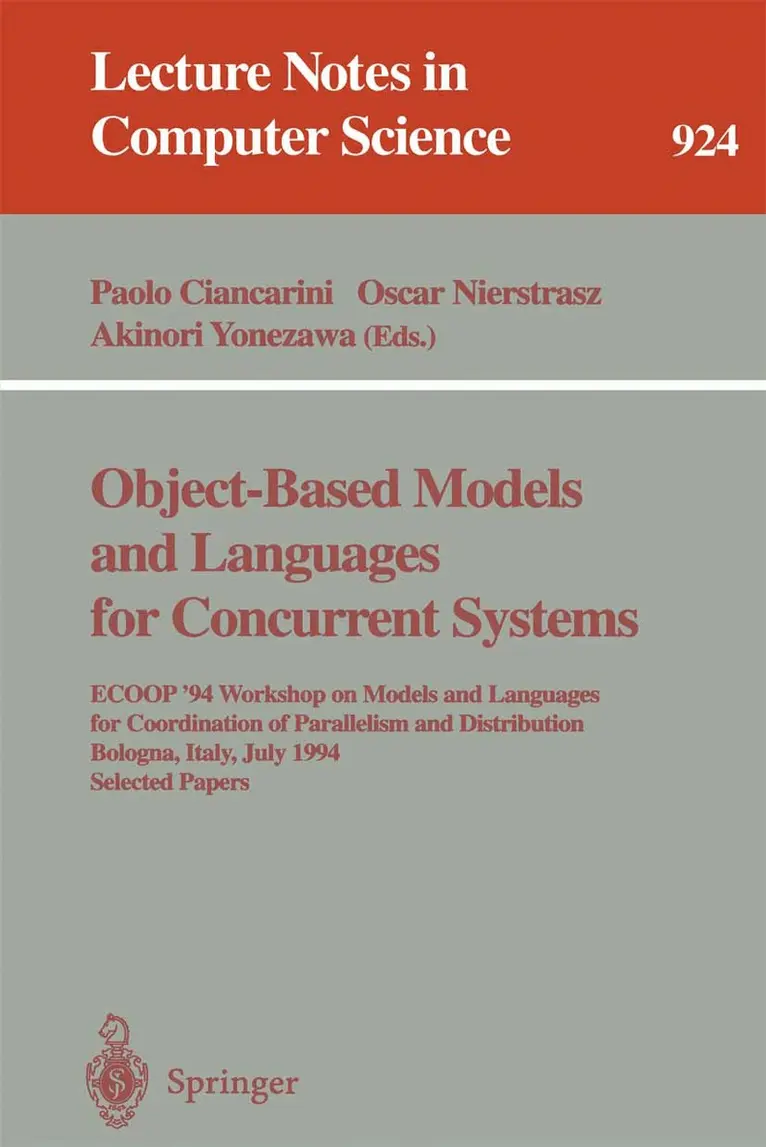
This volume presents carefully refereed versions of the best papers presented at the Workshop on Models and Languages for Coordination of Parallelism and Distribution, held during ECOOP '94 in Bologna, Italy in July 1994.Recently a new class of models and languages for distributed and parallel programming has evolved; all these models share a few basic concepts: simple features for data description and a small number of mechanisms for coordinating the work of agents in a distributed setting. This volume demonstrates that integrating such features with those known from concurrent object-oriented programming is very promising with regard to language support for distribution and software composition.
Häftad, Engelska, 2010
206 kr
Tillfälligt slut