Nikola Biller-Andorno - Böcker
Visar alla böcker från författaren Nikola Biller-Andorno. Handla med fri frakt och snabb leverans.
9 produkter
9 produkter
1 761 kr
Skickas inom 3-6 vardagar
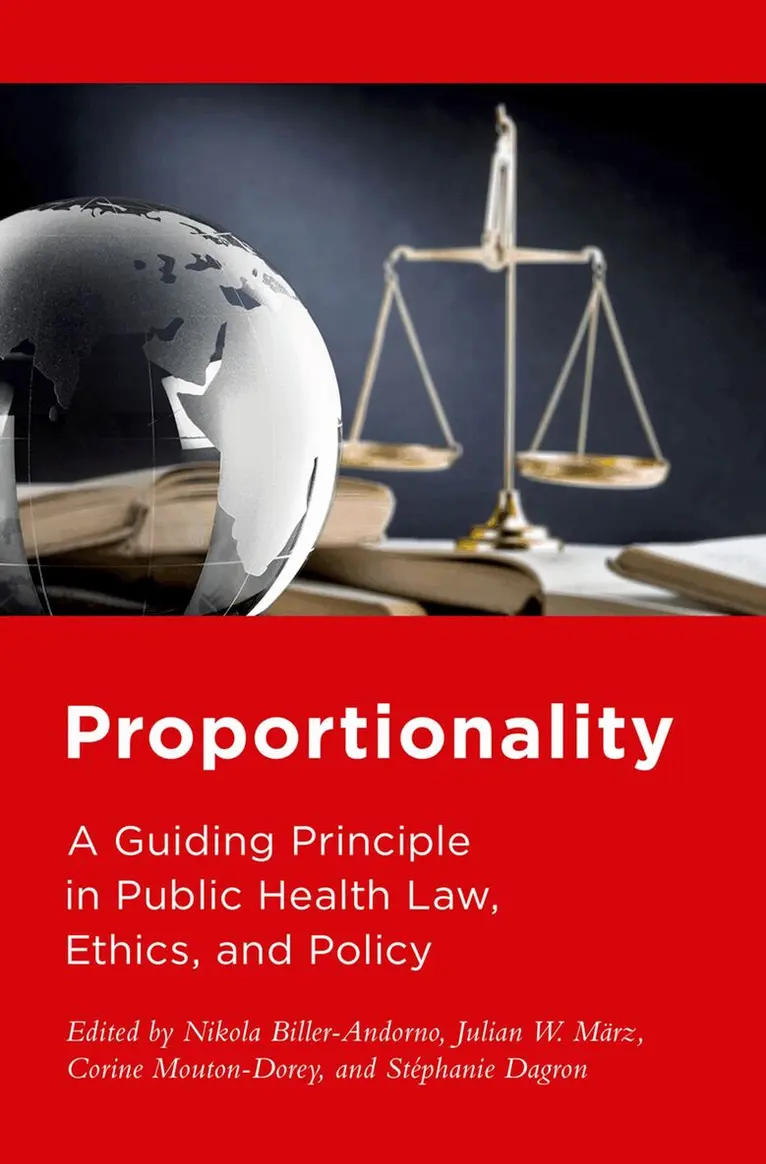
This is an open access title available under the terms of a CC BY-NC-ND 4.0 International licence. It is free to read on the Oxford Academic platform and offered as a free PDF download from OUP and selected open access locations.During crises, such as pandemics or environmental disasters, governments must act swiftly to prevent disease and death, often with incomplete information. The principle of proportionality serves as the established legal and ethical standard for navigating this balance. However, during times of severe crisis and uncertainty, determining the proportionality of public health actions is extremely complex, particularly when decisions are made without conclusive evidence or uniformly applicable international standards.In Proportionality, Nikola Biller-Andorno, Julian W. März, Corine Mouton-Dorey, and Stéphanie Dagron bring together 49 scholars and practitioners from around the world to explore how proportionality can guide and shape decision-making under crisis conditions. As they argue, a fundamental challenge in this domain is reconciling the obligation to foster population health through disease prevention, detection, and intervention with the imperative to respect and protect individual rights, including autonomy and privacy. Thus, the chapters in this volume highlight the principle and the process of proportionality, in order to guide decision-making and apply proportionate measures in the face of future public health crises, whether infectious, ecological, or linked to armed conflict. This volume not only develops the key concept of proportionality from the perspectives of law, human rights, philosophy, public health ethics, and political science, but it also looks at specific proportionality issues, such as freedom of movement, gender equity, children's rights and disease prevention.Examining how governments and health authorities navigate the delicate balance between protecting public health and safeguarding individual rights in times of crisis, Proportionality provides a comprehensive analysis on the topic. Further, it aims to guide the development of public health policies that are effective, equitable, and respectful of human rights.
3 066 kr
Skickas inom 7-10 vardagar
Psychotherapy is an indispensable approach in the treatment of mental disorders and, for some mental disorders, it is the most effective treatment. Yet, psychotherapy is abound with ethical issues. In psychotherapy ethics, numerous fundamental ethical issues converge, including self-determination/autonomy, decision-making capacity and freedom of choice, coercion and constraint, medical paternalism, the fine line between healthiness and illness, insight into illness and need of therapy, dignity, under- and overtreatment, and much more. The Oxford Handbook of Psychotherapy Ethics explores a whole range of ethical issues in the heterogenous field of psychotherapy thereby closing a widespread perceived gap between ethical sensitivity, technical language, and knowledge among psychotherapists. The book is intended not only for a clinical audience, but also for a philosophical/ethical audience - linking the two disciplines by fostering a productive dialogue between them, thereby enriching both the psychotherapeutic encounter and the ethical analysis and sensitivity in and outside the clinic. An essential book for psychotherapists in clinical practice, it will also be valuable for those professionals providing mental health services beyond psychology and medicine, including counsellors, social workers, nurses, and ministers.
2 246 kr
Skickas inom 10-15 vardagar
Population genomics research drawing on genetic databases has expanded rapidly, with some of this information being combined in 'biobanks'. Managing this information in an appropriate way is a highly complex ethical issue in the health policy arena. This book combines theoretical and empirical research to analyze the areas of conflict and consensus in the regulatory and ethical frameworks that have been developed to govern biobanks. Ethicists from the Department of Ethics, Trade, Human Rights and Health Law (ETH) of the World Health Organization, the Institute of Biomedical Ethics of Geneva University and the Institute of Biomedical Ethics of the University of Zurich, with the support of the Geneva International Academic Network (GIAN), examine the conditions under which genetic databases can be established, kept, and made use of in an ethically acceptable way. In addition to a comprehensive review of the scientific literature and a comparative analysis of existing normative frameworks, they present the results of in-depth interviews with experts around the world concerning the most unresolved and controversial issues. The results of that study, combined with their normative analysis, leads to recommendations for a better international framework.
777 kr
Skickas inom 10-15 vardagar
Population genomics research drawing on genetic databases has expanded rapidly, with some of this information being combined in 'biobanks'. Managing this information in an appropriate way is a highly complex ethical issue in the health policy arena. This book combines theoretical and empirical research to analyze the areas of conflict and consensus in the regulatory and ethical frameworks that have been developed to govern biobanks. Ethicists from the Department of Ethics, Trade, Human Rights and Health Law (ETH) of the World Health Organization, the Institute of Biomedical Ethics of Geneva University and the Institute of Biomedical Ethics of the University of Zurich, with the support of the Geneva International Academic Network (GIAN), examine the conditions under which genetic databases can be established, kept, and made use of in an ethically acceptable way. In addition to a comprehensive review of the scientific literature and a comparative analysis of existing normative frameworks, they present the results of in-depth interviews with experts around the world concerning the most unresolved and controversial issues. The results of that study, combined with their normative analysis, leads to recommendations for a better international framework.
Ethik und Recht in Medizin und Biowissenschaften
Aktuelle Fallbeispiele aus klinischer Praxis und Forschung
Inbunden, Tyska, 2014
473 kr
Skickas inom 7-10 vardagar
Aufgrund des schnellen Fortschritts der Biotechnologie und der modernen Medizin werden verschiedene Berufsgruppen in unserer Gesellschaft vermehrt mit ethischen Fragestellungen konfrontiert.Antworten müssen in den meisten Fällen situationsspezifisch erfolgen. Verschiedene Beispiele werden daher im vorliegenden Werk anhand von konkreten Fällen illustriert.Verantwortlichen aus den Bereichen der Lebenswissenschaften sowie Bio- und Medizinethik dient dieses Werk nicht nur als praktisches Handbuch, sondern auch als theoretisches Nachschlagewerk. Studierende, die sich mit Fragen bezüglich Anfang und Ende des Lebens sowie den Grenzen von Forschung und medizinischer Behandlung, aber auch generell im Zusammenhang mit der Ausübung bzw. Einschränkung von Grundrechten befassen, finden hier eine wertvolle Nachschlagequelle.Ausgesuchte Lösungsansätze für ethische und rechtliche Schwierigkeiten, mit denen Wissenschaftler und Forschende in ihrer täglichen Praxis konfrontiert sind, werden vergleichend aus der deutschen, österreichischen und schweizerischen Perspektive gegenübergestellt. Bestehende, die jeweilige gesellschaftliche und rechtliche Ordnung widerspiegelnde nationale Besonderheiten im Hinblick auf ethisch-moralische Wertungen, aber auch die Gesetzgebung bzw. deren Vollzug leiten den Leser dazu an, bei der Entscheidungsfindung jeden Einzelfall in seinem spezifischen Kontext zu eruieren und sich bei der Abwägung der unterschiedlichen Argumente nicht nur moralische Intuitionen, sondern auch das geltende Rechtvor Augen zu halten.Gegliedert in zwei Teile (nicht-klinische Bioethik und klinische Praxis der Medizin) zeigen die verschiedenen Falldiskussionen aus den Bereichen Forschungsethik, Ethik in den Lebenswissenschaften, Chirurgie, Intensiv- und Notfallmedizin, genetisches Screening, Allgemeinmedizin, Neurologie, Psychiatrie und innere Medizin konkrete Berührungspunkte von Recht und Ethik bzw. erlebte Konfliktsituationen sowie aktuell geltende rechtliche Lösungsansätze auf. Ziel des Werkes ist, zu einem besseren Verständnis der Zusammenhänge von Recht und Ethik beizutragen.
846 kr
Skickas inom 3-6 vardagar
332 kr
Skickas inom 10-15 vardagar
Er stellt konzeptuelle und methodische Zugänge zum Fach dar und bietet Einblicke in zentrale Themenfelder. Kurze Einführungen und Lektürefragen zu ausgewählten Texten erleichtern die systematische Einordnung der verschiedenen theoretischen und praktischen Fragestellungen der Medizinethik.
1 062 kr
Skickas inom 10-15 vardagar
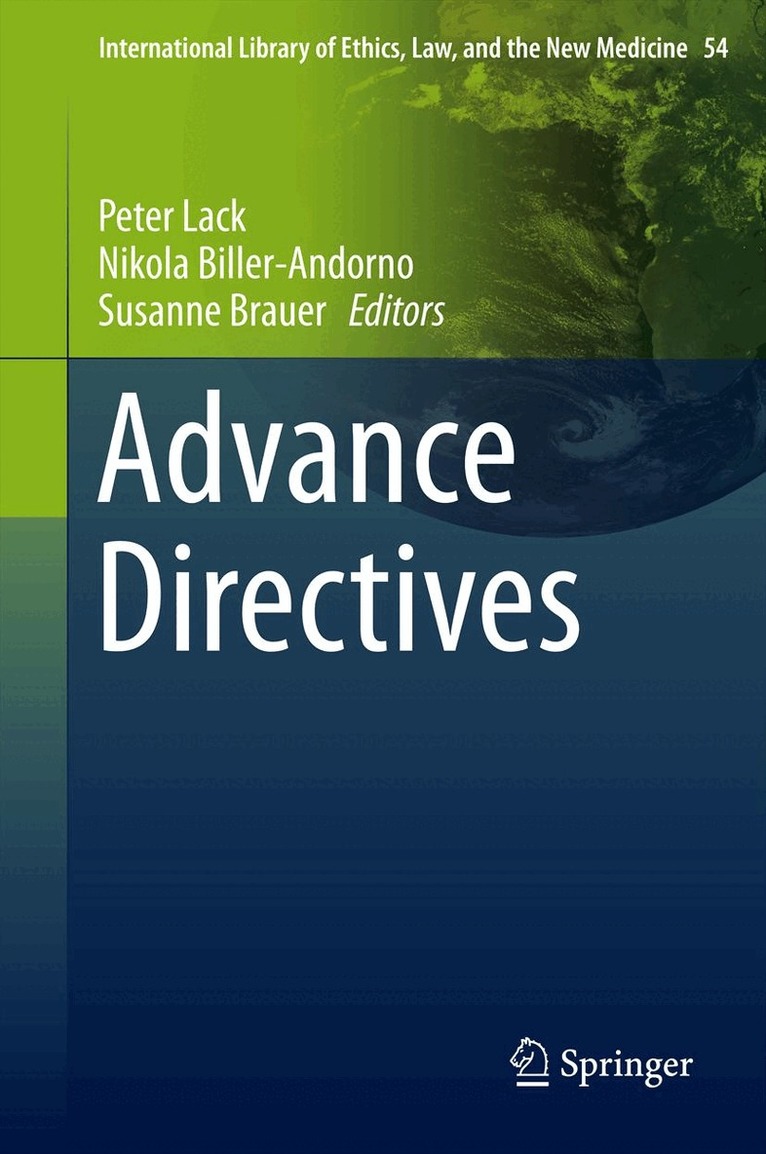
This volume gives an overview on the currently debated ethical issues regarding advance directives from an international perspective. It focuses on a wider understanding of the known and widely accepted concept of patient self-determination for future situations. Although advance directives have been widely discussed since the 1980s, the ethical bases of advance directives still remain a matter of heated debates. The book aims to contribute to these controversial debates by integrating fundamental ethical issues on advance directives with practical matters of their implementation. Cultural, national and professional differences in how advance directives are understood by health care professions and by patients, as well as in laws and regulations, are pinpointed.
1 062 kr
Skickas inom 10-15 vardagar
This volume gives an overview on the currently debated ethical issues regarding advance directives from an international perspective. It focuses on a wider understanding of the known and widely accepted concept of patient self-determination for future situations. Although advance directives have been widely discussed since the 1980s, the ethical bases of advance directives still remain a matter of heated debates. The book aims to contribute to these controversial debates by integrating fundamental ethical issues on advance directives with practical matters of their implementation. Cultural, national and professional differences in how advance directives are understood by health care professions and by patients, as well as in laws and regulations, are pinpointed.