Opher Etzion – författare
Visar alla böcker från författaren Opher Etzion. Handla med fri frakt och snabb leverans.
6 produkter
6 produkter
E-bok
Engelska, 2010428 kr
Läs direkt efter köp
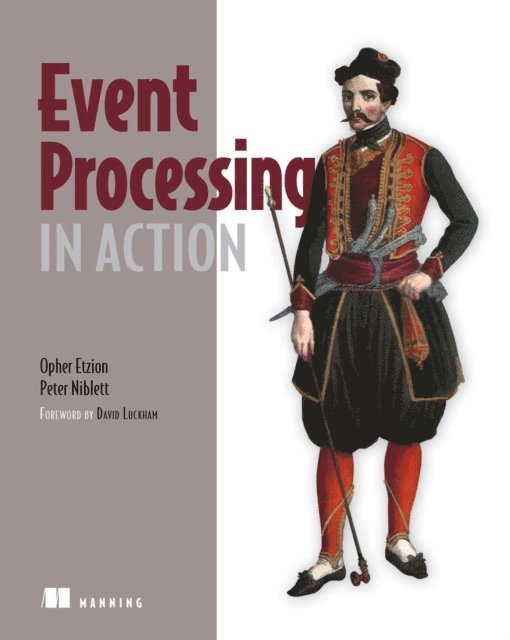
Unlike traditional information systems which work by issuing requests and waiting for responses, event-driven systems are designed to process events as they occur, allowing the system to observe, react dynamically, and issue personalized data depending on the recipient and situation.Event Processing in Action introduces the major concepts of event-driven architectures and shows how to use, design, and build event processing systems and applications. Written for working software architects and developers, the book looks at practical examples and provides an in-depth explanation of their architecture and implementation. Since patterns connect the events that occur in any system, the book also presents common event-driven patterns and explains how to detect and implement them. Throughout the book, readers follow a comprehensive use case that incorporates all event processing programming styles in practice today. Purchase of the print book comes with an offer of a free PDF, ePub, and Kindle eBook from Manning. Also available is all code from the book.
Häftad, Engelska, 2006
566 kr
Skickas inom 10-15 vardagar
Information technology is a rapidly changing field in which researchers and developers must continuously set their vision on the next generation of technologies and the systems that they enable. Suitably, Next-Generation Information Technologies and Systems (NGITS) is an ongoing series of workshops that provides a forum for presenting and discussing the latest advances in information technology. NGITS took are international events held in Israel; previous workshops took place in 1993, 1995, 1997, 1999 and 2002. The call for papers for the 2006 workshop was answered by 138 papers on a very diverse range of subjects, thus presenting a considerable challenge to the Program Committee. Each of these papers received professional reviewing from at least three experts, and eventually 32 papers (less than 25%) were selected for presentation at the workshop and inclusion in these proceedings. Of these, 28 are full-length papers and 4 are short papers. In addition, several research works were selected to display “poster” presentations, and a number of research projects exhibited demonstrations. Finally, the workshop featured three keynote lectures by notable experts. The selected papers may be classified roughly in ten broad areas: ? Information systems development ? Distributed systems ? Semi-structured data ? Data mining and agent-oriented computing ? User-oriented design ? Frameworks, models and taxonomies ? Simulation and incremental computing ? Information integration ? Security and privacy ? Next-generation applications This event is the culmination of efforts by many talented and dedicated individuals.
E-bok
PDF, Engelska, 2006708 kr
Läs direkt efter köp
Information technology is a rapidly changing field in which researchers and developers must continuously set their vision on the next generation of technologies and the systems that they enable. Suitably, Next-Generation Information Technologies and Systems (NGITS) is an ongoing series of workshops that provides a forum for presenting and discussing the latest advances in information technology. NGITS took are international events held in Israel; previous workshops took place in 1993, 1995, 1997, 1999 and 2002. The call for papers for the 2006 workshop was answered by 138 papers on a very diverse range of subjects, thus presenting a considerable challenge to the Program Committee. Each of these papers received professional reviewing from at least three experts, and eventually 32 papers (less than 25%) were selected for presentation at the workshop and inclusion in these proceedings. Of these, 28 are full-length papers and 4 are short papers. In addition, several research works were selected to display “poster” presentations, and a number of research projects exhibited demonstrations. Finally, the workshop featured three keynote lectures by notable experts. The selected papers may be classified roughly in ten broad areas: ? Information systems development ? Distributed systems ? Semi-structured data ? Data mining and agent-oriented computing ? User-oriented design ? Frameworks, models and taxonomies ? Simulation and incremental computing ? Information integration ? Security and privacy ? Next-generation applications This event is the culmination of efforts by many talented and dedicated individuals.
Häftad, Engelska, 2000
565 kr
Skickas inom 10-15 vardagar
Cooperation among systems has gained substantial importance in recent years: electronic commerce virtual enterprises and the middleware paradigm are just some examples in this area. CoopIS is a multi-disciplinary conference, which deals with all aspects of cooperation. The relevant disciplines are: collaborative work, distributed databases, distributed computing, electronic commerce, human-computer interaction, multi-agent systems, information retrieval, and workflow systems. The CoopIS series provides a forum for well-known researchers who are drawn by the stature and the tradition of these conference series and has a leading role in shaping the future of the cooperative information systems area. CoopIS 2000 is the seventh conference in the series and the fifth conference organized by the International Foundation on Cooperative Information Systems (IFCIS). It is sponsored by the IFCIS, the IBM Research Laboratory in Haifa and Compaq, Tandem labs Israel. It replaces the former international workshops on Interoperability in Multidatabase systems (IMS) and the conference series on Cooperative Information Systems (CoopIS & ICICIS). In response to the call for papers 74 papers were submitted. Each of them was reviewed by at least three reviewers, and at the end of this process 24 papers were accepted for presentation at the conference. Six additional papers were selected for short presentations. In addition the conference includes two panels, two keynote speakers (Professor Calton Pu from Georgia Tech and Professor Sheizaf Rafaeli from Haifa University) and one tutorial. A special issue of the International Journal of Cooperative Information Systems will follow. August 2000 Opher Etzion & Peter Scheuermann
E-bok
PDF, Engelska, 2006734 kr
Läs direkt efter köp
Cooperation among systems has gained substantial importance in recent years: electronic commerce virtual enterprises and the middleware paradigm are just some examples in this area. CoopIS is a multi-disciplinary conference, which deals with all aspects of cooperation. The relevant disciplines are: collaborative work, distributed databases, distributed computing, electronic commerce, human-computer interaction, multi-agent systems, information retrieval, and workflow systems. The CoopIS series provides a forum for well-known researchers who are drawn by the stature and the tradition of these conference series and has a leading role in shaping the future of the cooperative information systems area. CoopIS 2000 is the seventh conference in the series and the fifth conference organized by the International Foundation on Cooperative Information Systems (IFCIS). It is sponsored by the IFCIS, the IBM Research Laboratory in Haifa and Compaq, Tandem labs Israel. It replaces the former international workshops on Interoperability in Multidatabase systems (IMS) and the conference series on Cooperative Information Systems (CoopIS & ICICIS). In response to the call for papers 74 papers were submitted. Each of them was reviewed by at least three reviewers, and at the end of this process 24 papers were accepted for presentation at the conference. Six additional papers were selected for short presentations. In addition the conference includes two panels, two keynote speakers (Professor Calton Pu from Georgia Tech and Professor Sheizaf Rafaeli from Haifa University) and one tutorial. A special issue of the International Journal of Cooperative Information Systems will follow. August 2000 Opher Etzion & Peter Scheuermann
Häftad, Engelska, 1998
565 kr
Skickas inom 10-15 vardagar
This book grew out of a Dagstuhl seminar organized by the volume editors in June 1997. After the seminar, submissions for this book were solicited both from and beyond the group of participants. A peer review process followed, from which only original papers of the highest quality on the state of the art in the field were accepted for presentation in the book. The volume is divided into parts on temporal database infrastructure, temporal query languages, and advanced applications. A comprehensive bibliography, glossaries for both temporal database and time granularity concepts, and summaries of current work are also provided. The book is the ultimate reference for anyone actively involved in temporal database research and design or who is interested in their applications.