Tsvi Kuflik – författare
Visar alla böcker från författaren Tsvi Kuflik. Handla med fri frakt och snabb leverans.
13 produkter
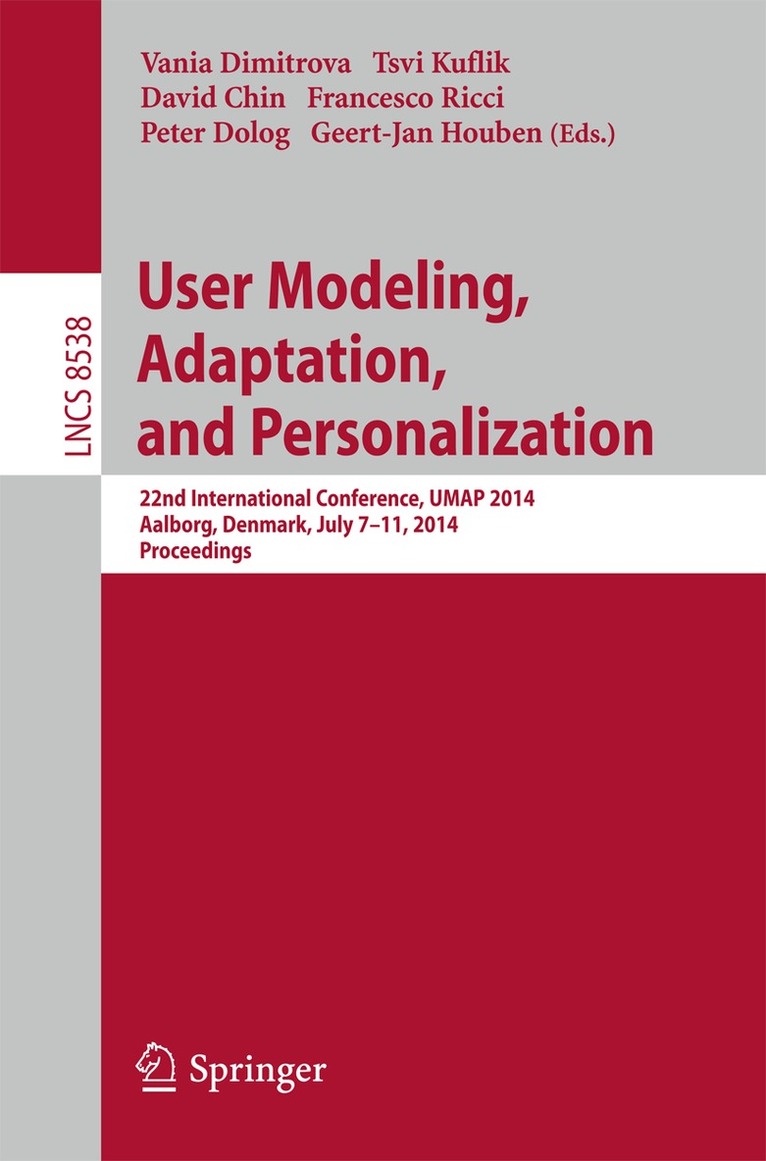
User Modeling, Adaptation and Personalization
22nd International Conference, UMAP 2014, Aalborg, Denmark, July 7-11, 2014. Proceedings
Av Vania Dimitrova, Tsvi Kuflik m. fl.
Häftad, 2014
567 kr
Lägg i varukorg
This book constitutes the thoroughly refereed proceedings of the 22nd International Conference on User Modeling, Adaption and Personalization, held in Aalborg, Denmark, in July 2014. The 23 long and 19 short papers of the research paper track were carefully reviewed and selected from 146 …
User Modeling, Adaptation and Personalization
22nd International Conference, UMAP 2014, Aalborg, Denmark, July 7-11, 2014. Proceedings
Av Geert-Jan Houben, Peter Dolog m. fl.
E-bok, 2014
755 kr
Lägg i varukorg
This book constitutes the thoroughly refereed proceedings of the 22nd International Conference on User Modeling, Adaption and Personalization, held in Aalborg, Denmark, in July 2014. The 23 long and 19 short papers of the research paper track were carefully reviewed and selected from 146 …
Next Generation Information Technologies and Systems
6th International Conference, NGITS 2006, Kebbutz Sehfayim, Israel, July 4-6, 2006, Proceedings
Av Opher Etzion, Tsvi Kuflik m. fl.
Häftad, 2006
567 kr
Lägg i varukorg
Information technology is a rapidly changing field in which researchers and developers must continuously set their vision on the next generation of technologies and the systems that they enable. Suitably, Next-Generation Information Technologies and Systems (NGITS) is an ongoing series of workshops …
Next Generation Information Technologies and Systems
6th International Conference, NGITS 2006, Kebbutz Sehfayim, Israel, July 4-6, 2006, Proceedings
Av Amihai Motro, Tsvi Kuflik m. fl.
E-bok, 2006
755 kr
Lägg i varukorg
Information technology is a rapidly changing field in which researchers and developers must continuously set their vision on the next generation of technologies and the systems that they enable. Suitably, Next-Generation Information Technologies and Systems (NGITS) is an ongoing series of workshops …
Next Generation Information Technologies and Systems
7th International Conference, NGITS 2009 Haifa, Israel, June 16-18, 2009 Revised Selected Papers
Av Yishai Feldman, Donald Kraft m. fl.
Häftad, 2009
567 kr
Lägg i varukorg
Information technology is a rapidly changing field in which researchers and devel- ers must continuously set their vision on the next generation of technologies and the systems that they enable. The Next Generation Information Technologies and Systems (NGITS) series of conferences provides a forum …
Next Generation Information Technologies and Systems
7th International Conference, NGITS 2009 Haifa, Israel, June 16-18, 2009 Revised Selected Papers
Av Tsvi Kuflik, Donald Kraft m. fl.
E-bok, 2009
755 kr
Lägg i varukorg
Information technology is a rapidly changing field in which researchers and devel- ers must continuously set their vision on the next generation of technologies and the systems that they enable. The Next Generation Information Technologies and Systems (NGITS) series of conferences provides a forum …
Advances in Ubiquitous User Modelling
Revised Selected Papers
Av Tsvi Kuflik, Shlomo Berkovsky m. fl.
Häftad, 2009
564 kr
Lägg i varukorg
Ubiquitous user modeling differs from generic user modeling by three additional concepts: ongoing modeling, ongoing sharing, and ongoing exploitation. Systems that share their user models will improve the coverage, the level of detail, and the reliability of the integrated user models and thus …
Advances in Ubiquitous User Modelling
Revised Selected Papers
Av Antonio Kruger, Dominikus Heckmann m. fl.
E-bok, 2009
732 kr
Lägg i varukorg
Ubiquitous user modeling differs from generic user modeling by three additional concepts: ongoing modeling, ongoing sharing, and ongoing exploitation. Systems that share their user models will improve the coverage, the level of detail, and the reliability of the integrated user models and thus …
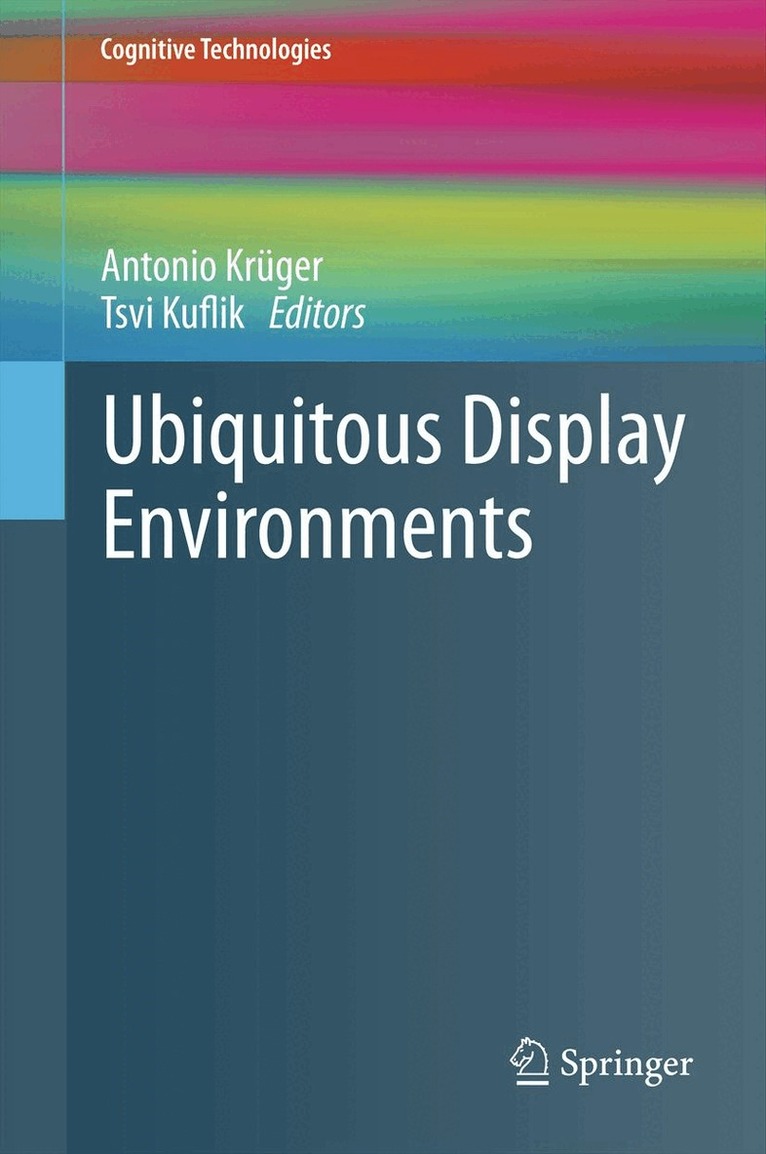
Ubiquitous Display Environments
Av Antonio Krüger, Tsvi Kuflik
Inbunden, 2012
1126 kr
Lägg i varukorg
Our increasingly smart environments will sense, track and model users and provide them with personalized services. We can already embed computers in everyday objects such as shirt buttons and pencils; objects of all sizes, from wristwatches to billboards, will soon incorporate high-quality flexible …
Ubiquitous Display Environments
Av Tsvi Kuflik, Antonio Kruger
E-bok, 2012
1470 kr
Lägg i varukorg
Our increasingly smart environments will sense, track and model users and provide them with personalized services. We can already embed computers in everyday objects such as shirt buttons and pencils; objects of all sizes, from wristwatches to billboards, will soon incorporate high-quality flexible …
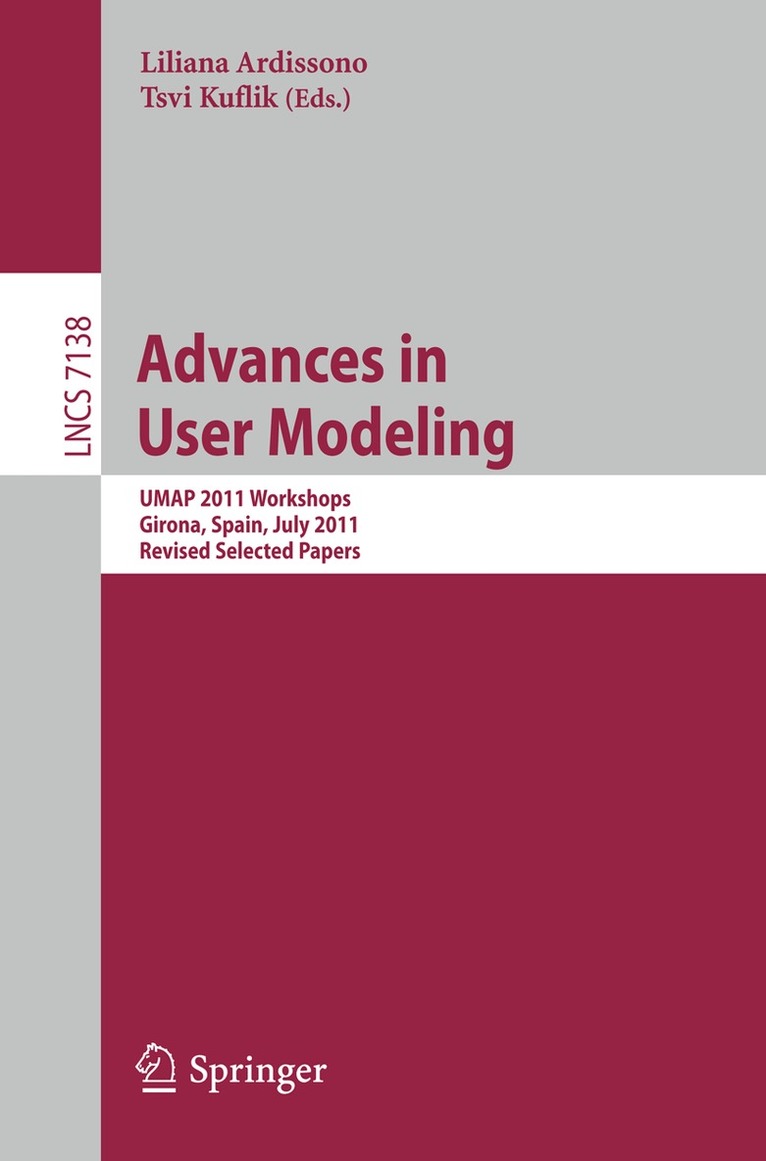
Advances in User Modeling
UMAP 2011 Workshops, Girona, Spain, July 11-15, 2011, Revised Selected Papers
Av Liliana Ardissono, Tsvi Kuflik
Häftad, 2012
567 kr
Lägg i varukorg
This book constitutes selected papers from the lectures given at the workshops held in conjunction with the User Modeling, Adaptation and Personalization Conference, UMAP 2011, Girona, Spain, in July 2011. The 40 papers presented were carefully reviewed and selected for inclusion in this book. For …
Advances in User Modeling
UMAP 2011 Workshops, Girona, Spain, July 11-15, 2011, Revised Selected Papers
Av Tsvi Kuflik, Liliana Ardissono
E-bok, 2012
718 kr
Lägg i varukorg
This book constitutes selected papers from the lectures given at the workshops held in conjunction with the User Modeling, Adaptation and Personalization Conference, UMAP 2011, Girona, Spain, in July 2011. The 40 papers presented were carefully reviewed and selected for inclusion in this book. For …
Ubiquitous Display Environments
Av Antonio Krüger, Tsvi Kuflik
Häftad, 2014
1126 kr
Lägg i varukorg
Our increasingly smart environments will sense, track and model users and provide them with personalized services. We can already embed computers in everyday objects such as shirt buttons and pencils; objects of all sizes, from wristwatches to billboards, will soon incorporate high-quality flexible …