Paul Bridge – författare
Visar alla böcker från författaren Paul Bridge. Handla med fri frakt och snabb leverans.
9 produkter
Molecular Variability of Fungal Pathogens
Av Paul D. Bridge, Yvonne Couteaudier m. fl.
Inbunden, 1998
2170 kr
Lägg i varukorg
This volume contains a series of contributions from established European researchers which consider aspects of molecular variability in fungal pathogens. Chapters are derived from a workshop held in Evian, France, in September 1997, supported by the EU Concerted Action Air 3-CT94-2448. The volume …
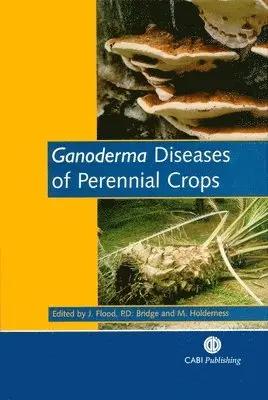
Ganoderma Diseases of Perennial Crops
Av Julie Flood, Paul D. Bridge m. fl.
Inbunden, 2000
2055 kr
Lägg i varukorg
Diseases caused by Ganoderma species cause major losses of palms and other perennial crops throughout the world, and these are particularly significant in Asia. Successive replanting of crop monocultures can be rapidly exploited by soil borne fungi such as Ganoderma, and the problem will become …
Trends in the Systematics of Bacteria and Fungi
Av Paul Bridge, David Smith m. fl.
Inbunden, 2020
1898 kr
Lägg i varukorg
Methods in microbial systematics have developed and changed significantly in the last 40 years. This has resulted in considerable change in both the defining microbial species and the methods required to make reliable identifications. Developments in information technology have enabled ready access …
Trends in the Systematics of Bacteria and Fungi
Av Paul Bridge, David Smith m. fl.
E-bok, 2020
2026 kr
Lägg i varukorg
Methods in microbial systematics have developed and changed significantly in the last 40 years. This has resulted in considerable change in both the defining microbial species and the methods required to make reliable identifications. Developments in information technology have enabled ready access …
Trends in the Systematics of Bacteria and Fungi
Av Paul Bridge, David Smith m. fl.
E-bok, 2020
2026 kr
Lägg i varukorg
Methods in microbial systematics have developed and changed significantly in the last 40 years. This has resulted in considerable change in both the defining microbial species and the methods required to make reliable identifications. Developments in information technology have enabled ready access …
Ganoderma Diseases of Tropical Crops
Av Carmel A Pilotti, Paul Bridge
Inbunden, 2023
1579 kr
Lägg i varukorg
The fungal genus Ganoderma includes around 80 currently recognized species that are widely distributed in temperate, subtropical and tropical regions, and cause disease in a range of economically important perennial crops and tree-like plants. Ganoderma root and lower stem rots have a significant …
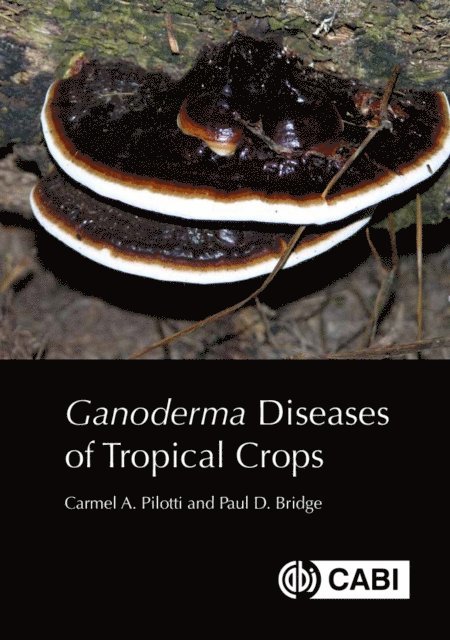
Ganoderma Diseases of Tropical Crops
Av Carmel A Pilotti, Paul Bridge
E-bok, 2023
1685 kr
Lägg i varukorg
The fungal genus Ganoderma includes around 80 currently recognized species that are widely distributed in temperate, subtropical and tropical regions, and cause disease in a range of economically important perennial crops and tree-like plants. Ganoderma root and lower stem rots have a significant …
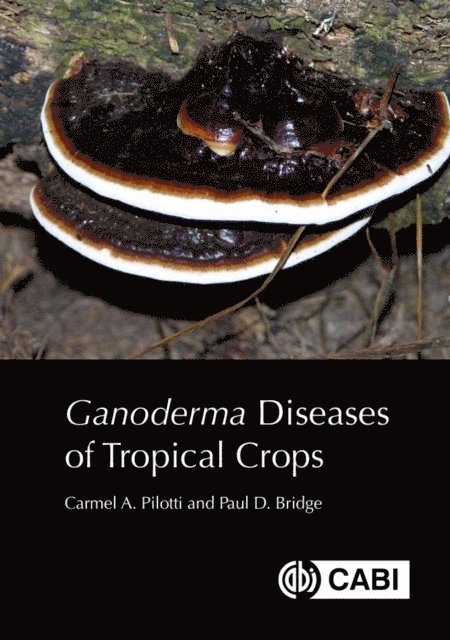
Ganoderma Diseases of Tropical Crops
Av Carmel A Pilotti, Paul Bridge
E-bok, 2023
1685 kr
Lägg i varukorg
The fungal genus Ganoderma includes around 80 currently recognized species that are widely distributed in temperate, subtropical and tropical regions, and cause disease in a range of economically important perennial crops and tree-like plants. Ganoderma root and lower stem rots have a significant …
Applied Mycology
Inbunden, 2009
1928 kr
Lägg i varukorg
The fungal kingdom consists of a wide variety of organisms with a diverse range of forms and functions. Fungi have been utilized for thousands of years and their importance in agriculture, medicine, food production and the environmental sciences is well known. New advances in genomic and …