Paul J.J. Hooykaas – författare
Visar alla böcker från författaren Paul J.J. Hooykaas. Handla med fri frakt och snabb leverans.
2 produkter
2 produkter
Häftad, Engelska, 1998
545 kr
Skickas inom 10-15 vardagar
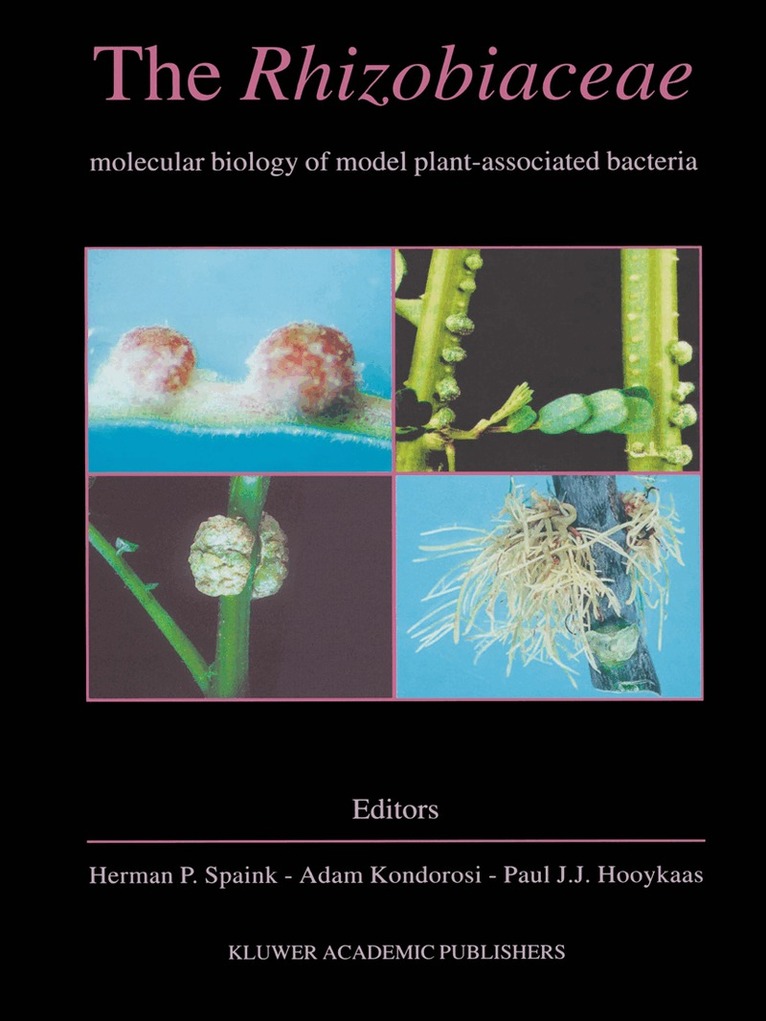
This work gives a comprehensive overview of our present molecular biological knowledge about the Rhizobiaceae, which can be called the best studied family of soil bacteria in the late 20th century. For many centuries they have attracted the attention of scientists because of their capacity to associate with plants and as a consequence also to specifically modify plant development. Some of these associations are beneficial for the plant, as is the case for the Rhizobiaceae subgroups collectively called rhizobia, which are able to fix nitrogen in a symbiosis with the plant hosts. This symbiosis results in the formation of root or stem nodules, as illustrated on the front cover. In contrast, several Rhizobiaceae subgroups can negatively affect plant development and evoke plant diseases. Examples are Agrobacterium tumefaciens and A. rhizogenes which induce the formation of crown galls or hairy roots on the stems of their host plants, respectively.
E-bok
PDF, Engelska, 2012673 kr
Läs direkt efter köp
The Rhizobiaceae, Molecular Biology of Model Plant-Associated Bacteria. This book gives a comprehensive overview on our present molecular biological knowledge about the Rhizobiaceae, which currently can be called the best-studied family of soil bacteria. For many centuries they have attracted the attention of scientists because of their capacity to associate with plants and as a consequence also to specifically modify plant development. Some of these associations are beneficial for the plant, as is the case for the Rhizobiaceae subgroups collectively called rhizobia, which are able to fix nitrogen in a symbiosis with the plant hosts. This symbiosis results in the fonnation of root or stem nodules, as illustrated on the front cover. In contrast, several Rhizobiaceae subgroups can negatively affect plant development and evoke plant diseases. Examples are Agrobacterium tumefaciens andA. rhizogenes which induce the formation of crown galls or hairy roots on the stems of their host plants, respectively (bottom panels on front cover). In addition to the obvious importance of studies on the Rhizobiaceae for agronomy, this research field has resulted in the discovery of many fundamental scientific principles of general interest, which are highlighted in this book. To mention three examples: (i) the discovery of DNA transfer of A.