Pertti Lounesto - Böcker
Visar alla böcker från författaren Pertti Lounesto. Handla med fri frakt och snabb leverans.
2 produkter
2 produkter
Del 286 - London Mathematical Society Lecture Note Series
Clifford Algebras and Spinors
Häftad, Engelska, 2001
758 kr
Skickas inom 7-10 vardagar
In this book, Professor Lounesto offers a unique introduction to Clifford algebras and spinors. The initial chapters could be read by undergraduates; vectors, complex numbers and quaternions are introduced with an eye on Clifford algebras. The next chapters will also interest physicists, and include treatments of the quantum mechanics of the electron, electromagnetism and special relativity with a flavour of Clifford algebras. This book also gives the first comprehensive survey of recent research on Clifford algebras. A new classification of spinors is introduced, based on bilinear covariants of physical observables. This reveals a new class of spinors, residing between the Weyl, Majorana and Dirac spinors. Scalar products of spinors are classified by involutory anti-automorphisms of Clifford algebras. This leads to the chessboard of automorphism groups of scalar products of spinors. On the analytic side, Brauer-Wall groups and Witt rings are discussed, and Caucy's integral formula is generalized to higher dimensions.
535 kr
Skickas inom 10-15 vardagar
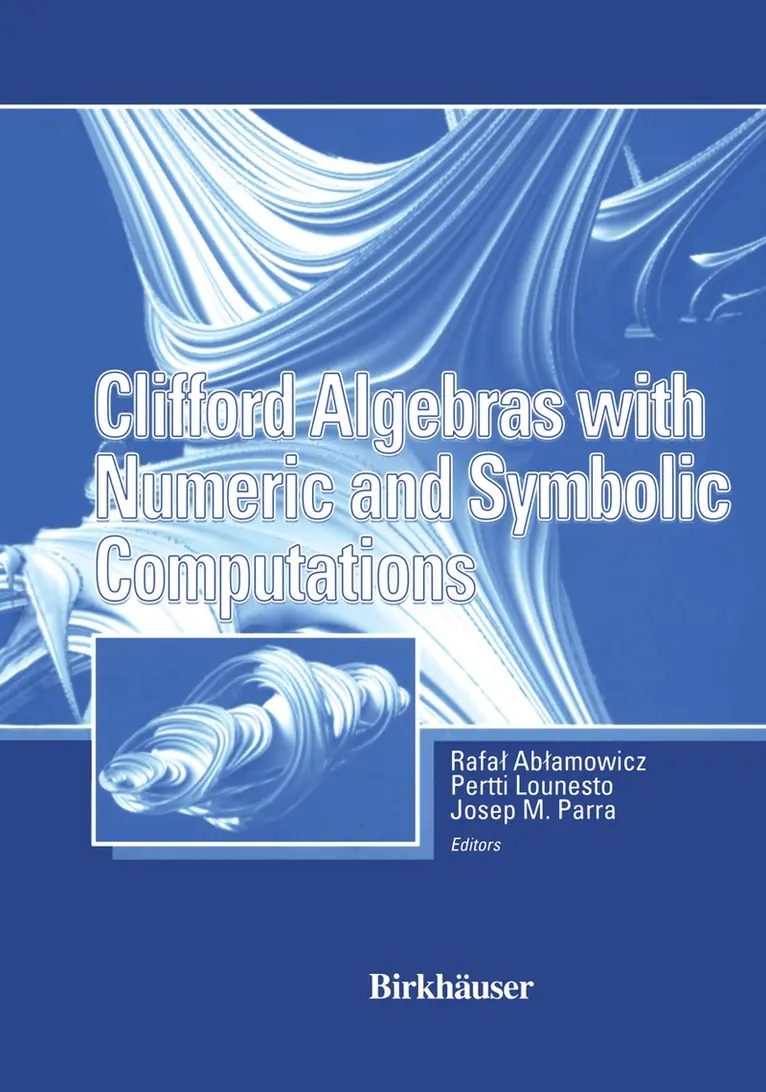
Clifford algebras are at a crossing point in a variety of research areas, including abstract algebra, crystallography, projective geometry, quantum mechanics, differential geometry and analysis. For many researchers working in this field in ma- thematics and physics, computer algebra software systems have become indispensable tools in theory and applications. This edited survey book consists of 20 chapters showing application of Clifford algebra in quantum mechanics, field theory, spinor calculations, projective geometry, Hypercomplex algebra, function theory and crystallography. Many examples of computations performed with a variety of readily available software programs are presented in detail, i.e., Maple, Mathematica, Axiom, etc. A key feature of the book is that it shows how scientific knowledge can advance with the use of computational tools and software.