Peter Hick - Böcker
Visar alla böcker från författaren Peter Hick. Handla med fri frakt och snabb leverans.
4 produkter
4 produkter
2 485 kr
Skickas inom 10-15 vardagar
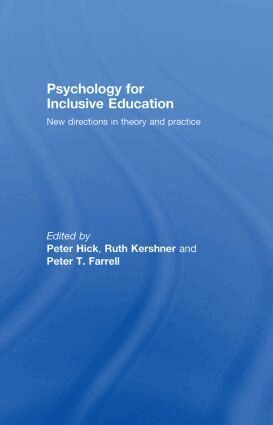
What can psychology offer inclusive education? Traditionally, special education has looked to psychology for many of its theoretical resources and practical strategies. While those seeking to promote more inclusive education have tended to see psychology and psychologists as part of the problem by providing a rationale for segregation. However, in practice many psychologists today are developing inclusive ways of working, and are paying attention to psychological theories that underpin inclusive education. Psychology for Inclusive Education reframes the contribution of psychology in terms of its relevance to inclusion and will show how psychological theories of learning and human development are compatible with inclusive education. Part 1 explores psychological theories relevant to understanding inclusive education and Part 2 looks at how psychology can contribute to promoting more inclusive education in practice. Chapters cover: how psychologists can collaborate with teachers for inclusive solutions Vygotsky's theories of learning and their significance for inclusion the challenge of developing pedagogies for inclusion sociocultural understandings of learning in inclusive classrooms the role of emotion in learning and inclusion cooperative learning and inclusion the challenges and tensions of inclusion and high standards for schools the practice of dynamic assessment as an inclusive alternative to IQ social justice and inclusive psychologyBringing together a highly distinguished list of international contributors from the UK, USA and South Africa and including practising educational psychologists, this book will link theory to practice in schools and classrooms. International in focus and at the very cutting edge of the field, this is essential reading for all those interested in the development of inclusive education.
665 kr
Skickas inom 10-15 vardagar
What can psychology offer inclusive education? Traditionally, special education has looked to psychology for many of its theoretical resources and practical strategies. While those seeking to promote more inclusive education have tended to see psychology and psychologists as part of the problem by providing a rationale for segregation. However, in practice many psychologists today are developing inclusive ways of working, and are paying attention to psychological theories that underpin inclusive education. Psychology for Inclusive Education reframes the contribution of psychology in terms of its relevance to inclusion and will show how psychological theories of learning and human development are compatible with inclusive education. Part 1 explores psychological theories relevant to understanding inclusive education and Part 2 looks at how psychology can contribute to promoting more inclusive education in practice. Chapters cover: how psychologists can collaborate with teachers for inclusive solutions Vygotsky's theories of learning and their significance for inclusion the challenge of developing pedagogies for inclusion sociocultural understandings of learning in inclusive classrooms the role of emotion in learning and inclusion cooperative learning and inclusion the challenges and tensions of inclusion and high standards for schools the practice of dynamic assessment as an inclusive alternative to IQ social justice and inclusive psychologyBringing together a highly distinguished list of international contributors from the UK, USA and South Africa and including practising educational psychologists, this book will link theory to practice in schools and classrooms. International in focus and at the very cutting edge of the field, this is essential reading for all those interested in the development of inclusive education.
9 094 kr
Tillfälligt slut
This four-volume set brings together seminal articles and key writings on the theme of inclusion and diversity in education. The collection takes disability and special educational need as a starting point from which to develop a broader focus on a range of themes relating to learners who may be marginalised from educational opportunities. This includes for example members of minority ethnic communities, students excluded from schools or who are ′looked after′ in public care, and other dimensions of exclusion arising from social class, gender or sexuality.The starting point for understanding inclusive education lies in social justice perspectives, and this forms the basis for the first volume. Volumes two and three focus on research aimed at developing more inclusive practices both at the levels of schools and school systems, and at the levels of inclusive pedagogy, enacted in the classroom and through the curriculum. Volume four reflects the range of voices in research on inclusive education, drawing on traditionally marginalised voices and those of learners in particular.Three cross-cutting themes are represented across all four volumes:-A chronological approach, showing how key concepts and perspectives have developed in each area of the literature. -Identified groups of learners - developing more nuanced readings of how processes of exclusion and inclusion intersect dimensions such as disability, class and race-Contexts for learning - such as urban education and global or comparative perspectives.
231 kr
Skickas inom 3-6 vardagar