Peter J. Diggle - Böcker
Visar alla böcker från författaren Peter J. Diggle. Handla med fri frakt och snabb leverans.
6 produkter
6 produkter
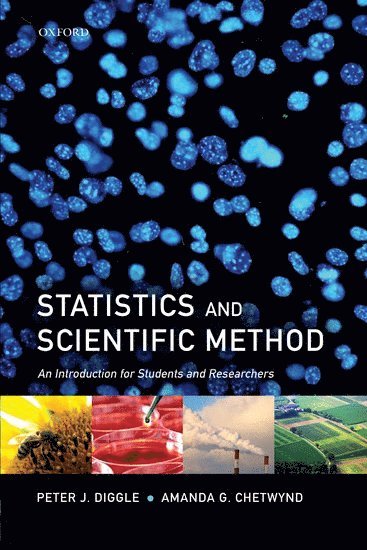
Statistics and Scientific Method
An Introduction for Students and Researchers
Inbunden, Engelska, 2011
1 722 kr
Skickas inom 7-10 vardagar
Most introductory statistics text-books are written either in a highly mathematical style for an intended readership of mathematics undergraduate students, or in a recipe-book style for an intended audience of non-mathematically inclined undergraduate or postgraduate students, typically in a single discipline; hence, "statistics for biologists", "statistics for psychologists", and so on.An antidote to technique-oriented service courses, this book is different. It studiously avoids the recipe-book style and keeps algebraic details of specific statistical methods to the minimum extent necessary to understand the underlying concepts. Instead, the text aims to give the reader a clear understanding of how core statistical ideas of experimental design, modelling and data analysis are integral to the scientific method. Aimed primarily at beginning postgraduate students across a range of scientific disciplines (albeit with a bias towards the biological, environmental and health sciences), it therefore assumes some maturity of understanding of scientific method, but does not require any prior knowledge of statistics, or any mathematical knowledge beyond basic algebra and a willingness to come to terms with mathematical notation.Any statistical analysis of a realistically sized data-set requires the use of specially written computer software. An Appendix introduces the reader to our open-source software of choice, R, whilst the book's web-page includes downloadable data and R code that enables the reader to reproduce all of the analyses in the book and, with easy modifications, to adapt the code to analyse their own data if they wish. However, the book is not intended to be a textbook on statistical computing, and all of the material in the book can be understood without using either R or any other computer software.
566 kr
Skickas inom 7-10 vardagar
Most introductory statistics text-books are written either in a highly mathematical style for an intended readership of mathematics undergraduate students, or in a recipe-book style for an intended audience of non-mathematically inclined undergraduate or postgraduate students, typically in a single discipline; hence, "statistics for biologists", "statistics for psychologists", and so on.An antidote to technique-oriented service courses, this book is different. It studiously avoids the recipe-book style and keeps algebraic details of specific statistical methods to the minimum extent necessary to understand the underlying concepts. Instead, the text aims to give the reader a clear understanding of how core statistical ideas of experimental design, modelling and data analysis are integral to the scientific method. Aimed primarily at beginning postgraduate students across a range of scientific disciplines (albeit with a bias towards the biological, environmental and health sciences), it therefore assumes some maturity of understanding of scientific method, but does not require any prior knowledge of statistics, or any mathematical knowledge beyond basic algebra and a willingness to come to terms with mathematical notation.Any statistical analysis of a realistically sized data-set requires the use of specially written computer software. An Appendix introduces the reader to our open-source software of choice, R, whilst the book's web-page includes downloadable data and R code that enables the reader to reproduce all of the analyses in the book and, with easy modifications, to adapt the code to analyse their own data if they wish. However, the book is not intended to be a textbook on statistical computing, and all of the material in the book can be understood without using either R or any other computer software.
736 kr
Skickas inom 10-15 vardagar
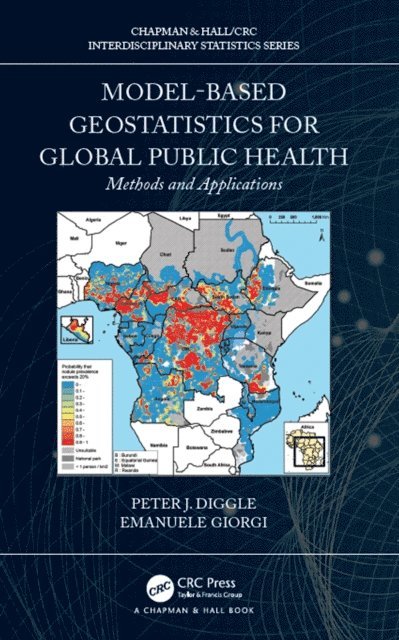
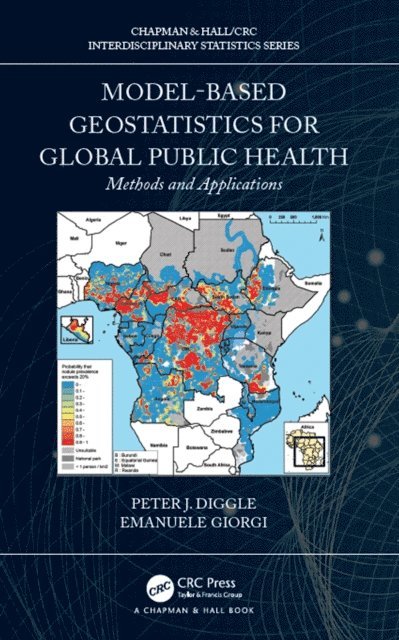
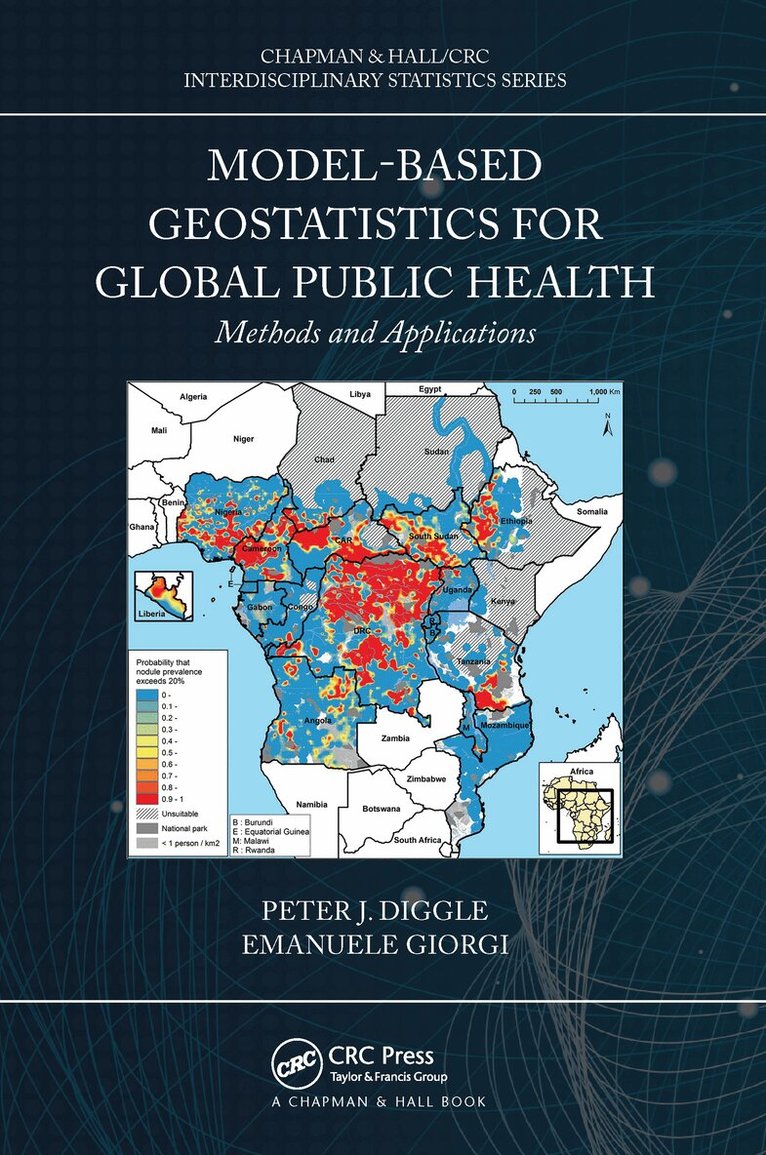
Model-based Geostatistics for Global Public Health: Methods and Applications provides an introductory account of model-based geostatistics, its implementation in open-source software and its application in public health research. In the public health problems that are the focus of this book, the authors describe and explain the pattern of spatial variation in a health outcome or exposure measurement of interest. Model-based geostatistics uses explicit probability models and established principles of statistical inference to address questions of this kind.Features: Presents state-of-the-art methods in model-based geostatistics. Discusses the application these methods some of the most challenging global public health problems including disease mapping, exposure mapping and environmental epidemiology. Describes exploratory methods for analysing geostatistical data, including: diagnostic checking of residuals standard linear and generalized linear models; variogram analysis; Gaussian process models and geostatistical design issues. Includes a range of more complex geostatistical problems where research is ongoing. All of the results in the book are reproducible using publicly available R code and data-sets, as well as a dedicated R package. This book has been written to be accessible not only to statisticians but also to students and researchers in the public health sciences.The AuthorsPeter Diggle is Distinguished University Professor of Statistics in the Faculty of Health and Medicine, Lancaster University. He also holds honorary positions at the Johns Hopkins University School of Public Health, Columbia University International Research Institute for Climate and Society, and Yale University School of Public Health. His research involves the development of statistical methods for analyzing spatial and longitudinal data and their applications in the biomedical and health sciences.Dr Emanuele Giorgi is a Lecturer in Biostatistics and member of the CHICAS research group at Lancaster University, where he formerly obtained a PhD in Statistics and Epidemiology in 2015. His research interests involve the development of novel geostatistical methods for disease mapping, with a special focus on malaria and other tropical diseases. In 2018, Dr Giorgi was awarded the Royal Statistical Society Research Prize "for outstanding published contribution at the interface of statistics and epidemiology." He is also the lead developer of PrevMap, an R package where all the methodology found in this book has been implemented.
674 kr
Skickas inom 10-15 vardagar
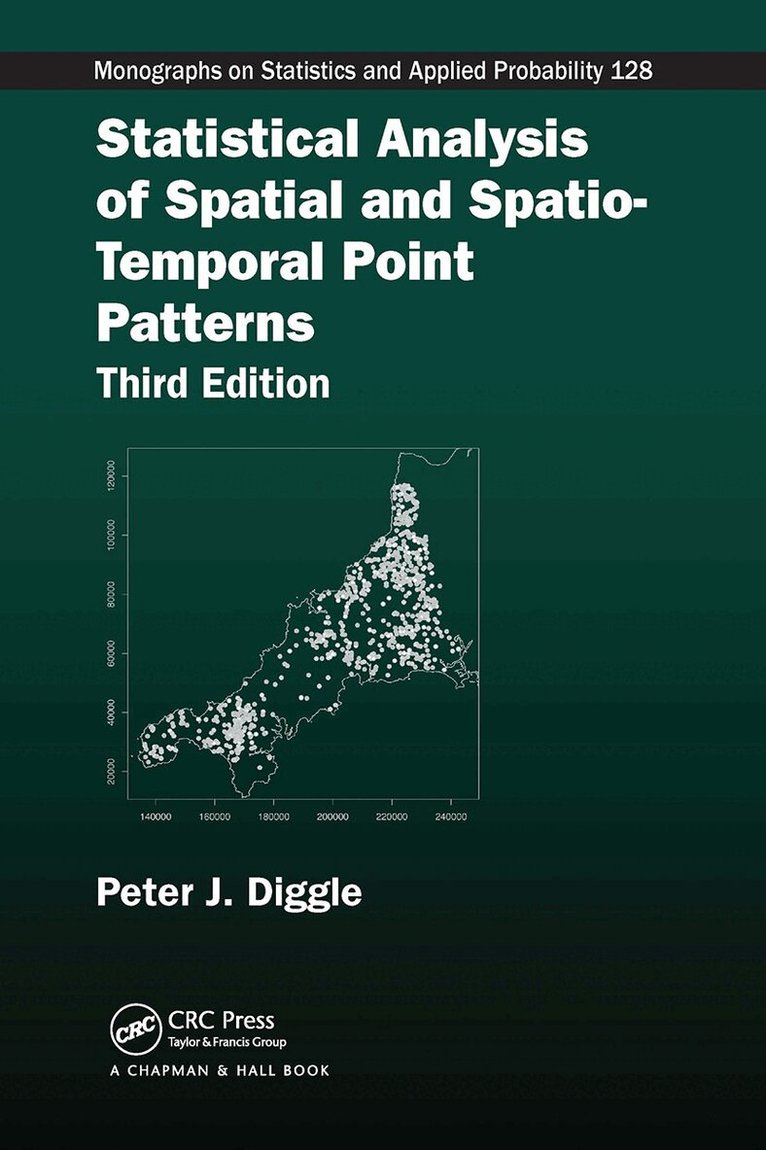
Written by a prominent statistician and author, the first edition of this bestseller broke new ground in the then emerging subject of spatial statistics with its coverage of spatial point patterns. Retaining all the material from the second edition and adding substantial new material, Statistical Analysis of Spatial and Spatio-Temporal Point Patterns, Third Edition presents models and statistical methods for analyzing spatially referenced point process data.Reflected in the title, this third edition now covers spatio-temporal point patterns. It explores the methodological developments from the last decade along with diverse applications that use spatio-temporally indexed data. Practical examples illustrate how the methods are applied to analyze spatial data in the life sciences.This edition also incorporates the use of R through several packages dedicated to the analysis of spatial point process data. Sample R code and data sets are available on the author’s website.
1 368 kr
Skickas inom 10-15 vardagar
Model-based Geostatistics for Global Public Health: Methods and Applications provides an introductory account of model-based geostatistics, its implementation in open-source software and its application in public health research. In the public health problems that are the focus of this book, the authors describe and explain the pattern of spatial variation in a health outcome or exposure measurement of interest. Model-based geostatistics uses explicit probability models and established principles of statistical inference to address questions of this kind.Features: Presents state-of-the-art methods in model-based geostatistics. Discusses the application these methods some of the most challenging global public health problems including disease mapping, exposure mapping and environmental epidemiology. Describes exploratory methods for analysing geostatistical data, including: diagnostic checking of residuals standard linear and generalized linear models; variogram analysis; Gaussian process models and geostatistical design issues. Includes a range of more complex geostatistical problems where research is ongoing. All of the results in the book are reproducible using publicly available R code and data-sets, as well as a dedicated R package.This book has been written to be accessible not only to statisticians but also to students and researchers in the public health sciences.The AuthorsPeter Diggle is Distinguished University Professor of Statistics in the Faculty of Health and Medicine, Lancaster University. He also holds honorary positions at the Johns Hopkins University School of Public Health, Columbia University International Research Institute for Climate and Society, and Yale University School of Public Health. His research involves the development of statistical methods for analyzing spatial and longitudinal data and their applications in the biomedical and health sciences.Dr Emanuele Giorgi is a Lecturer in Biostatistics and member of the CHICAS research group at Lancaster University, where he formerly obtained a PhD in Statistics and Epidemiology in 2015. His research interests involve the development of novel geostatistical methods for disease mapping, with a special focus on malaria and other tropical diseases. In 2018, Dr Giorgi was awarded the Royal Statistical Society Research Prize "for outstanding published contribution at the interface of statistics and epidemiology." He is also the lead developer of PrevMap, an R package where all the methodology found in this book has been implemented.
1 205 kr
Skickas inom 10-15 vardagar
Written by a prominent statistician and author, the first edition of this bestseller broke new ground in the then emerging subject of spatial statistics with its coverage of spatial point patterns. Retaining all the material from the second edition and adding substantial new material, Statistical Analysis of Spatial and Spatio-Temporal Point Patterns, Third Edition presents models and statistical methods for analyzing spatially referenced point process data.Reflected in the title, this third edition now covers spatio-temporal point patterns. It explores the methodological developments from the last decade along with diverse applications that use spatio-temporally indexed data. Practical examples illustrate how the methods are applied to analyze spatial data in the life sciences.This edition also incorporates the use of R through several packages dedicated to the analysis of spatial point process data. Sample R code and data sets are available on the author’s website.