• Fri frakt över 249 kr
  • •
  • Snabba leveranser
  • •
  • Billiga böcker
Kundservice

Du är på sajten för privatpersoner.

Företag, bibliotek eller offentlig verksamhet?

Du handlar på classic.bokus.com, där alla dina funktioner finns intakta.
Till classic.bokus.com
Bokus logotyp. Gå till startsidan.
  • Erbjudanden
  • Nyheter
  • Student
  • Topplistor
  • Barn & ungdom
  • Bokus Play
  • E-böcker
  • Pocketböcker
  • Spel & pussel

10% rabatt på allt med kod NYSTART10 →

Sidfot

Mina sidor

    Hjälp

    • Kundservice
    • Vanliga frågor och svar
    • Frakt och leverans
    • Retur vid ångerrätt
    • Reklamera vara
    • Betalning
    • Köpvillkor
    • Allmänna villkor
    • Information om webbplatsens tillgänglighet

    Om Bokus

    • Om oss
    • Pressrum
    • För studenter
    • För företag
    • För bibliotek och offentlig verksamhet
    • För leverantörer
    • Hållbarhet

    Populärt

    • Aktuella erbjudanden
    • Presentkort
    • Studentlitteratur
    • Nya böcker
    • Topplistor
    • Signerade böcker
    • Engelska böcker

    Inspiration

    • Boktips
    • BookTok
    • Populära bokserier
    • Barnbokskaraktärer
    • Populära författare
    Logotyp för Bokus
    Följ oss på Facebook (extern länk)Följ oss på Instagram (extern länk)Följ oss på YouTube (extern länk)Följ oss på TikTok (extern länk)
    bokus @ CookiesAnpassa cookiesIntegritetspolicyKöpvillkor
    Till Citymail hemsida (extern länk)Till Budbee hemsida (extern länk)Till Postnord hemsida (extern länk)Till Schenker hemsida (extern länk)Till Early Bird hemsida (extern länk)Till Walleys hemsida (extern länk)
    1. Samhälle och politik
    2. Samhälle och kultur
    3. Kultur och medier
    4. Referensverk och tvärvetenskap

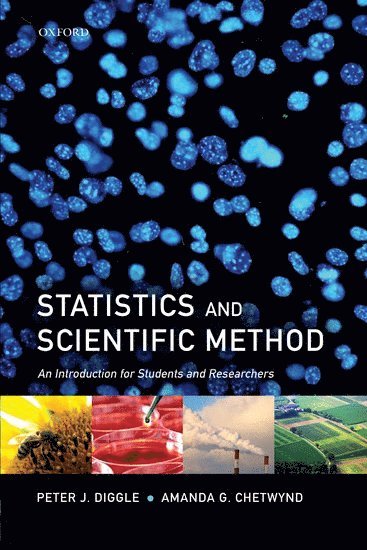
    Statistics and Scientific Method

    An Introduction for Students and Researchers

    AvPeter J. Diggle,Amanda G. Chetwynd

    Inbunden, Engelska, 2011

    1 840 kr

    Beställningsvara. Skickas inom 7-10 vardagar. Fri frakt över 249 kr.

    Fler format och utgåvor

    Häftad

    610 kr

    Beskrivning

    Most introductory statistics text-books are written either in a highly mathematical style for an intended readership of mathematics undergraduate students, or in a recipe-book style for an intended audience of non-mathematically inclined undergraduate or postgraduate students, typically in a single discipline; hence, "statistics for biologists", "statistics for psychologists", and so on.An antidote to technique-oriented service courses, this book is different. It studiously avoids the recipe-book style and keeps algebraic details of specific statistical methods to the minimum extent necessary to understand the underlying concepts. Instead, the text aims to give the reader a clear understanding of how core statistical ideas of experimental design, modelling and data analysis are integral to the scientific method. Aimed primarily at beginning postgraduate students across a range of scientific disciplines (albeit with a bias towards the biological, environmental and health sciences), it therefore assumes some maturity of understanding of scientific method, but does not require any prior knowledge of statistics, or any mathematical knowledge beyond basic algebra and a willingness to come to terms with mathematical notation.Any statistical analysis of a realistically sized data-set requires the use of specially written computer software. An Appendix introduces the reader to our open-source software of choice, R, whilst the book's web-page includes downloadable data and R code that enables the reader to reproduce all of the analyses in the book and, with easy modifications, to adapt the code to analyse their own data if they wish. However, the book is not intended to be a textbook on statistical computing, and all of the material in the book can be understood without using either R or any other computer software.

    Produktinformation

    • Utgivningsdatum:2011-08-11
    • Mått:171 x 241 x 17 mm
    • Vikt:430 g
    • Format:Inbunden
    • Språk:Engelska
    • Antal sidor:190
    • Förlag:OUP OXFORD
    • ISBN:9780199543182

    Utforska kategorier

    • Referensverk och tvärvetenskap inom Samhälle och politik
    • Matematisk statistik inom Naturvetenskap och teknik
    • Sociologi inom Samhälle och politik

    Mer om författaren

    Peter Diggle is Distinguished University Professor of Statistics and Associate Dean for Research in the School of Health and Medicine, Lancaster University, Adjunct Professor in the Department of Biostatistics, Johns Hopkins University School of Public Health and Adjunct Senior Researcher in the International Research Institute for Climate and Society, Columbia University. Between 1974 and 1983 he was a Lecturer, then Reader, in Statistics at the University of Newcastle upon Tyne. Between 1984 and 1988 he was Senior, then Principal, then Chief Research Scientist and Chief of the Division of Mathematics and Statistics at CSIRO, Australia. He has published nine books and around 180 articles on these topics in the open literature. He was awarded the Royal Statistical Society's Guy Medal in Silver in 1997, is a former editor of the Society's Journal, Series B and is a Fellow of the American Statistical Association.Amanda Chetwynd is Pro-Vice-Chancellor for the Student Experience and Professor of Mathematics and Statistics at Lancaster University. Before joining Lancaster University she held a Post-Doctoral position in the Mathematics Department at the University of Stockholm. She has published three books and around 80 refereed articles. Amanda was awarded a National Teaching Fellowship in 2003 and in 2005 led Lancaster's successful bid for a Postgraduate Statistics Centre of Excellence in Teaching and Learning.

    Recensioner i media

    The authors have a nice writing style and explain all the important concepts well ... reader/student will gain a good understanding of the essential aspects of statistics in scientific research.

    Innehållsförteckning

    • 1. Introduction ; 2. Overview ; 3. Uncertainty ; 4. Exploratory data analysis ; 5. Experimental design ; 6. Simple comparative experiments ; 7. Statistical modelling ; 8. Survival analysis ; 9. Time series analysis ; 10. Spatial statistics