Ph.D. Chandra Wickramasinghe – författare
Visar alla böcker från författaren Ph.D. Chandra Wickramasinghe. Handla med fri frakt och snabb leverans.
3 produkter
3 produkter
E-bok
Engelska, 2017127 kr
Läs direkt efter köp
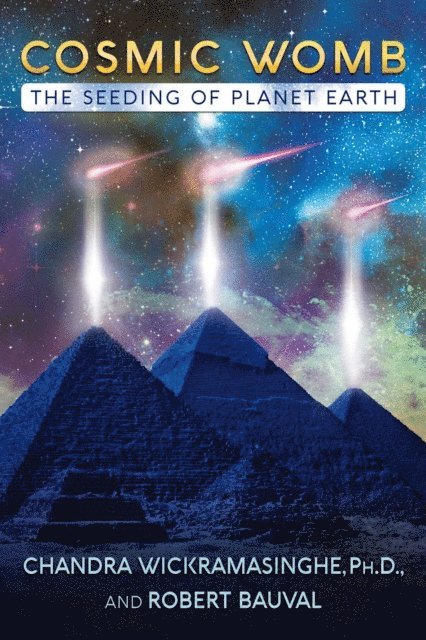
Compelling evidence that life, intelligence, and evolution on Earth were seeded by comets and cosmic intelligence • Explains how life first came from interstellar dust and comets and how later arrivals of cosmic dust and comets spurred evolution • Explores the possibility that universal knowledge may be stored in human DNA and how ancient cultures may have known a way to retrieve this knowledge • Reveals new discoveries about the dimensions of the Great Pyramid of Giza All ancient cultures link humanity’s origins to the heavens. The Egyptians, for example, were adamant that their ancestors came from the stars of Orion and Sirius. Today, however, religion and science assert that life arose spontaneously here on Earth. Did the ancients know our true cosmic origins? Have they left us clues? Expanding on the panspermia theory developed with the celebrated astronomer Sir Fred Hoyle--namely that the building blocks of life were imported to Earth by comets in the distant past--Chandra Wickramasinghe and Robert Bauval explore the latest findings in support of a cosmic origin for humanity. They detail the astrobiological discoveries of organic molecules deep in space, how microbes are incredibly resistant to the harshest conditions of space--enabling the transfer of genes from one star system to another, and the recent recovery of microorganisms from comets still in space. They argue that the universe was “born” and preset with the blueprint of life and that the cosmos must be teeming with lifeforms far older and perhaps far more developed than us. They show how life arrived on our planet in the form of interstellar dust containing alien bacteria approximately 3.8 billion years ago and how later comets, meteoroids, and asteroids brought new bacterial and viral genetic material, which was vital for evolution. Using the latest advances in physics, cosmology, and neuroscience, the authors explore how universal knowledge may be stored in human DNA and cells, and they postulate that ancient cultures, such as the pyramid builders of Egypt and the temple builders of India, may have known a way to retrieve this knowledge. Sharing new discoveries from experienced architects, engineers, and mathematicians, they show how the Great Pyramid is a three-dimensional mathematical equation in stone, bearing a potent message for humanity across time and space about who we are and where we come from.
E-bok
Engelska, 201985 kr
Läs direkt efter köp
An exploration of how acceptance of panspermia will soon change history • Offers extensive scientific proof of panspermia--that life arose on Earth via comets and that evolution is seeded by viruses arriving via comets and interstellar dust • Explores the major philosophical, psychological, cultural, religious, and environmental ramifications of the acceptance of this new scientific worldview Mainstream consensus is that life arose on Earth spontaneously out of “primordial soup.” Yet this theory, as well as the Darwinian “survival of the fittest” concept as it relates to major steps in evolution, has no scientific basis or proof. Where, then, did life come from? As the authors show, with conclusive scientific evidence, life came from space--a concept known as “panspermia.” We humans, and all other life on Earth, evolved over millennia in response to viruses that arrived via comets, and we continue to do so. Exploring the philosophical, psychological, cultural, and environmental ramifications of the acceptance of panspermia, the authors show how the shift will be on par with the Copernican Revolution--when it was finally accepted that the Earth was not the center of the Universe. Explaining the origins of the panspermia theory in the work of the late Sir Fred Hoyle, the authors reveal the vast body of evidence that has accumulated over the past 4 decades in favor of the cosmic origins of life, including viral inserts found in DNA that have shaped our human genome over millions of years. They show how the tiniest of viruses, microscopic animals (tardigrades), and even seeds have been found to be natural cosmonauts. The authors also show how space-borne viruses play a crucial role in the positive evolution of life and that our entire existence on this planet is contingent on the continuing ingress of cosmic viruses. Revealing how panspermia offers answers to some of humanity’s longstanding questions about the origins of life, the authors discuss the impact this shift in understanding will have on our relationship with the Earth and on culture, history, and religion. And perhaps the most dramatic ramification of all is that acceptance of panspermia means acceptance that Earth is not unique--that other life-filled planets exist and intelligent life is common in the Universe. Not only did we come from space, but we are not alone.
Ljudbok
Engelska, 2020241 kr
Lyssna direkt efter köp
An exploration of how acceptance of panspermia will soon change history • Offers extensive scientific proof of panspermia--that life arose on Earth via comets and that evolution is seeded by viruses arriving via comets and interstellar dust • Explores the major philosophical, psychological, cultural, religious, and environmental ramifications of the acceptance of this new scientific worldview Mainstream consensus is that life arose on Earth spontaneously out of “primordial soup.” Yet this theory, as well as the Darwinian “survival of the fittest” concept as it relates to major steps in evolution, has no scientific basis or proof. Where, then, did life come from? As the authors show, with conclusive scientific evidence, life came from space--a concept known as “panspermia.” We humans, and all other life on Earth, evolved over millennia in response to viruses that arrived via comets, and we continue to do so. Exploring the philosophical, psychological, cultural, and environmental ramifications of the acceptance of panspermia, the authors show how the shift will be on par with the Copernican Revolution--when it was finally accepted that the Earth was not the center of the Universe. Explaining the origins of the panspermia theory in the work of the late Sir Fred Hoyle, the authors reveal the vast body of evidence that has accumulated over the past 4 decades in favor of the cosmic origins of life, including viral inserts found in DNA that have shaped our human genome over millions of years. They show how the tiniest of viruses, microscopic animals (tardigrades), and even seeds have been found to be natural cosmonauts. The authors also show how space-borne viruses play a crucial role in the positive evolution of life and that our entire existence on this planet is contingent on the continuing ingress of cosmic viruses. Revealing how panspermia offers answers to some of humanity’s longstanding questions about the origins of life, the authors discuss the impact this shift in understanding will have on our relationship with the Earth and on culture, history, and religion. And perhaps the most dramatic ramification of all is that acceptance of panspermia means acceptance that Earth is not unique--that other life-filled planets exist and intelligent life is common in the Universe. Not only did we come from space, but we are not alone.