Rachel M. Gisselquist - Böcker
Visar alla böcker från författaren Rachel M. Gisselquist. Handla med fri frakt och snabb leverans.
10 produkter
10 produkter
1 180 kr
Skickas inom 5-8 vardagar
This is an open access title available under the terms of a CC BY-NC-SA 3.0 IGO licence. It is free to read at Oxford Academic and is offered as a free PDF download from OUP and selected open access locations.We expect the state to matter in times of crisis, for more 'capable' or 'stronger' states to better provide for and protect their populations. But how is it, precisely, that the quality of the state matters? This volume speaks to this question through comparative study of how diverse states in the Global South responded to the COVID-19 pandemic, the largest global crisis in recent memory. Bringing together insights from quantitative cross-country analysis and detailed country case studies, How States Respond to Crisis analyses the ways in which the quality of the state - in terms of its capacity, authority, and legitimacy - affected pandemic governance and health outcomes. Overall, while the significance of state capacity to deliver public services in effective pandemic response is clear, so too is striking variation among states lacking 'strong' capacity. State legitimacy and authority shed light on this variation, linked in particular to the degree to which governments' responses were evidence-based versus politically driven, and the tenor of citizen compliance with and government enforcement of public health regulations. Seven case study chapters authored by leading scholars of each country provide deep and specific insight into these relationships in Bolivia, Ghana, Nicaragua, Peru, the Philippines, Tanzania, and Vietnam. Extending beyond a literature on the state based heavily on study of Global North contexts, this volume sheds new light on the nature of the state and its role in crisis response and development.
1 180 kr
Skickas inom 5-8 vardagar
This is an open access title available under the terms of a CC BY-NC-SA 3.0 IGO licence. It is free to read at Oxford Scholarship Online and offered as a free PDF download from OUP and selected open access locationsInternational development cooperation plays a key role in promoting social, economic, and political progress and wellbeing in developing countries. Yet, it has long been clear that the effectiveness of aid is most challenging in countries with weak institutions. It is estimated that by 2030 around a fifth of the world's poorest people will live in fragile and conflict-affected countries. Despite increased attention, much more needs to be done to maximize the effectiveness of aid in these highly complex situations. This book offers fresh, in-depth understandings of the effectiveness of development cooperation in fragile contexts, and where challenges regarding the effectiveness of development cooperation are most pronounced. The empirical chapters combine quantitative macro analysis of cross-country data with detailed country case studies to take stock of past research on the topic, investigate the impact of foreign aid in fragile state contexts, and explore whether and how aid delivered in accordance with the principles of effective development cooperation works in these settings. Cross-national studies provide a broader picture of the topic, while country case studies allow us to identify specific ways in which development cooperation operates. More reflective chapters discuss the feasibility of the effectiveness agenda and provide important insights on how the effectiveness principles could be improved and better put into practice.The collection offers important original contributions to a large body of policy-relevant scholarship on the aid-development nexus, as well as to rapidly evolving research and policy debates on building strong and inclusive state institutions.
644 kr
Skickas inom 10-15 vardagar
Development assistance to fragile states and conflict-affected areas can be a core component of peacebuilding, providing support for the restoration of government functions, delivery of basic services, the rule of law, and economic revitalization. What has worked, why it has worked, and what is scalable and transferable, are key questions for both development practice and research into how peace is built and the interactive role of domestic and international processes therein. Despite a wealth of research into these questions, significant gaps remain. This volume speaks to these gaps through new analysis of a selected set of well-regarded aid interventions. Drawing on diverse scholarly and policy expertise, eight case study chapters span multiple domains and regions to analyse Afghanistan’s National Solidarity Programme, the Yemen Social Fund for Development, public financial management reform in Sierra Leone, Finn Church Aid’s assistance in Somalia, Liberia’s gender-sensitive police reform, the judicial facilitators programme in Nicaragua, UNICEF’s education projects in Somalia, and World Bank health projects in Timor-Leste. Analysis illustrates the significance of three broad factors in understanding why some aid interventions work better than others: the area of intervention and related degree of engagement with state institutions; local contextual factors such as windows of opportunity and the degree of local support; and programme design and management. This book was originally published as a special issue of the journal International Peacekeeping. The Open Access version of this book, available at https://www.taylorfrancis.com/books/e/9781351624572, has been made available under a Creative Commons Attribution-Non Commercial-No Derivatives 4.0 license.
644 kr
Skickas inom 10-15 vardagar
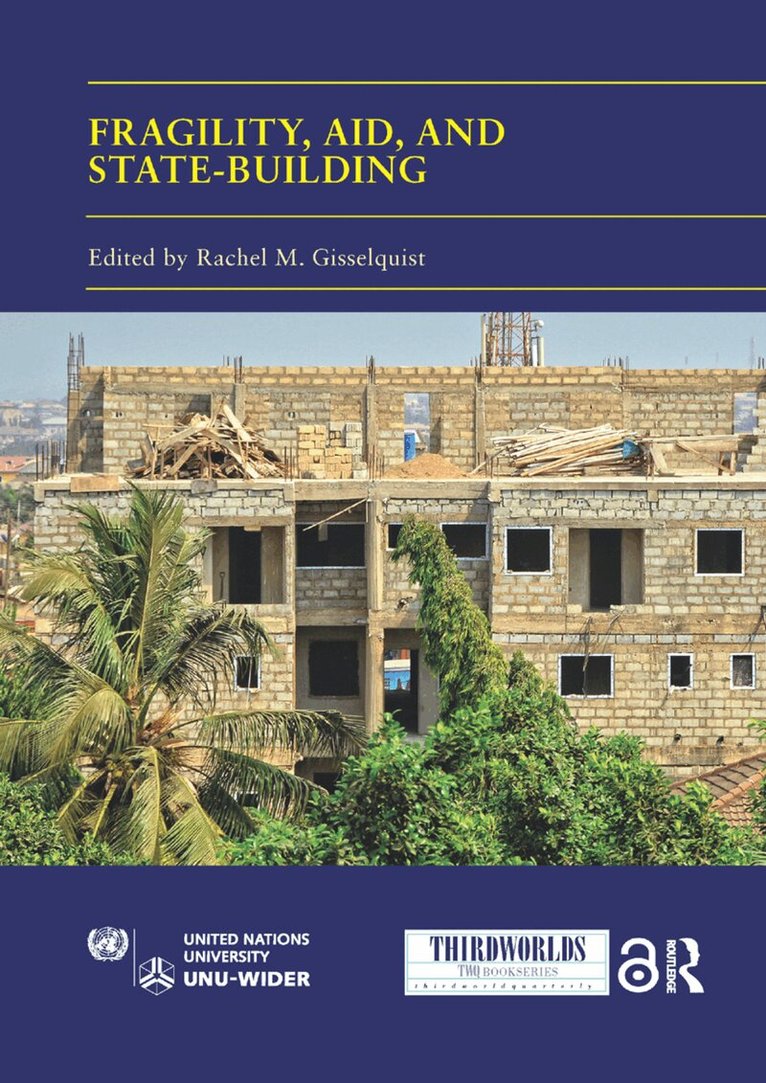
Fragile states pose major development and security challenges. Considerable international resources are therefore devoted to state-building and institutional strengthening in fragile states, with generally mixed results. This volume explores how unpacking the concept of fragility and studying its dimensions and forms can help to build policy-relevant understandings of how states become more resilient and the role of aid therein. It highlights the particular challenges for donors in dealing with ‘chronically’ (as opposed to ‘temporarily’) fragile states and those with weak legitimacy, as well as how unpacking fragility can provide traction on how to take ‘local context’ into account. Three chapters present new analysis from innovative initiatives to study fragility and fragile state transitions in cross-national perspective. Four chapters offer new focused analysis of selected countries, drawing on comparative methods and spotlighting the role of aid versus historical, institutional and other factors. It has become a truism that one-size-fits-all policies do not work in development, whether in fragile or non-fragile states. This is should not be confused with a broader rejection of ‘off-the-rack’ policy models that can then be further adjusted in particular situations. Systematic thinking about varieties of fragility helps us to develop this range, drawing lessons – appropriately – from past experience. This book was originally published as a special issue of Third World Quarterly, and is available online as an Open Access monograph at https://www.taylorfrancis.com/books/e/9781351630337.
Subnational State and Crisis Response
Understanding Pandemic Governance across India
Inbunden, Engelska, 2026
2 258 kr
Kommande
How did India’s states confront the challenge of COVID‑19? And what insights does this experience offer for future crisis response?This book explores the varied impacts of the pandemic and the policy responses undertaken across India’s states and union territories, bringing together nationwide quantitative analysis with five in‑depth case studies of Bihar, Kerala, Maharashtra, Uttar Pradesh, and West Bengal. Moving beyond the numbers, the case studies examine how differences in state capacity, legitimacy, and authority shaped policy responses and pandemic outcomes. Focusing on the first two waves of the pandemic, the volume shows how this early period provides a valuable snapshot of state functioning under crisis conditions—marked by profound uncertainty and limited information.This volume offers new insight into one of the most consequential global crises of our time. It is important reading for students and scholars of public policy, political science, economics, and South Asian studies. It will also engage policymakers, journalists, and anyone seeking a deeper understanding the factors that influence how states respond when it matters most.
2 088 kr
Skickas inom 10-15 vardagar
Fragile states pose major development and security challenges. Considerable international resources are therefore devoted to state-building and institutional strengthening in fragile states, with generally mixed results. This volume explores how unpacking the concept of fragility and studying its dimensions and forms can help to build policy-relevant understandings of how states become more resilient and the role of aid therein. It highlights the particular challenges for donors in dealing with ‘chronically’ (as opposed to ‘temporarily’) fragile states and those with weak legitimacy, as well as how unpacking fragility can provide traction on how to take ‘local context’ into account. Three chapters present new analysis from innovative initiatives to study fragility and fragile state transitions in cross-national perspective. Four chapters offer new focused analysis of selected countries, drawing on comparative methods and spotlighting the role of aid versus historical, institutional and other factors. It has become a truism that one-size-fits-all policies do not work in development, whether in fragile or non-fragile states. This is should not be confused with a broader rejection of ‘off-the-rack’ policy models that can then be further adjusted in particular situations. Systematic thinking about varieties of fragility helps us to develop this range, drawing lessons – appropriately – from past experience. This book was originally published as a special issue of Third World Quarterly, and is available online as an Open Access monograph at https://www.taylorfrancis.com/books/e/9781351630337.
2 155 kr
Skickas inom 10-15 vardagar
Development assistance to fragile states and conflict-affected areas can be a core component of peacebuilding, providing support for the restoration of government functions, delivery of basic services, the rule of law, and economic revitalization. What has worked, why it has worked, and what is scalable and transferable, are key questions for both development practice and research into how peace is built and the interactive role of domestic and international processes therein. Despite a wealth of research into these questions, significant gaps remain. This volume speaks to these gaps through new analysis of a selected set of well-regarded aid interventions. Drawing on diverse scholarly and policy expertise, eight case study chapters span multiple domains and regions to analyse Afghanistan’s National Solidarity Programme, the Yemen Social Fund for Development, public financial management reform in Sierra Leone, Finn Church Aid’s assistance in Somalia, Liberia’s gender-sensitive police reform, the judicial facilitators programme in Nicaragua, UNICEF’s education projects in Somalia, and World Bank health projects in Timor-Leste. Analysis illustrates the significance of three broad factors in understanding why some aid interventions work better than others: the area of intervention and related degree of engagement with state institutions; local contextual factors such as windows of opportunity and the degree of local support; and programme design and management. This book was originally published as a special issue of the journal International Peacekeeping. The Open Access version of this book, available at https://www.taylorfrancis.com/books/e/9781351624572, has been made available under a Creative Commons Attribution-Non Commercial-No Derivatives 4.0 license.
278 kr
Kommande
This open access book offers a balanced, readable introduction to key topics around inequality across the globe.Inequality matters—and yet, despite an explosion of research and debate, it remains one of the most contested issues of our time. Is it rising or falling? Why do expert analyses often clash? And how can non-specialists make sense of the evidence? Too often, discussions focus narrowly on wealthy Western countries, overlooking also urgent realities in Africa, Asia, and Latin America.This book tackles those gaps, combining expert synthesis of the scholarly literature with new findings from @EQUAL, a major research consortium project spanning institutions in the Global North and South. Through vivid examples—particularly from Colombia, Ethiopia, Mozambique, South Africa, and Vietnam—it examines how inequality is measured, understood, and acted upon across diverse contexts.Rejecting one-size-fits-all solutions, it advocates nuanced, practical, and transformative approaches rooted in context, values, and evidence. Making complex research accessible, this open-access book equips readers with essential knowledge and tools to confront inequality worldwide.The ebook editions of this book are available open access under a CC BY-NC-ND 4.0 licence on bloomsburycollections.com. Open access was funded by the Novo Nordisk Foundation.
Dimensions of Inequality
Impacts on Growth, Governance, and Human Development
Inbunden, Engelska, 2026
888 kr
Kommande
This open access book offers a balanced, readable introduction to key topics around inequality across the globe.Inequality matters—and yet, despite an explosion of research and debate, it remains one of the most contested issues of our time. Is it rising or falling? Why do expert analyses often clash? And how can non-specialists make sense of the evidence? Too often, discussions focus narrowly on wealthy Western countries, overlooking also urgent realities in Africa, Asia, and Latin America.This book tackles those gaps, combining expert synthesis of the scholarly literature with new findings from @EQUAL, a major research consortium project spanning institutions in the Global North and South. Through vivid examples—particularly from Colombia, Ethiopia, Mozambique, South Africa, and Vietnam—it examines how inequality is measured, understood, and acted upon across diverse contexts.Rejecting one-size-fits-all solutions, it advocates nuanced, practical, and transformative approaches rooted in context, values, and evidence. Making complex research accessible, this open-access book equips readers with essential knowledge and tools to confront inequality worldwide.The ebook editions of this book are available open access under a CC BY-NC-ND 4.0 licence on bloomsburycollections.com. Open access was funded by the Novo Nordisk Foundation.
Del 656 - Annals of the American Academy of Political and Social Scien
Aid and Institution-Building in Fragile States
Findings from Comparative Cases
Inbunden, Engelska, 2014
518 kr
Skickas inom 5-8 vardagar