Ramzi Suleiman – författare
Visar alla böcker från författaren Ramzi Suleiman. Handla med fri frakt och snabb leverans.
5 produkter
5 produkter
Häftad, Engelska, 2011
530 kr
Skickas inom 7-10 vardagar
A social dilemma is a situation in which the interests of the collective and its individual members clash. In these situations individuals typically are tempted to take actions that favor (sometimes even maximize) their short-term egocentric interests. However if all group members adopt such behaviors, the group suffers since all its members are worse off than they could be by endorsing alternative pro-social actions that favor (sometimes even maximize) the collective interest. This book provides an overview and summary of the state of social psychological research on social dilemmas. It is organized around four core issues: individual differences which determine people's preferences for outcomes that promote either their own or their group's well-being; the study of dynamic processes based on simulations of artificial societies; social dilemmas that emerge in inter-group conflicts; and the effect of various types and sources of uncertainty on behavior in social dilemma situations.
Inbunden, Engelska, 2004
915 kr
Skickas inom 7-10 vardagar
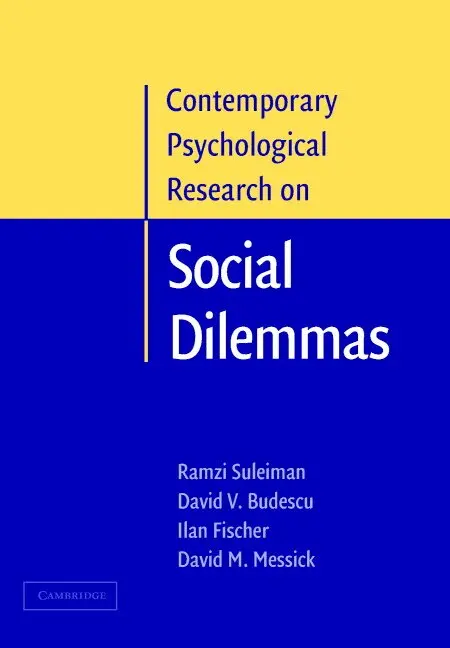
A social dilemma is a situation in which the interests of the collective and its individual members clash. In these situations individuals typically are tempted to take actions that favor (sometimes even maximize) their short-term egocentric interests. However if all group members adopt such behaviors, the group suffers since all its members are worse off than they could be by endorsing alternative pro-social actions that favor (sometimes even maximize) the collective interest. This book provides an overview and summary of the state of social psychological research on social dilemmas. It is organized around four core issues: individual differences which determine people's preferences for outcomes that promote either their own or their group's well-being; the study of dynamic processes based on simulations of artificial societies; social dilemmas that emerge in inter-group conflicts; and the effect of various types and sources of uncertainty on behavior in social dilemma situations.
E-bok
PDF, Engelska, 20192 977 kr
Läs direkt efter köp
“Relativizing Newton” is a first step towards a simple and beautiful theory of everything. The theory, termed “Information Relativity” (IR) takes a novel approach to physics that overlooks all post-Newtonian physics. It stands on the shoulders of Newtonian dynamics, but modifies it by accounting for the time-travel of information from one reference-frame to another, a fact which somehow was ignored by Galileo Galilee and Isaac Newton, and which remained ill-treated by all post-Newtonian theories, including Einstein’s relativity and quantum theories. Except for the aforementioned correction of classical physics, IR has no axiomatic presumptions, nor arbitrary free parameters. Astonishingly, accounting for the aforementioned delays in information results in a set of simple and beautiful transformations, which explain and predict a great deal of physical phenomena. Most importantly, IR’s transformations reveal the mysteries of dark matter, dark energy, and gravity. They also provide a unifying platform for the physics of the too-big (astrophysics and cosmology), and the too-small (small particles dynamics and quantum mechanics). The phenomena explained and predicted successfully by IR include the “time-dilation” of decaying muons, the neutrino velocities measured by OPERA and other collaborations, particle diffraction in the double-slit experiment, Sagnac Effects, the quantization of orbits in Bohr’s hydrogen atom, entanglement, quantum criticality, confinement, asymptotic freedom, solar light bending, gravitational redshift, the Pioneer anomaly, dark matter in galaxies, and the Schwarzschild’s black hole.
E-bok
PDF, Engelska, 20121 416 kr
Läs direkt efter köp
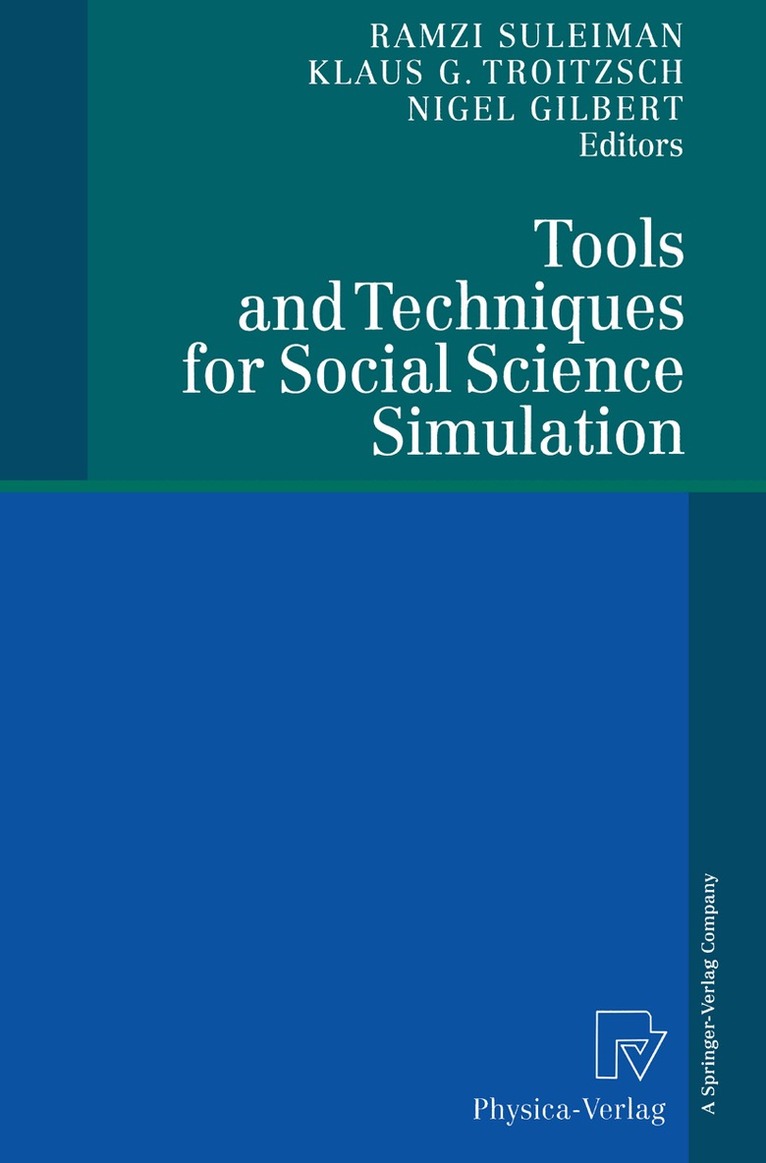
The use of computer simulations to study social phenomena has grown rapidly during the last few years. Many social scientists from the fields of economics, sociology, psychology and other disciplines now use computer simulations to study a wide range of social phenomena. The availability of powerful personal computers, the development of multidisciplinary approaches and the use of artificial intelligence models have all contributed to this development. The benefits of using computer simulations in the social sciences are obvious. This holds true for the use of simulations as tools for theory building and for its implementation as a tool for sensitivity analysis and parameter optimization in application-oriented models. In both, simulation provides powerful tools for the study of complex social systems, especially for dynamic and multi-agent social systems in which mathematical tractability is often impossible. The graphical display of simulation output renders it user friendly to many social scientists that lack sufficient familiarity with the language of mathematics. The present volume aims to contribute in four directions: (1) To examine theoretical and methodological issues related to the application of simulations in the social sciences. By this we wish to promote the objective of designing a unified, user-friendly, simulation toolkit which could be applied to diverse social problems. While no claim is made that this objective has been met, the theoretical issues treated in Part 1 of this volume are a contribution towards this objective.
Häftad, Engelska, 2000
1 091 kr
Skickas inom 10-15 vardagar
The use of computer simulations to study social phenomena has grown rapidly during the last few years. Many social scientists from the fields of economics, sociology, psychology and other disciplines now use computer simulations to study a wide range of social phenomena. The availability of powerful personal computers, the development of multidisciplinary approaches and the use of artificial intelligence models have all contributed to this development. The benefits of using computer simulations in the social sciences are obvious. This holds true for the use of simulations as tools for theory building and for its implementation as a tool for sensitivity analysis and parameter optimization in application-oriented models. In both, simulation provides powerful tools for the study of complex social systems, especially for dynamic and multi-agent social systems in which mathematical tractability is often impossible. The graphical display of simulation output renders it user friendly to many social scientists that lack sufficient familiarity with the language of mathematics. The present volume aims to contribute in four directions: (1) To examine theoretical and methodological issues related to the application of simulations in the social sciences. By this we wish to promote the objective of designing a unified, user-friendly, simulation toolkit which could be applied to diverse social problems. While no claim is made that this objective has been met, the theoretical issues treated in Part 1 of this volume are a contribution towards this objective.