Ranjan Datta – författare
2 008 kr
Skickas inom 10-15 vardagar
638 kr
Skickas inom 10-15 vardagar
587 kr
Skickas inom 10-15 vardagar
730 kr
Läs direkt efter köp
Indigenous sustainability and environmental management cannot be understood apart from a community, its traditions, and ways of practices. Interest in Indigenous environmental sustainability has grown steadily in past years, reflecting traditional cultural perspectives about the environment and developing research priorities.
This book explores the ways one Indigenous community, in the Chittagong Hill Tracts in Bangladesh, has reinvented the meanings of sustainability using traditional knowledge to blend traditional sentiment with large-scale dislocations within their own communities and international economy. This book includes up-to-date research on meanings and implications of Bangladeshi Indigenous sustainability which focus on relationality, traditional knowledge, spirituality and hybridity. Environmental protection and Indigenous land-water rights have been ignored in the region and there has been minimal research on these intersecting issues locally or internationally. Land-Water Management and Sustainability in Bangladesh addresses this gap in an examination of postcolonial Indigenous communities’ complex and shifting relationships to nature and in relation to discrimination and oppression regarding Indigenous land and rights. The book makes a contribution to both the research literature and on the ground practice in inspiring a new culture of sustainability in Indigenous regions.
Bringing together community engagement, activism, critical research and scholarship to advocate for socio-environmental justice and trans-systematic sustainability of cross-cultural knowledge, the book will be of interest to academics of a variety of disciplines, including environmental policy, conservation practices, Indigenous studies environmental sustainability, anthropology, American studies, Asian Studies and ethnic studies.
730 kr
Läs direkt efter köp
Indigenous sustainability and environmental management cannot be understood apart from a community, its traditions, and ways of practices. Interest in Indigenous environmental sustainability has grown steadily in past years, reflecting traditional cultural perspectives about the environment and developing research priorities.
This book explores the ways one Indigenous community, in the Chittagong Hill Tracts in Bangladesh, has reinvented the meanings of sustainability using traditional knowledge to blend traditional sentiment with large-scale dislocations within their own communities and international economy. This book includes up-to-date research on meanings and implications of Bangladeshi Indigenous sustainability which focus on relationality, traditional knowledge, spirituality and hybridity. Environmental protection and Indigenous land-water rights have been ignored in the region and there has been minimal research on these intersecting issues locally or internationally. Land-Water Management and Sustainability in Bangladesh addresses this gap in an examination of postcolonial Indigenous communities’ complex and shifting relationships to nature and in relation to discrimination and oppression regarding Indigenous land and rights. The book makes a contribution to both the research literature and on the ground practice in inspiring a new culture of sustainability in Indigenous regions.
Bringing together community engagement, activism, critical research and scholarship to advocate for socio-environmental justice and trans-systematic sustainability of cross-cultural knowledge, the book will be of interest to academics of a variety of disciplines, including environmental policy, conservation practices, Indigenous studies environmental sustainability, anthropology, American studies, Asian Studies and ethnic studies.
356 kr
Kommande
730 kr
Läs direkt efter köp
This book addresses the ethical and practical issues at stake in the reconciliation of Indigenous and non-indigenous communities.
An increasing number of researchers, educators, and social and environmental activists are eager to find ways to effectively support ongoing attempts to recognize, integrate and promote Indigenous perspectives and communities. Taking Canada as its focus, this book offers a multidisciplinary consideration of a range of reconciliation policies, practices and initiatives that are relevant in all settler states. Set against its increasing neoliberal appropriation, the book resituates reconciliation in the everyday contexts of community interaction and engagement, as well as in the important areas of Indigenous knowledge, resource management and social and environmental justice. Reconciliation is not just the responsibility of law and government. And, attuned to the different perspectives of settlers, migrants and refugee communities, the book examines areas of opportunity, as well as obstacles to progress, in the forging of a truly decolonizing framework for reconciliation.
As the challenges of reconciliation cross numerous academic and substantial areas, this book will appeal to a range of scholars and practitioners working in law, politics, education, environmental studies, anthropology and Indigenous studies.
730 kr
Läs direkt efter köp
This book addresses the ethical and practical issues at stake in the reconciliation of Indigenous and non-indigenous communities.
An increasing number of researchers, educators, and social and environmental activists are eager to find ways to effectively support ongoing attempts to recognize, integrate and promote Indigenous perspectives and communities. Taking Canada as its focus, this book offers a multidisciplinary consideration of a range of reconciliation policies, practices and initiatives that are relevant in all settler states. Set against its increasing neoliberal appropriation, the book resituates reconciliation in the everyday contexts of community interaction and engagement, as well as in the important areas of Indigenous knowledge, resource management and social and environmental justice. Reconciliation is not just the responsibility of law and government. And, attuned to the different perspectives of settlers, migrants and refugee communities, the book examines areas of opportunity, as well as obstacles to progress, in the forging of a truly decolonizing framework for reconciliation.
As the challenges of reconciliation cross numerous academic and substantial areas, this book will appeal to a range of scholars and practitioners working in law, politics, education, environmental studies, anthropology and Indigenous studies.
682 kr
Läs direkt efter köp
This book examines how current energy and water management processes affect Indigenous communities in North America, with a specific focus on Canada.
Currently, there is no known Indigenous community-led strategic environmental assessment (ICSEA) tool for developing community-led solutions for pipeline leak management and energy resiliency. To fill this lacuna, this book draws on expertise from Indigenous Elders, Knowledge-keepers, and leaders representing communities who are highly affected by pipeline leaks. These accounts highlight the importance of providing Indigenous communities with technical information and advice, allowing them to practise community-led disaster management, and giving them direct access to lawyers and decision-makers. If implemented into current policy and practice, these tools would succeed in helping rural Indigenous communities make strategic choices for sustainable energy management and utilize their lands, traditional territories, and natural resources to develop a robust, sustainable energy future.
Prioritizing Indigenous perspectives on energy management and governance, this book will be of great interest to students, scholars, and practitioners working in the fields of energy policy and justice, environmental sociology, and Indigenous studies.
688 kr
Läs direkt efter köp
This book examines how current energy and water management processes affect Indigenous communities in North America, with a specific focus on Canada.
Currently, there is no known Indigenous community-led strategic environmental assessment (ICSEA) tool for developing community-led solutions for pipeline leak management and energy resiliency. To fill this lacuna, this book draws on expertise from Indigenous Elders, Knowledge-keepers, and leaders representing communities who are highly affected by pipeline leaks. These accounts highlight the importance of providing Indigenous communities with technical information and advice, allowing them to practise community-led disaster management, and giving them direct access to lawyers and decision-makers. If implemented into current policy and practice, these tools would succeed in helping rural Indigenous communities make strategic choices for sustainable energy management and utilize their lands, traditional territories, and natural resources to develop a robust, sustainable energy future.
Prioritizing Indigenous perspectives on energy management and governance, this book will be of great interest to students, scholars, and practitioners working in the fields of energy policy and justice, environmental sociology, and Indigenous studies.
746 kr
Läs direkt efter köp
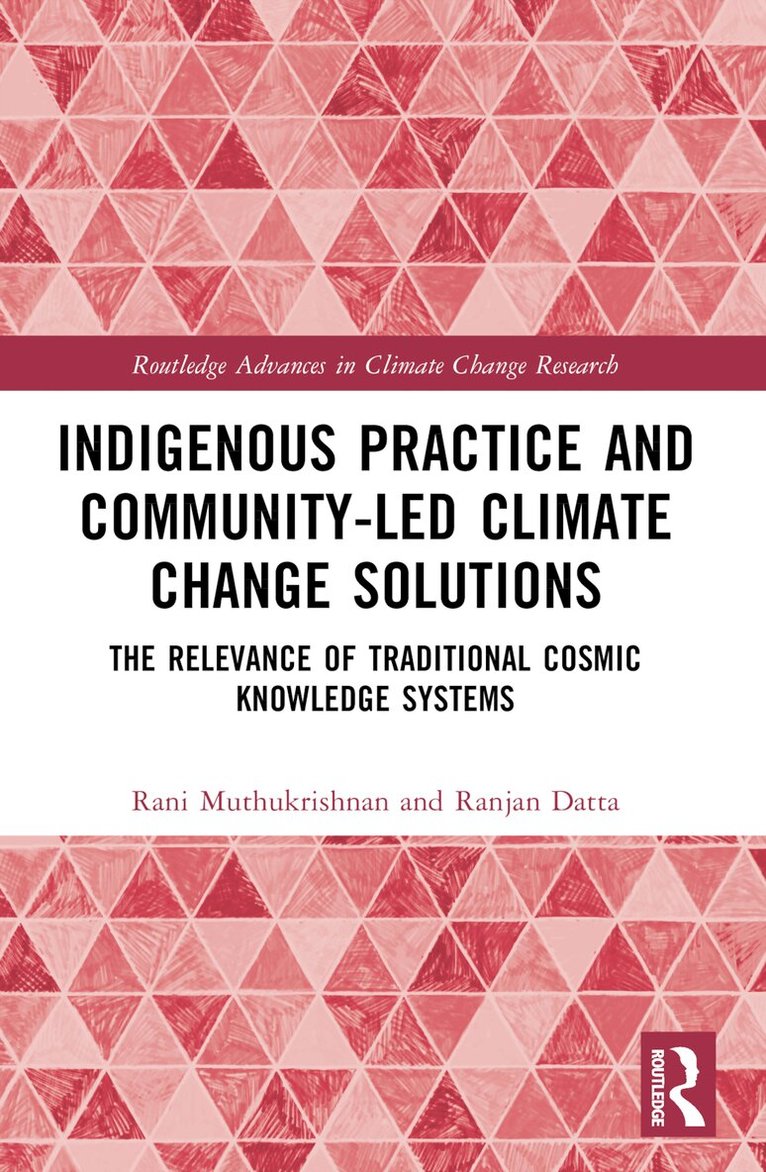
This book centers Indigenous knowledge and practice in community-led climate change solutions.
This book will be one of the first academic books to use the consciousness framework to examine and explain humans'' situatedness and role in maintaining ecosystems'' health. Drawing on teachings from the Indigenous Adi-Shaiva community, the authors present up-to-date research on meanings and implications of South Asian traditional cosmic knowledge, which focuses on relationality and spirituality connected to climate change. This knowledge can create innovative climate change solutions in areas including land, water, traditional management, sustainability goals and expectations, and state development projects. Overall, this book provides an innovative framework for nonviolent climate solutions, which has its foundations in a traditional cosmic and consciousness-based context.
This book, which aims to bridge the gap between Indigenous and Western perspectives by re-educating researchers and decolonizing popular climate change solutions, will be of great interest to students and scholars studying climate change, conservation, environmental anthropology, and Indigenous studies on a broader scale.
746 kr
Läs direkt efter köp
This book centers Indigenous knowledge and practice in community-led climate change solutions.
This book will be one of the first academic books to use the consciousness framework to examine and explain humans'' situatedness and role in maintaining ecosystems'' health. Drawing on teachings from the Indigenous Adi-Shaiva community, the authors present up-to-date research on meanings and implications of South Asian traditional cosmic knowledge, which focuses on relationality and spirituality connected to climate change. This knowledge can create innovative climate change solutions in areas including land, water, traditional management, sustainability goals and expectations, and state development projects. Overall, this book provides an innovative framework for nonviolent climate solutions, which has its foundations in a traditional cosmic and consciousness-based context.
This book, which aims to bridge the gap between Indigenous and Western perspectives by re-educating researchers and decolonizing popular climate change solutions, will be of great interest to students and scholars studying climate change, conservation, environmental anthropology, and Indigenous studies on a broader scale.
1 902 kr
Skickas inom 10-15 vardagar
596 kr
Skickas inom 10-15 vardagar
2 182 kr
Skickas inom 10-15 vardagar
652 kr
Skickas inom 10-15 vardagar
2 320 kr
Skickas inom 10-15 vardagar
652 kr
Skickas inom 10-15 vardagar
2 182 kr
Skickas inom 10-15 vardagar
665 kr
Kommande
746 kr
Läs direkt efter köp
This edited volume explores the crucial intersections between Indigenous Land-Based Knowledge (ILK), sustainability, settler colonialism, and the ongoing environmental crisis.
Contributors from cross-cultural communities, including Indigenous, settlers, immigrants, and refugee communities, discuss why ILK and practice hold great potential for tackling our current environmental crises, particularly addressing the settler colonialism that contributes towards the environmental challenges faced in the world. The authors offer insights into sustainable practices, biodiversity conservation, climate change adaptation, and sustainable land management and centre Indigenous perspectives on ILK as a space to practise, preserve, and promote Indigenous cultures. With case studies spanning topics as diverse as land acknowledgements, land-based learning, Indigenous-led water governance, and birth evacuation, this book shows how our responsibility for ILK can benefit collectively by fostering a more inclusive, sustainable, and interconnected world. Through the promotion of Indigenous perspectives and responsibility towards land and community, this volume advocates for a shift in paradigm towards more inclusive and sustainable approaches to environmental sustainability.
This volume will be of great interest to students and scholars of environmental sociology, postcolonial studies, and Indigenous studies.
753 kr
Läs direkt efter köp
This edited volume explores the crucial intersections between Indigenous Land-Based Knowledge (ILK), sustainability, settler colonialism, and the ongoing environmental crisis.
Contributors from cross-cultural communities, including Indigenous, settlers, immigrants, and refugee communities, discuss why ILK and practice hold great potential for tackling our current environmental crises, particularly addressing the settler colonialism that contributes towards the environmental challenges faced in the world. The authors offer insights into sustainable practices, biodiversity conservation, climate change adaptation, and sustainable land management and centre Indigenous perspectives on ILK as a space to practise, preserve, and promote Indigenous cultures. With case studies spanning topics as diverse as land acknowledgements, land-based learning, Indigenous-led water governance, and birth evacuation, this book shows how our responsibility for ILK can benefit collectively by fostering a more inclusive, sustainable, and interconnected world. Through the promotion of Indigenous perspectives and responsibility towards land and community, this volume advocates for a shift in paradigm towards more inclusive and sustainable approaches to environmental sustainability.
This volume will be of great interest to students and scholars of environmental sociology, postcolonial studies, and Indigenous studies.
746 kr
Läs direkt efter köp
This book offers a critical exploration into Indigenous knowledge systems, particularly focusing on Indigenous land-based knowledge and practice in reshaping disaster adaptations.
Drawing from Indigenous communities in Bangladesh, this book challenges transformational approaches to disaster resilience by centering on land-based perspectives intrinsic to Indigenous cultures. The book showcases how Indigenous and land-based minority communities in Bangladesh have historically coped with and adapted to environmental challenges. It navigates beyond the Eurocentric paradigm, acknowledging the richness of traditional Indigenous land-based knowledge and practice embedded in the relationship between Indigenous peoples, land-based minority communities, and their natural environments. The book focuses on the interconnectedness of Indigenous land-based knowledge, culture, and sustainable practices, providing a blueprint for rethinking contemporary disaster adaptation strategies. By relearning from Indigenous land-based perspectives, readers gain invaluable insights into holistic, community-based approaches prioritizing harmony with nature over technological fixes. Through Indigenist, decolonial, relational, and feminist theoretical research frameworks, the book advocates for a paradigm shift in disaster management, emphasizing the importance of respecting and integrating Indigenous land-based solutions.
Rethinking and Relearning Disaster Adaptations from and within Indigenous Land-Based Perspectives emerges as a crucial resource for scholars, policymakers, and practitioners seeking to foster resilience through a more inclusive and culturally sensitive lens.
746 kr
Läs direkt efter köp
This book offers a critical exploration into Indigenous knowledge systems, particularly focusing on Indigenous land-based knowledge and practice in reshaping disaster adaptations.
Drawing from Indigenous communities in Bangladesh, this book challenges transformational approaches to disaster resilience by centering on land-based perspectives intrinsic to Indigenous cultures. The book showcases how Indigenous and land-based minority communities in Bangladesh have historically coped with and adapted to environmental challenges. It navigates beyond the Eurocentric paradigm, acknowledging the richness of traditional Indigenous land-based knowledge and practice embedded in the relationship between Indigenous peoples, land-based minority communities, and their natural environments. The book focuses on the interconnectedness of Indigenous land-based knowledge, culture, and sustainable practices, providing a blueprint for rethinking contemporary disaster adaptation strategies. By relearning from Indigenous land-based perspectives, readers gain invaluable insights into holistic, community-based approaches prioritizing harmony with nature over technological fixes. Through Indigenist, decolonial, relational, and feminist theoretical research frameworks, the book advocates for a paradigm shift in disaster management, emphasizing the importance of respecting and integrating Indigenous land-based solutions.
Rethinking and Relearning Disaster Adaptations from and within Indigenous Land-Based Perspectives emerges as a crucial resource for scholars, policymakers, and practitioners seeking to foster resilience through a more inclusive and culturally sensitive lens.
685 kr
Kommande
2 218 kr
Kommande
651 kr
Kommande
2 225 kr
Kommande
2 182 kr
Skickas inom 10-15 vardagar
596 kr
Skickas inom 11-20 vardagar