Reeshad S. Dalal - Böcker
Visar alla böcker från författaren Reeshad S. Dalal. Handla med fri frakt och snabb leverans.
5 produkter
5 produkter
1 899 kr
Skickas inom 10-15 vardagar
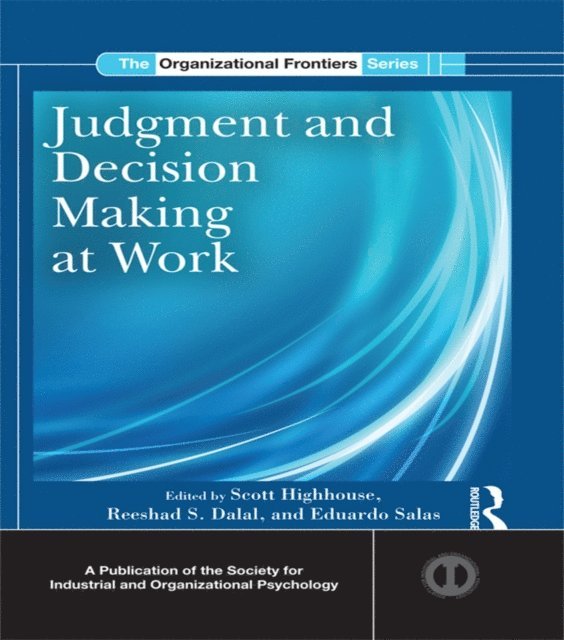
Employees are constantly making decisions and judgments that have the potential to affect themselves, their families, their work organizations, and on some occasion even the broader societies in which they live. A few examples include: deciding which job applicant to hire, setting a production goal, judging one’s level of job satisfaction, deciding to steal from the cash register, agreeing to help organize the company’s holiday party, forecasting corporate tax rates two years later, deciding to report a coworker for sexual harassment, and predicting the level of risk inherent in a new business venture. In other words, a great many topics of interest to organizational researchers ultimately reduce to decisions made by employees.Yet, numerous entreaties notwithstanding, industrial and organizational psychologists typically have not incorporated a judgment and decision-making perspective in their research. The current book begins to remedy the situation by facilitating cross-pollination between the disciplines of organizational psychology and decision-making. The book describes both laboratory and more “naturalistic” field research on judgment and decision-making, and applies it to core topics of interest to industrial and organizational psychologists: performance appraisal, employee selection, individual differences, goals, leadership, teams, and stress, among others. The book also suggests ways in which industrial and organizational psychology research can benefit the discipline of judgment and decision-making. The authors of the chapters in this book conduct research at the intersection of organizational psychology and decision-making, and consequently are uniquely positioned to bridging the divide between the two disciplines.
4 668 kr
Skickas inom 7-10 vardagar
This enlightening Handbook presents empirical and theoretical insights on counterproductive work behavior (CWB), exploring the manifold intentional behaviors of employees that oppose the legitimate interests of their organization. Leading researchers and practitioners examine diverse forms of CWB spanning harassment, theft, substance misuse, presenteeism, and absenteeism, among others.Contributing authors emphasize the continually evolving landscape of work, and outline how scholarship should reflect changes that include the development of methods of communication and the consideration of alternative displays of CWB. Through a multidisciplinary approach, they utilize various paradigms, emphasizing organizational psychology and behavior throughout but also including artificial intelligence, cybersecurity, and neuroscience. Chapters shed light on the impact of CWB and critically assess how it is measured and studied in a variety of organizational settings. The Handbook also outlines contributing factors leading to CWB, such as office culture and ineffective leadership. It also examines how to manage the fallout after severe instances of CWB have occurred, such as via restorative justice approaches. Ultimately, it provides a thorough overview of current knowledge on CWB, summarizing the latest scholarship and avenues for future research.This Handbook is a vital resource for scholars and students of organizational psychology and behavior as well as sociology, social psychology, economics, and criminology. Practitioners and policymakers in human resource management will also benefit from its practical applications for prevention and intervention strategies.
784 kr
Skickas inom 10-15 vardagar
Employees are constantly making decisions and judgments that have the potential to affect themselves, their families, their work organizations, and on some occasion even the broader societies in which they live. A few examples include: deciding which job applicant to hire, setting a production goal, judging one’s level of job satisfaction, deciding to steal from the cash register, agreeing to help organize the company’s holiday party, forecasting corporate tax rates two years later, deciding to report a coworker for sexual harassment, and predicting the level of risk inherent in a new business venture. In other words, a great many topics of interest to organizational researchers ultimately reduce to decisions made by employees.Yet, numerous entreaties notwithstanding, industrial and organizational psychologists typically have not incorporated a judgment and decision-making perspective in their research. The current book begins to remedy the situation by facilitating cross-pollination between the disciplines of organizational psychology and decision-making. The book describes both laboratory and more “naturalistic” field research on judgment and decision-making, and applies it to core topics of interest to industrial and organizational psychologists: performance appraisal, employee selection, individual differences, goals, leadership, teams, and stress, among others. The book also suggests ways in which industrial and organizational psychology research can benefit the discipline of judgment and decision-making. The authors of the chapters in this book conduct research at the intersection of organizational psychology and decision-making, and consequently are uniquely positioned to bridging the divide between the two disciplines.
2 682 kr
Skickas inom 10-15 vardagar
This new volume, edited by industrial and organizational psychologists, will look at the important topic of cyber security work in the US and around the world. With contributions from experts in the fields of industrial and organizational psychology, human factors, computer science, economics, and applied anthropology, the book takes the position that employees in cyber security professions must maintain attention over long periods of time, must make decisions with imperfect information with the potential to exceed their cognitive capacity, may often need to contend with stress and fatigue, and must frequently interact with others in team settings and multiteam systems. Consequently, psychosocial dynamics become a critical driver of cyber security effectiveness. Chapters in the book reflect a multilevel perspective (individuals, teams, multiteam systems) and describe cognitive, affective and behavioral inputs, processes and outcomes that operate at each level. The book chapters also include contributions from both research scientists and cyber security policy-makers/professionals to promote a strong scientist-practitioner dynamic. The intent of the book editors is to inform both theory and practice regarding the psychosocial dynamics of cyber security work.
889 kr
Skickas inom 10-15 vardagar
This new volume, edited by industrial and organizational psychologists, will look at the important topic of cyber security work in the US and around the world. With contributions from experts in the fields of industrial and organizational psychology, human factors, computer science, economics, and applied anthropology, the book takes the position that employees in cyber security professions must maintain attention over long periods of time, must make decisions with imperfect information with the potential to exceed their cognitive capacity, may often need to contend with stress and fatigue, and must frequently interact with others in team settings and multiteam systems. Consequently, psychosocial dynamics become a critical driver of cyber security effectiveness. Chapters in the book reflect a multilevel perspective (individuals, teams, multiteam systems) and describe cognitive, affective and behavioral inputs, processes and outcomes that operate at each level. The book chapters also include contributions from both research scientists and cyber security policy-makers/professionals to promote a strong scientist-practitioner dynamic. The intent of the book editors is to inform both theory and practice regarding the psychosocial dynamics of cyber security work.