Richard F. Doner - Böcker
Visar alla böcker från författaren Richard F. Doner. Handla med fri frakt och snabb leverans.
9 produkter
9 produkter
1 130 kr
Skickas inom 5-8 vardagar
East Asia is a powerhouse of automobile production. Yet, across the region, national automobile industries have had strikingly different patterns of development. Despite starting from equally low levels of performance and initially similar strategies, countries have experienced vastly different results. From Thailand's success as an assembly hub for foreign automakers and China's unexpected achievements in building its own car industry, to South Korea's impressive development of an integrated industry, to the Philippines' persistent weakness, these divergent paths offer a fascinating window into the determinants of economic growth. The Political Economy of Automotive Industrialization in East Asia provides a political explanation for why development strategies and performance have been so uneven within one of the world's most important regions. Utilizing interviews and original-language research from multiple nations, this book explains that factors such as market size and neoclassical economic policies alone cannot explain these patterns of development. Richard F. Doner, Gregory W. Noble, and John Ravenhill instead highlight the significance of two sets of factors: countries' very different capabilities for implementing policies and the political forces that help to explain the emergence of effective institutions. Through cross-national analyses of China, Taiwan, South Korea, Indonesia, Malaysia, the Philippines, and Thailand, the book sets up a clear structure for understanding industrial development and how it enables or constrains the capabilities of domestic firms. Brief comparisons with Brazil, Mexico, and other developing countries confirm the utility of the analytic framework and demonstrate how it is superior both to accounts in mainstream economics and much of political science, which fail to give sufficient emphasis to the role of public and public-private institutions, or provide an explanation of the political bases of those institutions.In a world where auto assemblers and suppliers are facing new challenges in an ever-evolving industry--such as the transition to electric and autonomous vehicles--this book offers a crucial perspective on the centrality of institutional capacities and political economy. By tracing the divergent trajectories of seven nations, The Political Economy of Automotive Industrialization in East Asia offers lessons beyond the automobile industry that illustrate the broader importance of institutions to economic growth.
536 kr
Skickas inom 5-8 vardagar
East Asia is a powerhouse of automobile production. Yet, across the region, national automobile industries have had strikingly different patterns of development. Despite starting from equally low levels of performance and initially similar strategies, countries have experienced vastly different results. From Thailand's success as an assembly hub for foreign automakers and China's unexpected achievements in building its own car industry, to South Korea's impressive development of an integrated industry, to the Philippines' persistent weakness, these divergent paths offer a fascinating window into the determinants of economic growth. The Political Economy of Automotive Industrialization in East Asia provides a political explanation for why development strategies and performance have been so uneven within one of the world's most important regions. Utilizing interviews and original-language research from multiple nations, this book explains that factors such as market size and neoclassical economic policies alone cannot explain these patterns of development. Richard F. Doner, Gregory W. Noble, and John Ravenhill instead highlight the significance of two sets of factors: countries' very different capabilities for implementing policies and the political forces that help to explain the emergence of effective institutions. Through cross-national analyses of China, Taiwan, South Korea, Indonesia, Malaysia, the Philippines, and Thailand, the book sets up a clear structure for understanding industrial development and how it enables or constrains the capabilities of domestic firms. Brief comparisons with Brazil, Mexico, and other developing countries confirm the utility of the analytic framework and demonstrate how it is superior both to accounts in mainstream economics and much of political science, which fail to give sufficient emphasis to the role of public and public-private institutions, or provide an explanation of the political bases of those institutions.In a world where auto assemblers and suppliers are facing new challenges in an ever-evolving industry--such as the transition to electric and autonomous vehicles--this book offers a crucial perspective on the centrality of institutional capacities and political economy. By tracing the divergent trajectories of seven nations, The Political Economy of Automotive Industrialization in East Asia offers lessons beyond the automobile industry that illustrate the broader importance of institutions to economic growth.
Del 23 - Studies in International Political Economy
Driving a Bargain
Automobile Industrialization and Japanese Firms in Southeast Asia
Häftad, Engelska, 2022
835 kr
Skickas inom 3-6 vardagar
Driving a Bargain: Automobile Industrialization and Japanese Firms in Southeast Asia explores the dynamics between developing nations and foreign investors in the context of automobile manufacturing. Focused on Southeast Asia, the book analyzes the national efforts of the Philippines, Malaysia, Indonesia, and Thailand to establish domestic automobile industries. These countries have pursued policies aimed at reducing dependency on foreign imports and building local manufacturing capacities. By examining the interactions between ASEAN countries and largely Japanese auto firms, the study highlights the challenges and opportunities these nations face in negotiating technology transfer, market access, and industrial autonomy. The book presents a critical examination of the bargaining processes that shape these countries' industrialization strategies.Through comparative case studies, the book challenges prevailing theories of foreign investment and dependency. It critiques the structuralist approach to bargaining, arguing for a more nuanced understanding of local leverage in manufacturing industries. The study highlights the significance of local firms, the role of the state, and the political and economic conditions that determine bargaining success. By exploring the interplay between the private sector and government in ASEAN nations, Driving a Bargain offers new insights into the potential for developing countries to increase their manufacturing capacity and achieve economic growth through strategic partnerships with foreign firms. This work also contributes to the broader development literature by emphasizing the importance of public-private coalitions in fostering sustainable industrial development.This title is part of UC Press's Voices Revived program, which commemorates University of California Press’s mission to seek out and cultivate the brightest minds and give them voice, reach, and impact. Drawing on a backlist dating to 1893, Voices Revived makes high-quality, peer-reviewed scholarship accessible once again using print-on-demand technology. This title was originally published in 1991.
Del 23 - Studies in International Political Economy
Driving a Bargain
Automobile Industrialization and Japanese Firms in Southeast Asia
Inbunden, Engelska, 2022
1 513 kr
Skickas inom 3-6 vardagar
Driving a Bargain: Automobile Industrialization and Japanese Firms in Southeast Asia explores the dynamics between developing nations and foreign investors in the context of automobile manufacturing. Focused on Southeast Asia, the book analyzes the national efforts of the Philippines, Malaysia, Indonesia, and Thailand to establish domestic automobile industries. These countries have pursued policies aimed at reducing dependency on foreign imports and building local manufacturing capacities. By examining the interactions between ASEAN countries and largely Japanese auto firms, the study highlights the challenges and opportunities these nations face in negotiating technology transfer, market access, and industrial autonomy. The book presents a critical examination of the bargaining processes that shape these countries' industrialization strategies.Through comparative case studies, the book challenges prevailing theories of foreign investment and dependency. It critiques the structuralist approach to bargaining, arguing for a more nuanced understanding of local leverage in manufacturing industries. The study highlights the significance of local firms, the role of the state, and the political and economic conditions that determine bargaining success. By exploring the interplay between the private sector and government in ASEAN nations, Driving a Bargain offers new insights into the potential for developing countries to increase their manufacturing capacity and achieve economic growth through strategic partnerships with foreign firms. This work also contributes to the broader development literature by emphasizing the importance of public-private coalitions in fostering sustainable industrial development.This title is part of UC Press's Voices Revived program, which commemorates University of California Press’s mission to seek out and cultivate the brightest minds and give them voice, reach, and impact. Drawing on a backlist dating to 1893, Voices Revived makes high-quality, peer-reviewed scholarship accessible once again using print-on-demand technology. This title was originally published in 1991.
The Politics of Uneven Development
Thailand's Economic Growth in Comparative Perspective
Inbunden, Engelska, 2009
482 kr
Skickas inom 7-10 vardagar
Why do some middle-income countries diversify their economies but fail to upgrade - to produce world-class products based on local inputs and technological capacities? Why have the 'little tigers' of Southeast Asia, such as Thailand, continued to lag behind the Newly Industrializing Countries of East Asia? Richard Doner goes beyond 'political will' by emphasizing institutional capacities and political pressures: development challenges vary; upgrading poses tough challenges that require robust institutional capacities. Such strengths are political in origin. They reflect pressures, such as security threats and resource constraints, which motivate political leaders to focus on efficiency more than clientelist payoffs. Such pressures help to explain the political institutions - 'veto players' - through which leaders operate. Doner assesses this argument by analyzing Thai development historically, in three sectors (sugar, textiles, and autos) and in comparison with both weaker and stronger competitors (Philippines, Indonesia, Taiwan, Brazil, and South Korea).
The Politics of Uneven Development
Thailand's Economic Growth in Comparative Perspective
Häftad, Engelska, 2009
396 kr
Skickas inom 7-10 vardagar
Why do some middle-income countries diversify their economies but fail to upgrade - to produce world-class products based on local inputs and technological capacities? Why have the 'little tigers' of Southeast Asia, such as Thailand, continued to lag behind the Newly Industrializing Countries of East Asia? Richard Doner goes beyond 'political will' by emphasizing institutional capacities and political pressures: development challenges vary; upgrading poses tough challenges that require robust institutional capacities. Such strengths are political in origin. They reflect pressures, such as security threats and resource constraints, which motivate political leaders to focus on efficiency more than clientelist payoffs. Such pressures help to explain the political institutions - 'veto players' - through which leaders operate. Doner assesses this argument by analyzing Thai development historically, in three sectors (sugar, textiles, and autos) and in comparison with both weaker and stronger competitors (Philippines, Indonesia, Taiwan, Brazil, and South Korea).
599 kr
Skickas inom 10-15 vardagar
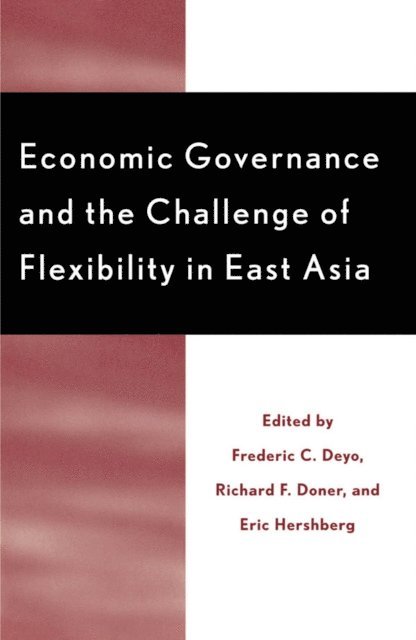
This book analyzes the institutional underpinnings of East Asia's dynamic growth by exploring the interplay between governance and flexibility. As the challenges of promoting and sustaining economic growth become ever more complex, firms in both advanced and industrializing countries face constant pressures for change from markets and technology. Globalization, heightened competition, and shorter product cycles mean that markets are increasingly volatile and fragmented. To contend with demands for higher quality, quicker delivery, and cost efficiencies, firms must enhance their capability to innovate and diversify. Achieving this flexibility, in turn, often requires new forms of governance—arrangements that facilitate the exchange of resources among diverse yet interdependent economic actors. Moving beyond the literature's emphasis on developed economies, this volume emphasizes the relevance of the links between governance and flexibility for understanding East Asia's explosive economic growth over the past quarter century. In case studies that encompass a variety of key industrial sectors and countries, the contributors emphasize the importance of network patterns of governance for facilitating flexibility in firms throughout the region. Their analyses illuminate both the strengths and limitations of recent growth strategies and offer insights into prospects for continued expansion in the wake of the East Asian economic crisis of the late 1990s.Contributions by: Richard P. Appelbaum, Lu-lin Cheng, Stephen W. K. Chiu, Frederic C. Deyo, Richard F. Doner, Dieter Ernst, Eric Hershberg, Tai Lok Lui, Rajah Rasiah, David A. Smith, and Poh-Kam Wong.
From Silicon Valley to Singapore
Location and Competitive Advantage in the Hard Disk Drive Industry
Inbunden, Engelska, 2000
1 938 kr
Skickas inom 10-15 vardagar
Momentous developments in the global economy over the last two decades have dramatically increased the availability of industrial investment sites and lowered the cost of relocating core activities to new countries. But how should these developments be exploited for competitive advantage? Firms face competing pressures: scale economies and the advantages of proximity push them to concentrate activities in one or only a few locations, while low wages and new markets invite dispersal across several countries.This book examines how location decisions have contributed to the global dominance of U.S. firms in the hard disk drive industry. In analyzing the industry since its beginnings some forty years ago, the book explains how American leadership in disk drives has rested on the formation of two complementary industrial clusters. Fundamental research and product development has been located almost entirely in the United States, principally California. Manufacturing has been concentrated in Southeast Asia (initially in Singapore and later in Thailand and Malaysia as well). This duality has proven key to the successful competitive position of the U.S. disk drive industry.Beyond the particulars of the disk drive industry, the authors present new perspectives on the sources of industrial leadership, the strategic behavior of multinational corporations, the geographic evolution of industry, and the creation and endurance of industrial clusters. Managers will gain insight into how location decisions can contribute to organizational effectiveness, and will learn that globalizing production, while keeping innovative activities at home, can contribute to their firms' competitive advantage. Policy makers will find that first mover advantages may be as important for countries as for companies, since early and systematic efforts to attract a specific industry can generate a critical mass of investments that, over time, will make a location resistant to inducements offered by other countries.
From Silicon Valley to Singapore
Location and Competitive Advantage in the Hard Disk Drive Industry
Häftad, Engelska, 2000
476 kr
Skickas inom 3-6 vardagar
Momentous developments in the global economy over the last two decades have dramatically increased the availability of industrial investment sites and lowered the cost of relocating core activities to new countries. But how should these developments be exploited for competitive advantage? Firms face competing pressures: scale economies and the advantages of proximity push them to concentrate activities in one or only a few locations, while low wages and new markets invite dispersal across several countries.This book examines how location decisions have contributed to the global dominance of U.S. firms in the hard disk drive industry. In analyzing the industry since its beginnings some forty years ago, the book explains how American leadership in disk drives has rested on the formation of two complementary industrial clusters. Fundamental research and product development has been located almost entirely in the United States, principally California. Manufacturing has been concentrated in Southeast Asia (initially in Singapore and later in Thailand and Malaysia as well). This duality has proven key to the successful competitive position of the U.S. disk drive industry.Beyond the particulars of the disk drive industry, the authors present new perspectives on the sources of industrial leadership, the strategic behavior of multinational corporations, the geographic evolution of industry, and the creation and endurance of industrial clusters. Managers will gain insight into how location decisions can contribute to organizational effectiveness, and will learn that globalizing production, while keeping innovative activities at home, can contribute to their firms' competitive advantage. Policy makers will find that first mover advantages may be as important for countries as for companies, since early and systematic efforts to attract a specific industry can generate a critical mass of investments that, over time, will make a location resistant to inducements offered by other countries.