346 kr
Richard Gombrich – författare
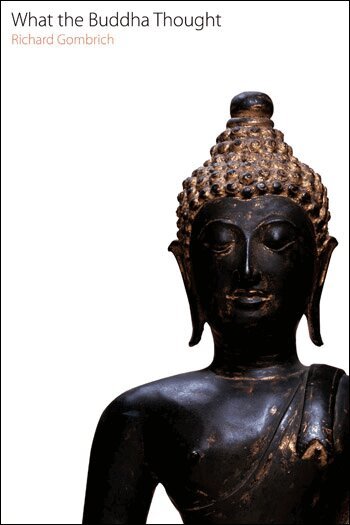
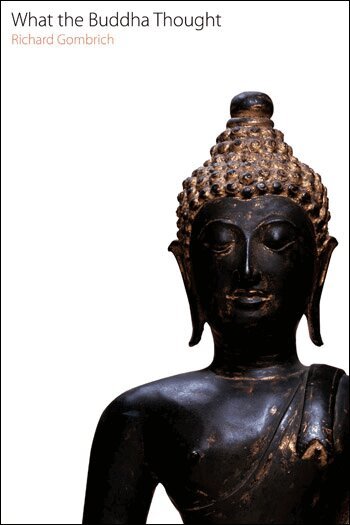
- Häftad, Engelska, 2009In What the Buddha Thought, Richard Gombrich argues that the Buddha was one of the most brilliant and original thinkers of all time. Intended to serve as an introduction to the Buddhas thought, and hence even to Buddhism itself, the book also has larger aims: it argues that we can know far more about the Buddha than it is fashionable among scholars to admit, and that his thought has a greater coherence than is usually recognised. It contains much new material. Interpreters both ancient and modern have taken little account of the historical context of the Buddhas teachings; but by relating them to early brahminical texts, and also to ancient Jainism, Gombrich gives a much richer picture of the Buddhas meaning, especially when his satire and irony are appreciated. Incidentally, since many of the Buddhas allusions can only be traced in the Pali versions of surviving texts, the book establishes the importance of the Pali Canon as evidence. The book contains much new material. The author stresses the Buddhas capacity for abstraction: though he made extensive use of metaphor, he did not found his arguments upon it, as earlier thinkers had done. He ethicized and radically reinterpreted older ideas of karma (human action) and rebirth. Similarly, building on older texts, he argued for the fundamental importance of love and compassion, and analysed fire as a process which could stand as a model for every component of conscious experience. Morally, the Buddhas theory of karma provided a principle of individuation and asserted each individuals responsibility for his own destiny. To make the book completely accessible to the general reader, the author provides an introductory section of Background Information, for easy reference.
- Häftad, Engelska, 1990
495 kr
Skickas inom 5-8 vardagar
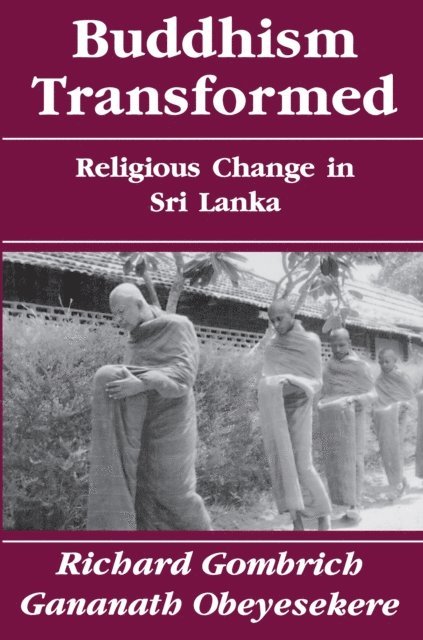
In this study a social and cultural anthropologist and a specialist in the study of religion pool their talents to examine recent changes in popular religion in Sri Lanka. As the Sinhalas themselves perceive it, Buddhism proper has always shared the religious arena with a spirit religion. While Buddhism concerns salvation, the spirit religion focuses on worldly welfare. Buddhism Transformed describes and analyzes the changes that have profoundly altered the character of Sinhala religion in both areas. - E-bokEngelska, 2021
670 kr
Läs direkt efter köp
In this study a social and cultural anthropologist and a specialist in the study of religion pool their talents to examine recent changes in popular religion in Sri Lanka. As the Sinhalas themselves perceive it, Buddhism proper has always shared the religious arena with a spirit religion. While Buddhism concerns salvation, the spirit religion focuses on worldly welfare. Buddhism Transformed describes and analyzes the changes that have profoundly altered the character of Sinhala religion in both areas.
- Inbunden, Engelska, 2022
1 051 kr
Skickas inom 5-8 vardagar
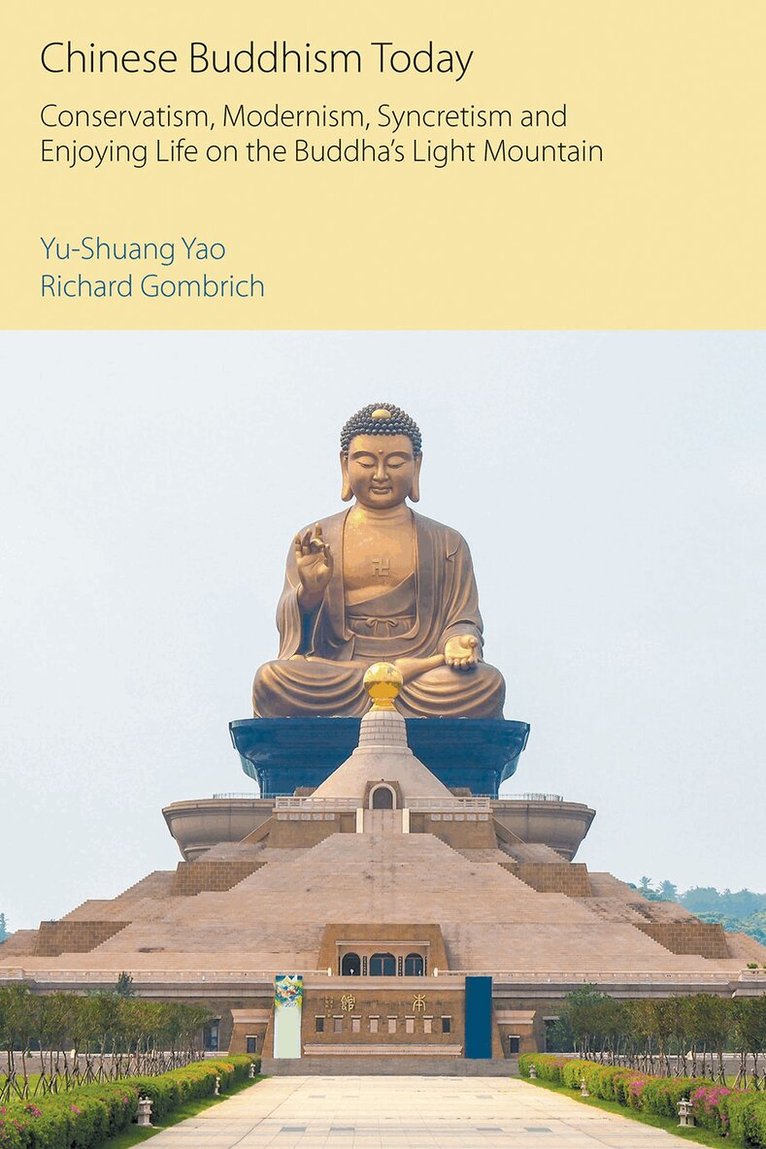
Fo Guang Shan, "Buddha's Light Mountain", is a Buddhist movement founded in Taiwan in 1967 and led by the Ven Hsing Yun (b.1927), who had fled to Taiwan from mainland China in 1949. It stands in the Chinese tradition of Mahāyāna Buddhism and more specifically is a form of Buddhism which in English is usually referred to as "Humanistic Buddhism" or as "engaged Buddhism". Humanistic Buddhism owes its origin to the Chinese monk Tai Xu (1890-1947). He found the Buddhism which surrounded him in China dreary and moribund, preoccupied with rituals for the dead, and offering nothing to help or guide people living in the world outside monasteries. His determination to reverse this decay centred on the idea that it was the vocation of a Mahayana Buddhist to do good to others, finding their own spiritual benefit in benefitting society. Hsing Yun has been a devoted disciple of Tai Xu. It is telling that he founded a seminary before he founded a monastery, and has laid huge emphasis on education. As the sub-title of this book indicates, in order to make Buddhism widely attractive and relevant he has incorporated every influence available. Gifted with a benign personality, he has turned his seemingly boundless energy and prodigious versatility to creating an institution which presents Buddhism as potentially a source for benefitting society through making life enjoyable. This book hopes to convey the movement's ethos primarily by focusing on his views and activities. - Häftad, Engelska, 2022
381 kr
Skickas inom 5-8 vardagar
Fo Guang Shan, "Buddha's Light Mountain", is a Buddhist movement founded in Taiwan in 1967 and led by the Ven Hsing Yun (b.1927), who had fled to Taiwan from mainland China in 1949. It stands in the Chinese tradition of Mahāyāna Buddhism and more specifically is a form of Buddhism which in English is usually referred to as "Humanistic Buddhism" or as "engaged Buddhism". Humanistic Buddhism owes its origin to the Chinese monk Tai Xu (1890-1947). He found the Buddhism which surrounded him in China dreary and moribund, preoccupied with rituals for the dead, and offering nothing to help or guide people living in the world outside monasteries. His determination to reverse this decay centred on the idea that it was the vocation of a Mahayana Buddhist to do good to others, finding their own spiritual benefit in benefitting society. Hsing Yun has been a devoted disciple of Tai Xu. It is telling that he founded a seminary before he founded a monastery, and has laid huge emphasis on education. As the sub-title of this book indicates, in order to make Buddhism widely attractive and relevant he has incorporated every influence available. Gifted with a benign personality, he has turned his seemingly boundless energy and prodigious versatility to creating an institution which presents Buddhism as potentially a source for benefitting society through making life enjoyable. This book hopes to convey the movement's ethos primarily by focusing on his views and activities. - Inbunden, Engelska, 2009
1 198 kr
Skickas inom 5-8 vardagar
In What the Buddha Thought, Richard Gombrich argues that the Buddha was one of the most brilliant and original thinkers of all time. Intended to serve as an introduction to the Buddhas thought, and hence even to Buddhism itself, the book also has larger aims: it argues that we can know far more about the Buddha than it is fashionable among scholars to admit, and that his thought has a greater coherence than is usually recognised. It contains much new material. Interpreters both ancient and modern have taken little account of the historical context of the Buddhas teachings; but by relating them to early brahminical texts, and also to ancient Jainism, Gombrich gives a much richer picture of the Buddhas meaning, especially when his satire and irony are appreciated. Incidentally, since many of the Buddhas allusions can only be traced in the Pali versions of surviving texts, the book establishes the importance of the Pali Canon as evidence. The book contains much new material. The author stresses the Buddhas capacity for abstraction: though he made extensive use of metaphor, he did not found his arguments upon it, as earlier thinkers had done. He ethicized and radically reinterpreted older ideas of karma (human action) and rebirth. Similarly, building on older texts, he argued for the fundamental importance of love and compassion, and analysed fire as a process which could stand as a model for every component of conscious experience. Morally, the Buddhas theory of karma provided a principle of individuation and asserted each individuals responsibility for his own destiny. To make the book completely accessible to the general reader, the author provides an introductory section of Background Information, for easy reference. - Inbunden, Engelska, 2012
1 198 kr
Skickas inom 5-8 vardagar
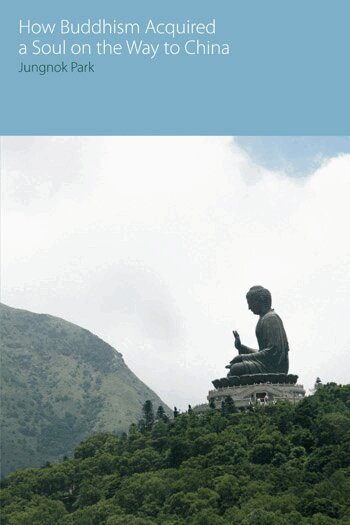
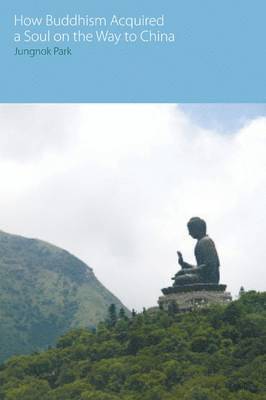
How Buddhism Acquired a Soul on the Way to China tells the story of the spread of Buddhist religious thinking and practice from India to China and how, along the way, a religion was changed. While Indian Buddhists had constructed their ideas of self by means of empiricism, anti-Brahmanism and analytic reasoning, Chinese Buddhists did so by means of non-analytic insights, utilising pre-established epistemology and cosmogony. Furthermore, many specific Buddhist ideas were transformed when exchanged from an Indian to a Chinese context, often through the work of translators concept-matching Buddhist and Daoist terms. One of the key changes was the Chinese reinterpretation of the concept of shen - originally an agent of thought which died with the body - into an eternal essence of human spirit, a soul. Though the notion of an imperishable soul was later disputed by Chinese Buddhist scholars the idea of a permanent agent of perception flourished in China. This historical analysis of the concept of self as it developed between Indian and Chinese Buddhism will be of interest to readers of Buddhist Philosophy as well as the History of Ideas. - Häftad, Engelska, 2012
409 kr
Skickas inom 5-8 vardagar
How Buddhism Acquired a Soul on the Way to China tells the story of the spread of Buddhist religious thinking and practice from India to China and how, along the way, a religion was changed. While Indian Buddhists had constructed their ideas of self by means of empiricism, anti-Brahmanism and analytic reasoning, Chinese Buddhists did so by means of non-analytic insights, utilising pre-established epistemology and cosmogony. Furthermore, many specific Buddhist ideas were transformed when exchanged from an Indian to a Chinese context, often through the work of translators concept-matching Buddhist and Daoist terms. One of the key changes was the Chinese reinterpretation of the concept of shen - originally an agent of thought which died with the body - into an eternal essence of human spirit, a soul. Though the notion of an imperishable soul was later disputed by Chinese Buddhist scholars the idea of a permanent agent of perception flourished in China. This historical analysis of the concept of self as it developed between Indian and Chinese Buddhism will be of interest to readers of Buddhist Philosophy as well as the History of Ideas.