Richard Kock - Böcker
Visar alla böcker från författaren Richard Kock. Handla med fri frakt och snabb leverans.
3 produkter
3 produkter
Del 6 - Conservation Science and Practice
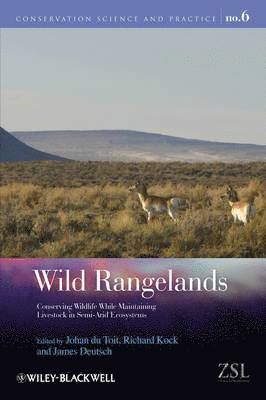
Wild Rangelands
Conserving Wildlife While Maintaining Livestock in Semi-Arid Ecosystems
Häftad, Engelska, 2010
935 kr
Skickas inom 7-10 vardagar
Rangeland ecosystems which include unimproved grasslands, shrublands, savannas and semi-deserts, support half of the world’s livestock, while also providing habitats for some of the most charismatic of wildlife species. This book examines the pressures on rangeland ecosystems worldwide from human land use, over-hunting, and subsistence and commercial farming of livestock and crops. Leading experts have pooled their experiences from all continents to cover the ecological, sociological, political, veterinary, and economic aspects of rangeland management today. This book provides practitioners and students of rangeland management and wildland conservation with a diversity of perspectives on a central question: can rangelands be wildlands? The first book to examine rangelands from a conservation perspectiveEmphasizes the balance between the needs of people and livestock, and wildlifeWritten by an international team of experts covering all geographical regionsExamines ecological, sociological, political, veterinary, and economic aspects of rangeland management and wildland conservation, providing a diversity of perspectives not seen before in a single volume
Clear-Cutting Disease Control
Capital-Led Deforestation, Public Health Austerity, and Vector-Borne Infection
Häftad, Engelska, 2019
516 kr
Skickas inom 10-15 vardagar
The vector-borne Zika virus joins avian influenza, Ebola, and yellow fever as recent public health crises threatening pandemicity.By a combination of stochastic modeling and economic geography, this book proposes two key causes together explain the explosive spread of the worst of the vector-borne outbreaks.Ecosystems in which such pathogens are largely controlled by environmental stochasticity are being drastically streamlined by both agribusiness-led deforestation and deficits in public health and environmental sanitation.Consequently, a subset of infections that once burned out relatively quickly in local forests are now propagating across susceptible human populations whose vulnerability to infection is often exacerbated in structurally adjusted cities. The resulting outbreaks are characterized by greater global extent, duration, and momentum.As infectious diseases in an age of nation states and global health programs cannot, as much of the present modeling literature presumes, be described by interacting populations of host, vector, and pathogen alone, a series of control theory models is also introduced here. These models, useful to researchers and health officials alike, explicitly address interactions between government ministries and the pathogens they aim to control.
Clear-Cutting Disease Control
Capital-Led Deforestation, Public Health Austerity, and Vector-Borne Infection
Inbunden, Engelska, 2018
733 kr
Skickas inom 10-15 vardagar
The vector-borne Zika virus joins avian influenza, Ebola, and yellow fever as recent public health crises threatening pandemicity.By a combination of stochastic modeling and economic geography, this book proposes two key causes together explain the explosive spread of the worst of the vector-borne outbreaks.Ecosystems in which such pathogens are largely controlled by environmental stochasticity are being drastically streamlined by both agribusiness-led deforestation and deficits in public health and environmental sanitation.Consequently, a subset of infections that once burned out relatively quickly in local forests are now propagating across susceptible human populations whose vulnerability to infection is often exacerbated in structurally adjusted cities. The resulting outbreaks are characterized by greater global extent, duration, and momentum.As infectious diseases in an age of nation states and global health programs cannot, as much of the present modeling literature presumes, be described by interacting populations of host, vector, and pathogen alone, a series of control theory models is also introduced here. These models, useful to researchers and health officials alike, explicitly address interactions between government ministries and the pathogens they aim to control.