Roundtable on Science and Technology for Sustainability – författare
Visar alla böcker från författaren Roundtable on Science and Technology for Sustainability. Handla med fri frakt och snabb leverans.
6 produkter
6 produkter
E-bok
Engelska, 2005276 kr
Läs direkt efter köp
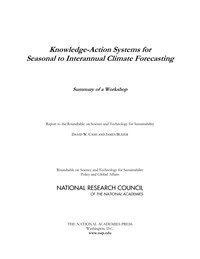
The National Academies'' Roundtable on Science and Technology for Sustainability hosted a workshop "Knowledge–Action Systems for Seasonal to Interannual Climate Forecasting" in 2004 to discover and distill general lessons about the design of effective systems for linking knowledge with action from the last decade''s experience with the production and application of seasonal to interannual climate forecasts. Workshop participants described lessons they had learned based on their experiences developing, applying, and using decision support systems in the United States, Columbia, Brazil, and Australia. Some of the key lessons discussed, as characterized by David Cash and James Buizer, were that effective knowledge–action systems: define and frame the problem to be addressed via collaboration between knowledge users and knowledge producers; tend to be end-to-end systems that link user needs to basic scientific findings and observations; are often anchored in "boundary organizations" that act as intermediaries between nodes in the system — most notably between scientists and decision makers; feature flexible processes and institutions to be responsive to what is learned; use funding strategies tailored to the dual public/private character of such systems; and require people who can work across disciplines, issue areas, and the knowledge–action interface.
E-bok
Engelska, 2006600 kr
Läs direkt efter köp
This report summarizes a workshop organized by the National Academies'' Roundtable on Science and Technology for Sustainability. The workshop brought together a select group of program managers from the public and private sectors to discuss specific cases of linking knowledge to action in a diverse set of integrated observation, assessment, and decision support systems. Workshop discussions explored a wide variety of experiments in harnessing science and technology to goals of promoting development and conserving the environment. Participants reflected on the most significant challenges that they have faced when trying to implement their programs and the strategies that they have used to address them successfully. The report summarizes discussions at the workshop, including common themes about the process of linking knowledge with actions for sustainable development that emerged across a wide range of cases, sectors, and regions.
E-bok
PDF, Engelska, 2005187 kr
Läs direkt efter köp
The National Academies'' Roundtable on Science and Technology for Sustainability hosted a workshop "Knowledge–Action Systems for Seasonal to Interannual Climate Forecasting" in 2004 to discover and distill general lessons about the design of effective systems for linking knowledge with action from the last decade''s experience with the production and application of seasonal to interannual climate forecasts. Workshop participants described lessons they had learned based on their experiences developing, applying, and using decision support systems in the United States, Columbia, Brazil, and Australia. Some of the key lessons discussed, as characterized by David Cash and James Buizer, were that effective knowledge–action systems: define and frame the problem to be addressed via collaboration between knowledge users and knowledge producers; tend to be end-to-end systems that link user needs to basic scientific findings and observations; are often anchored in "boundary organizations" that act as intermediaries between nodes in the system — most notably between scientists and decision makers; feature flexible processes and institutions to be responsive to what is learned; use funding strategies tailored to the dual public/private character of such systems; and require people who can work across disciplines, issue areas, and the knowledge–action interface.
E-bok
PDF, Engelska, 2006422 kr
Läs direkt efter köp
This report summarizes a workshop organized by the National Academies'' Roundtable on Science and Technology for Sustainability. The workshop brought together a select group of program managers from the public and private sectors to discuss specific cases of linking knowledge to action in a diverse set of integrated observation, assessment, and decision support systems. Workshop discussions explored a wide variety of experiments in harnessing science and technology to goals of promoting development and conserving the environment. Participants reflected on the most significant challenges that they have faced when trying to implement their programs and the strategies that they have used to address them successfully. The report summarizes discussions at the workshop, including common themes about the process of linking knowledge with actions for sustainable development that emerged across a wide range of cases, sectors, and regions.
Häftad, Engelska, 2005
408 kr
Tillfälligt slut
The National Academies' Roundtable on Science and Technology for Sustainability hosted a workshop "Knowledge-Action Systems for Seasonal to Interannual Climate Forecasting" in 2004 to discover and distill general lessons about the design of effective systems for linking knowledge with action from the last decade's experience with the production and application of seasonal to interannual climate forecasts. Workshop participants described lessons they had learned based on their experiences developing, applying, and using decision support systems in the United States, Columbia, Brazil, and Australia.Some of the key lessons discussed, as characterized by David Cash and James Buizer, were that effective knowledge-action systems: define and frame the problem to be addressed via collaboration between knowledge users and knowledge producers; tend to be end-to-end systems that link user needs to basic scientific findings and observations; are often anchored in "boundary organizations" that act as intermediaries between nodes in the system - most notably between scientists and decision makers; feature flexible processes and institutions to be responsive to what is learned; use funding strategies tailored to the dual public/private character of such systems; and require people who can work across disciplines, issue areas, and the knowledgea "action interface.
Häftad, Engelska, 2006
625 kr
Tillfälligt slut
This report summarizes a workshop organized by the National Academiesa (TM) Roundtable on Science and Technology for Sustainability. The workshop brought together a select group of program managers from the public and private sectors to discuss specific cases of linking knowledge to action in a diverse set of integrated observation, assessment, and decision support systems. Workshop discussions explored a wide variety of experiments in harnessing science and technology to goals of promoting development and conserving the environment. Participants reflected on the most significant challenges that they have faced when trying to implement their programs and the strategies that they have used to address them successfully. The report summarizes discussions at the workshop, including common themes about the process of linking knowledge with actions for sustainable development that emerged across a wide range of cases, sectors, and regions.