Sarah Kofman - Böcker
Visar alla böcker från författaren Sarah Kofman. Handla med fri frakt och snabb leverans.
12 produkter
12 produkter
1 719 kr
Skickas inom 5-8 vardagar
This book addresses the question of metaphor in Nietzsche. It provides an unusual reading of Nietzsche's ideas (particularly of the central concept of "will to power") and an incisive method for investigating his style. Developing work on Nietzsche undertaken by Derrida and the post-structuralists, Kofman shows how Nietzsche's style influences his ideas and how these ideas are to be understood. Since its first publication in France in 1972, this work has been a major influence on readings of Nietzsche and this English-language translation should be widely welcomed. Sarah Kofman's translated works include "The Enigma of Women: Women in Freud's Writings" (1985), "The Childhood of Art" (1988) and "Freud and Fiction" (1991).
229 kr
Skickas
Sarah Kofman (1934-1994) var fransk filosof. Rue Ordener, rue Labat a?r hennes sja?lvbiografiska bera?ttelse om sitt liv under den tyska ockupationen av Frankrike. Det a?r ocksa? historien om hennes far, rabbinen Berek Kofman, som deporterades och mo?rdades. Boken blev hennes sista. Sarah Kofmans Rue Ordener, rue Labat inga?r i bokfo?rlaget faethons serie alpha. Varje originalutga?va i serien a?r tryckt i 25 exemplar hors commerce, i-xxv och 475 numrerade exemplar. Redakto?r fo?r alpha a?r Daniel Pedersen.
229 kr
Skickas
Sarah Kofman (1934-1994) var fransk filosof. Kva?vda ord a?r en fragmentarisk dialog med fo?rfattarna Robert Antelme och Maurice Blanchot. Den tyste tredje i dialogen a?r hennes far, rabbinen Berek Kofman som deporterades och mo?rdades av nazisterna. Sarah Kofmans Kva?vda ord inga?r i bokfo?rlaget faethons serie alpha. Varje originalutga?va i serien a?r tryckt i 25 exemplar hors commerce, i-xxv och 475 numrerade exemplar. Redakto?r fo?r alpha a?r Daniel Pedersen.
1 287 kr
Skickas inom 3-6 vardagar
943 kr
Kommande
Distinguished critic reads Derrida's early texts in terms of sexual difference, the uncanny and psychoanalysis The first complete translation into English of Sarah Kofman's only book length study of her former teacher demonstrates the essentially affirmative and open ended nature of Derridean deconstruction. It also shows the ways in which Kofman's thinking shaped Derrida's work, especially around the topic of sexual difference. This volume will help English readers to reconsider the relation of deconstruction to current political theory as well as to research into the post human, biopolitics, globalised political theory, and the on going transformation and displacement of philosophy by the methods of cultural studies. Readings of Derrida will help redress a gap in Derrida scholarship, as well as highlight Kofman's contribution to 20th century French feminism.English complete translation of an incisive work on Derrida by a significant French feminist critic; situates Derrida's ideas in original relation to Freud, Plato, sexual difference and political philosophy; covers all the major works for which Derrida is best known and the introduction sets Kofman's work in today's theoretical context.
1 958 kr
Skickas inom 3-6 vardagar
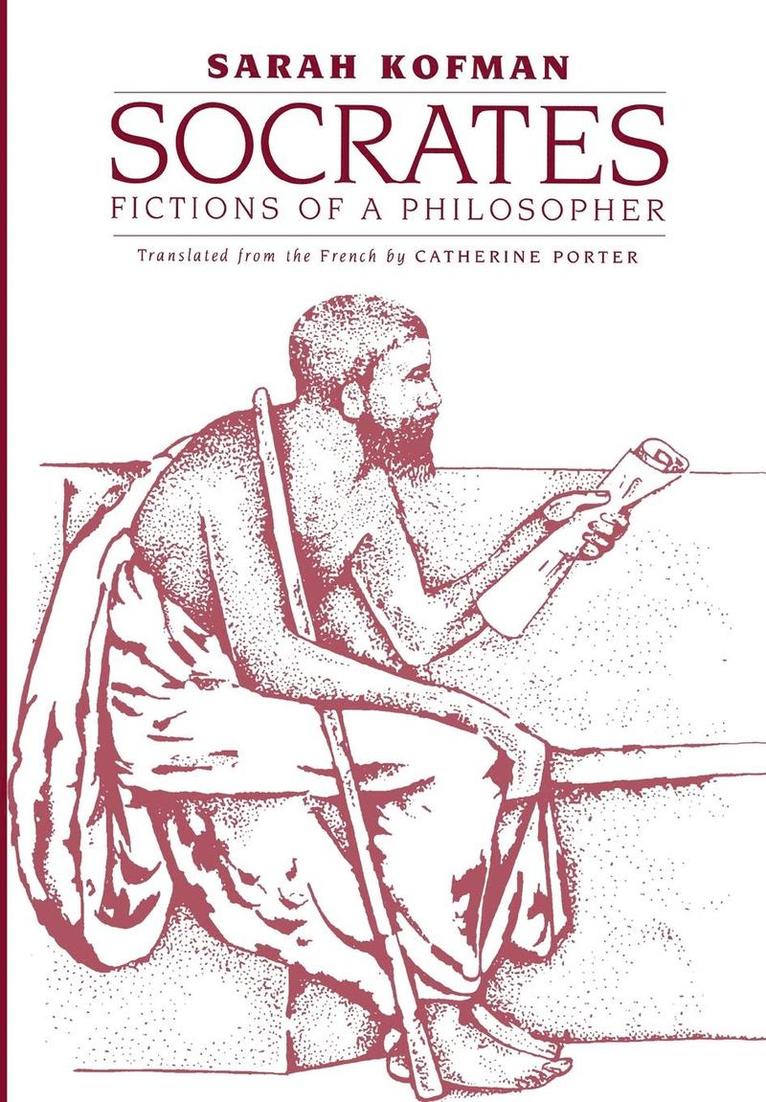
Socrates is an elusive figure, Sarah Kofman asserts, and he is necessarily so since he did not write or directly state his beliefs. "With Socrates," she writes in her introduction, "we will never leave fiction behind." Kofman suggests that Socrates's avowal of ignorance was meant to be ironic. Later philosophers who interpreted his text invariably resisted the profoundly ironic character of his way of life and diverged widely in their interpretations of him. Kofman focuses especially on the views of Plato, Hegel, Kierkegaard, and Nietzsche. The information that is available about Socrates's life is paradoxical. He was famously ugly, but he was also a notorious seducer of youth. His sexuality is ambiguous, according to Kofman, for his allure is stereotypically feminine. His death is also subject to varied interpretation. Some commentators regard him as a redemptive, proto-Christ figure, more Jewish than Greek, and others see him as an archetypal Stoic hero. Despite radically different interpretations, Plato, Hegel, Kierkegaard, and Nietzsche all found Socrates to be a dominant figure of immense importance in the history of philosophy. Kierkegaard and Nietzsche try to retain the idea of irony as essential to the Socratic way of life. Hegel, in contrast, insists that Socrates be assigned one particular place in the historical development of Absolute Spirit. While Kierkegaard considered Socratic irony as an intellectual position, Nietzsche recognized and resisted Socrates's irony as a predisposition. In examining each philospher's response to Socratic irony, Kofman draws specifically on the history of philosophy and psychoanalytic theory.
2 201 kr
Skickas inom 3-6 vardagar
Camera Obscura is a powerful discussion of a metaphor that dominates contemporary theory from philosophy to film.Marx, Freud, Nietzsche-in vastly different ways all three employed the metaphor of the camera obscura in their work. In this classic book-at last available in an English translation-the distinguished French philosopher Sarah Kofman offers an extended reflection on this metaphor. She contrasts the mechanical function of the camera obscura as a kind of copy machine, rendering a mirror-image of the work, with its use in the writings of master thinkers.In her opening chapter on Marx, Kofman provides a reading of inversion as necessary to the ideological process. She then explores the metaphor of the camera obscura in Freud's description of the unconscious. For Nietzsche the camera obscura is a "metaphor for forgetting." Kofman asks here whether the "magical apparatus" of the camera obscura, rather than bringing about clarity, serves some thinkers as fetish.
723 kr
Skickas inom 3-6 vardagar
Marx, Freud, Nietzsche—in vastly different ways all three employed the metaphor of the camera obscura in their work. In this classic book—at last available in an English translation—the distinguished French philosopher Sarah Kofman offers an extended reflection on this metaphor. She contrasts the mechanical function of the camera obscura as a kind of copy machine, rendering a mirror-image of the work, with its use in the writings of master thinkers. In her opening chapter on Marx, Kofman provides a reading of inversion as necessary to the ideological process. She then explores the metaphor of the camera obscura in Freud's description of the unconscious. For Nietzsche the camera obscura is a "metaphor for forgetting." Kofman asks here whether the "magical apparatus" of the camera obscura, rather than bringing about clarity, serves some thinkers as fetish. Camera Obscura is a powerful discussion of a metaphor that dominates contemporary theory from philosophy to film.
238 kr
Skickas inom 10-15 vardagar
Rue Ordener, Rue Labat is a moving memoir by the distinguished French philosopher Sarah Kofman. It opens with the horrifying moment in July 1942 when the author's father, the rabbi of a small synagogue, was dragged by police from the family home on Rue Ordener in Paris, then transported to Auschwitz—"the place," writes Kofman, "where no eternal rest would or could ever be granted." It ends in the mid-1950s, when Kofman enrolled at the Sorbonne. The book is as eloquent as it is forthright. Kofman recalls her father and family in the years before the war, then turns to the terrors and confusions of her own childhood in Paris during the German occupation. Not long after her father's disappearance, Kofman and her mother took refuge in the apartment of a Christian woman on Rue Labat, where they remained until the Liberation. This bold woman, whom Kofman called Mémé, undoubtedly saved the young girl and her mother from the death camps. But Kofman's close attachment to Mémé also resulted in a rupture between mother and child that was never to be fully healed.This slender volume is distinguished by the author's clear prose, the carefully recounted horrors of her childhood, and the uncommon poise that came to her only with the passage of many years.
567 kr
Skickas inom 3-6 vardagar
This long-overdue translation brings to the English-speaking world the work that set the tone for the post-structuralist reading of Nietzsche. The issue of style, of why Nietzsche wrote as he did, is fundamental, on any level, to reading his texts. Some Nietzsche critics (in particular, those, such as Jean Granier, indebted to Heidegger's reading), in effect translated Nietzsche's terms back into those of a philosophy of ontology. This book (which includes an appendix specifically directed against the "Heideggerian" reading) shows how such an approach fails to interrogate the precise terms, such as "Nature" or "life", that Nietzsche used in place of "being," and to ask the meaning of this substitution. The author gives not only a reading of Nietzsche's ideas, but a method for investigating his style. She shows in great detail how it influences both Nietzsche's ideas and the way in which they are to be understood. In so doing, she exemplifies how post-structuralist methods can be used to open up classical philosophical texts to new readings.She write conceptually in the knowledge that the concept has no greater value than metaphor and is itself a condensation of metaphors, rather than writing metaphorically as a way of denigrating the concept and proposing metaphor as the norm, and thus acknowledges the specificity of philosophy, its irreducibility to any other form of expression-even when this philosophy has nothing traditional about it any longer, even when it is, like Nietzsche's an unheard-of and insolent philosophy.
1 394 kr
Skickas inom 10-15 vardagar
Sarah Kofman (1934-1994), Professor of Philosophy at the Sorbonne in Paris and the author of over twenty books, was one of the most significant postwar thinkers in France. Kofman's scholarship was wide-ranging and included work on Freud and psychoanalysis, Nietzsche, feminism and the role of women in Western philosophy, visual art, and literature. The child of Polish Jewish immigrants who lost her father in the Holocaust, she also was interested in Judaism and anti-Semitism, especially as reflected in works of literature and philosophy. This book is an anthology of some of Kofman's most significant writings on these and other topics. Its purpose is to provide a general introduction to Kofman's thought, which has been highly influential in both Europe and America. Although some of the selections have been published previously, the majority of the books contents appear in English translation for the first time.
322 kr
Skickas inom 7-10 vardagar
Sarah Kofman (1934-1994), Professor of Philosophy at the Sorbonne in Paris and the author of over twenty books, was one of the most significant postwar thinkers in France. Kofman's scholarship was wide-ranging and included work on Freud and psychoanalysis, Nietzsche, feminism and the role of women in Western philosophy, visual art, and literature. The child of Polish Jewish immigrants who lost her father in the Holocaust, she also was interested in Judaism and anti-Semitism, especially as reflected in works of literature and philosophy. This book is an anthology of some of Kofman's most significant writings on these and other topics. Its purpose is to provide a general introduction to Kofman's thought, which has been highly influential in both Europe and America. Although some of the selections have been published previously, the majority of the books contents appear in English translation for the first time.