Serena Giusti - Böcker
Visar alla böcker från författaren Serena Giusti. Handla med fri frakt och snabb leverans.
6 produkter
6 produkter
575 kr
Skickas inom 10-15 vardagar
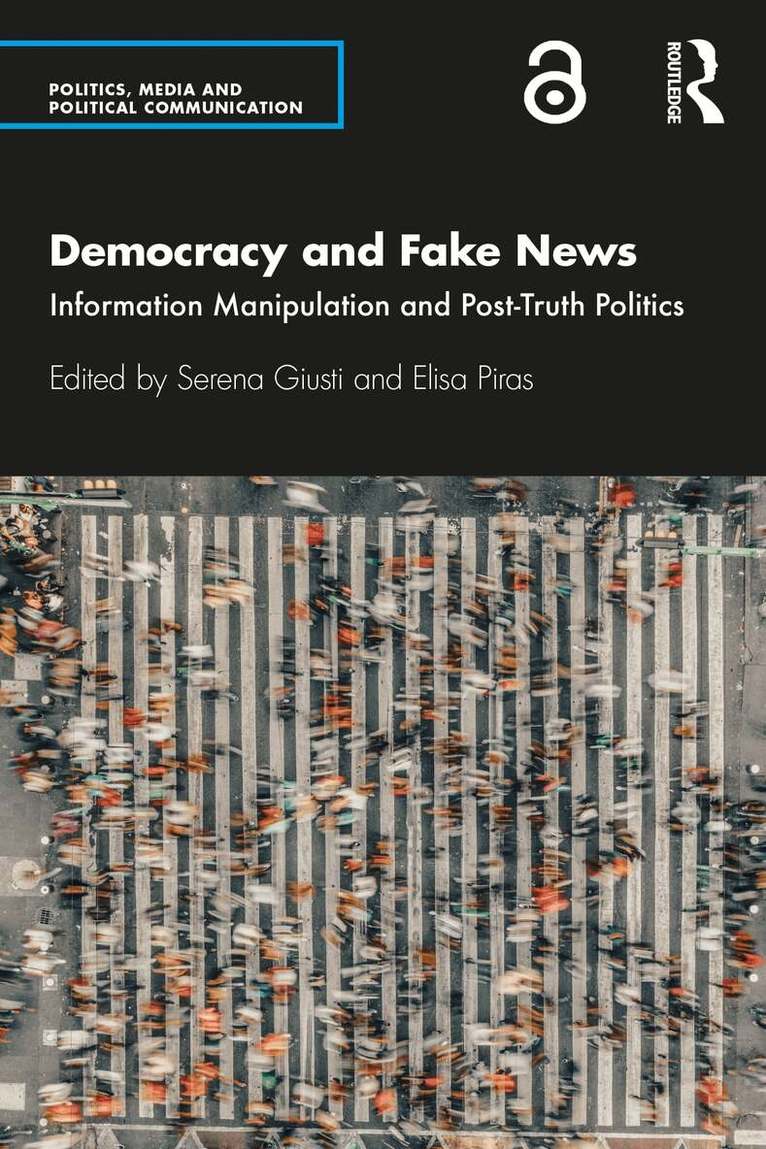
This book explores the challenges that disinformation, fake news, and post-truth politics pose to democracy from a multidisciplinary perspective. The authors analyse and interpret how the use of technology and social media as well as the emergence of new political narratives has been progressively changing the information landscape, undermining some of the pillars of democracy.The volume sheds light on some topical questions connected to fake news, thereby contributing to a fuller understanding of its impact on democracy. In the Introduction, the editors offer some orientating definitions of post-truth politics, building a theoretical framework where various different aspects of fake news can be understood. The book is then divided into three parts: Part I helps to contextualise the phenomena investigated, offering definitions and discussing key concepts as well as aspects linked to the manipulation of information systems, especially considering its reverberation on democracy. Part II considers the phenomena of disinformation, fake news, and post-truth politics in the context of Russia, which emerges as a laboratory where the phases of creation and diffusion of fake news can be broken down and analysed; consequently, Part II also reflects on the ways to counteract disinformation and fake news. Part III moves from case studies in Western and Central Europe to reflect on the methodological difficulty of investigating disinformation, as well as tackling the very delicate question of detection, combat, and prevention of fake news.This book will be of great interest to students and scholars of political science, law, political philosophy, journalism, media studies, and computer science, since it provides a multidisciplinary approach to the analysis of post-truth politics.
2 103 kr
Skickas inom 10-15 vardagar
This book explores the challenges that disinformation, fake news, and post-truth politics pose to democracy from a multidisciplinary perspective. The authors analyse and interpret how the use of technology and social media as well as the emergence of new political narratives has been progressively changing the information landscape, undermining some of the pillars of democracy.The volume sheds light on some topical questions connected to fake news, thereby contributing to a fuller understanding of its impact on democracy. In the Introduction, the editors offer some orientating definitions of post-truth politics, building a theoretical framework where various different aspects of fake news can be understood. The book is then divided into three parts: Part I helps to contextualise the phenomena investigated, offering definitions and discussing key concepts as well as aspects linked to the manipulation of information systems, especially considering its reverberation on democracy. Part II considers the phenomena of disinformation, fake news, and post-truth politics in the context of Russia, which emerges as a laboratory where the phases of creation and diffusion of fake news can be broken down and analysed; consequently, Part II also reflects on the ways to counteract disinformation and fake news. Part III moves from case studies in Western and Central Europe to reflect on the methodological difficulty of investigating disinformation, as well as tackling the very delicate question of detection, combat, and prevention of fake news.This book will be of great interest to students and scholars of political science, law, political philosophy, journalism, media studies, and computer science, since it provides a multidisciplinary approach to the analysis of post-truth politics.
616 kr
Skickas inom 10-15 vardagar
The book addresses the challenges faced by women on the two shores of the Mediterranean from a multidisciplinary and interdisciplinary perspective. While in the European Union’s (EU) Mediterranean countries inequality is mostly linked to the social sphere and, in particular refers to labour market dynamics, in the Middle East and Northern Africa (MENA) area, the situation is more complicated as the social and private spheres are blended and cultural and religious factors have a great impact on women autonomy and opportunities beyond the family perimeter. The different challenges women are facing on the two sides of the Mediterranean have sometimes originated incomprehension and misperceptions. Western-supported policies devoted to fill the gap between men and women in the MENA area have overlooked countries’ peculiarities simply exporting models tailored for EU’s member states. The EU’s attempts to strengthen relations with the Mediterranean countries on a multilevel basis have not rescued women from marginalisation. Nevertheless, during the 2011 awakening, women played an important role in activating civil society. They are still considered as a key part of the fight against terrorism and radicalisation, although in some countries their condition has worsened after secular regimes have been downturned. The number of migrant women has increased and, not differently from men, they are looking for opportunities and better conditions of life while Western media tend to present them in a stereotyped way either as traumatized victim and/or as caring mother. There are other misleading common places, which need to be better conceptualised and understood, such as the alleged incompatibility between Islam and women rights. Unfortunately, women’s rights are still under attack even in European countries where they are considered consolidated. The chapters in this book were originally published in a special issue of the Journal of the Balkans and Near Eastern Studies.
2 103 kr
Skickas inom 10-15 vardagar
The book addresses the challenges faced by women on the two shores of the Mediterranean from a multidisciplinary and interdisciplinary perspective. While in the European Union’s (EU) Mediterranean countries inequality is mostly linked to the social sphere and, in particular refers to labour market dynamics, in the Middle East and Northern Africa (MENA) area, the situation is more complicated as the social and private spheres are blended and cultural and religious factors have a great impact on women autonomy and opportunities beyond the family perimeter. The different challenges women are facing on the two sides of the Mediterranean have sometimes originated incomprehension and misperceptions. Western-supported policies devoted to fill the gap between men and women in the MENA area have overlooked countries’ peculiarities simply exporting models tailored for EU’s member states. The EU’s attempts to strengthen relations with the Mediterranean countries on a multilevel basis have not rescued women from marginalisation. Nevertheless, during the 2011 awakening, women played an important role in activating civil society. They are still considered as a key part of the fight against terrorism and radicalisation, although in some countries their condition has worsened after secular regimes have been downturned. The number of migrant women has increased and, not differently from men, they are looking for opportunities and better conditions of life while Western media tend to present them in a stereotyped way either as traumatized victim and/or as caring mother. There are other misleading common places, which need to be better conceptualised and understood, such as the alleged incompatibility between Islam and women rights. Unfortunately, women’s rights are still under attack even in European countries where they are considered consolidated. The chapters in this book were originally published in a special issue of the Journal of the Balkans and Near Eastern Studies.
EU in a Trans-European Space
External Relations across Europe, Asia and the Middle East
Inbunden, Engelska, 2019
1 381 kr
Skickas inom 10-15 vardagar
This book examines political, social, and economic interactions in highly interconnected areas, stretching from Europe to Eastern Europe, North Africa, the Middle East, and East Asia, labelled as Trans-Europe. The second part deals with the actions of national actors trying to compete with the EU influence in their shared neighbourhood.
483 kr
Skickas inom 10-15 vardagar
This book intends to make NI more accessible and viable, especially as a critical device for better understanding contemporary politics. Throughout time, NI has been presented as an ambiguous but obstinate concept in politics, political discourse, and theoretical elaboration.