Sharon A. Clay – författare
948 kr
Skickas inom 10-15 vardagar
Practical Mathematics for Precision Farming
821 kr
Skickas
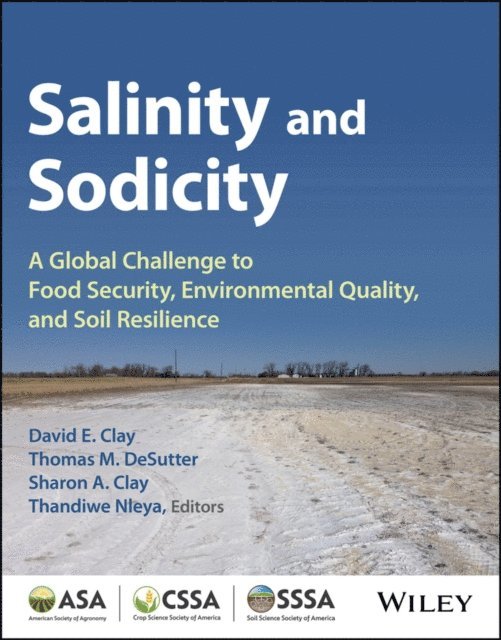
Salinity and Sodicity
A Growing Global Challenge to Food Security, Environmental Quality and Soil Resilience
880 kr
Skickas inom 3-6 vardagar
1 030 kr
Läs direkt efter köp
Explore the growing problem of soil salinity and sodicity and its impact on the environment, profitability, the human population, and soil resilience
In Salinity and Sodicity: A Global Challenge to Food Security, Environmental Quality, and Soil Resilience, a team of distinguished educators delivers an expert discussion of salinity and sodicity management. This book is designed to improve the problem-solving capabilities of students, soil health professionals, certified crop advisors, and other practicing professionals in this area.
In addition to an introduction to the causes of a rapidly growing problem, Salinity and Sodicity explores different measurement techniques, provides answers to common questions, provides potential solutions in a way that’s appropriate for introductory classes on soil salinity and sodicity management. It’s an ideal reference manual for professionals, as well as an effective tool for classrooms and crop advisor workshops.
Readers will also find:
A thorough introduction to the use of supplemental irrigation and the impact of salts on the environmentComprehensive explorations of the economic considerations for farming problematic soilsPractical discussions of the effects of salinity and sodicity on erosion and greenhouse gas emissionsPractical case studies, problem sets, and an instructor answer keyPerfect for undergraduate, graduate, and doctoral students and certified and practicing soil professionals and advisors, Salinity and Sodicity will also benefit industry and academic researchers with an interest in soil salinity and sodicity in dryland regions.
1 030 kr
Läs direkt efter köp
Explore the growing problem of soil salinity and sodicity and its impact on the environment, profitability, the human population, and soil resilience
In Salinity and Sodicity: A Global Challenge to Food Security, Environmental Quality, and Soil Resilience, a team of distinguished educators delivers an expert discussion of salinity and sodicity management. This book is designed to improve the problem-solving capabilities of students, soil health professionals, certified crop advisors, and other practicing professionals in this area.
In addition to an introduction to the causes of a rapidly growing problem, Salinity and Sodicity explores different measurement techniques, provides answers to common questions, provides potential solutions in a way that’s appropriate for introductory classes on soil salinity and sodicity management. It’s an ideal reference manual for professionals, as well as an effective tool for classrooms and crop advisor workshops.
Readers will also find:
A thorough introduction to the use of supplemental irrigation and the impact of salts on the environmentComprehensive explorations of the economic considerations for farming problematic soilsPractical discussions of the effects of salinity and sodicity on erosion and greenhouse gas emissionsPractical case studies, problem sets, and an instructor answer keyPerfect for undergraduate, graduate, and doctoral students and certified and practicing soil professionals and advisors, Salinity and Sodicity will also benefit industry and academic researchers with an interest in soil salinity and sodicity in dryland regions.
1 103 kr
Läs direkt efter köp
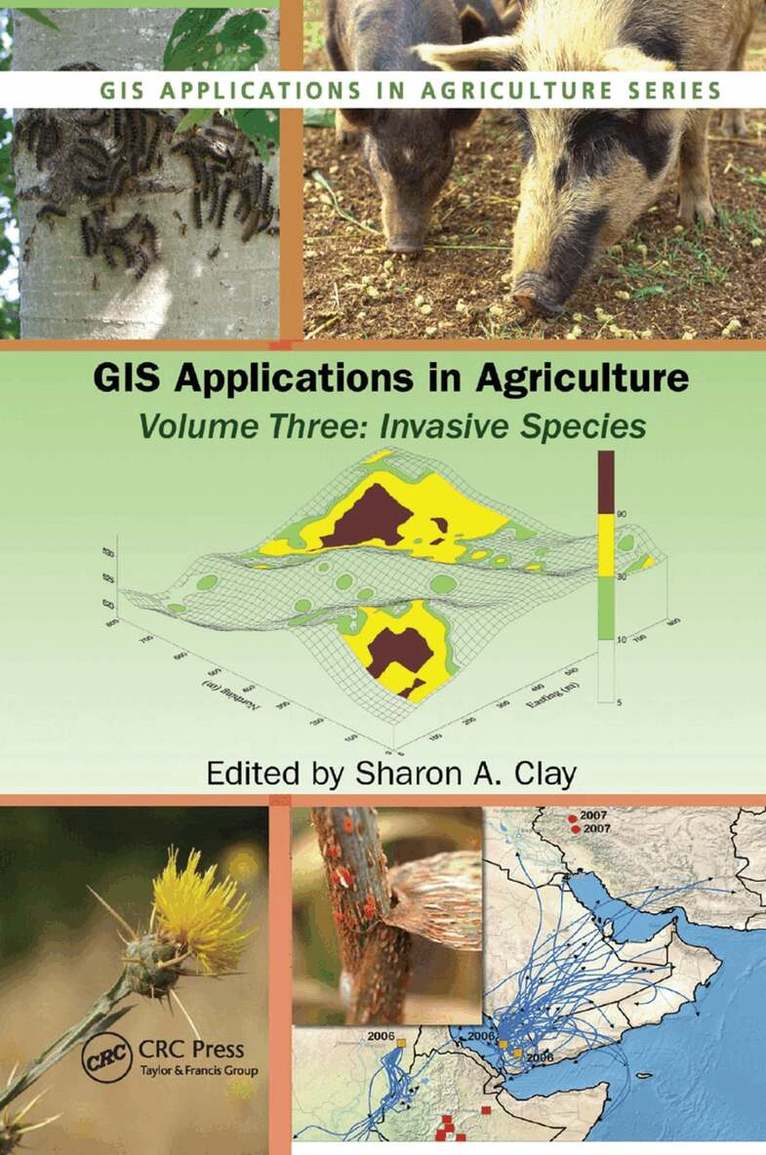
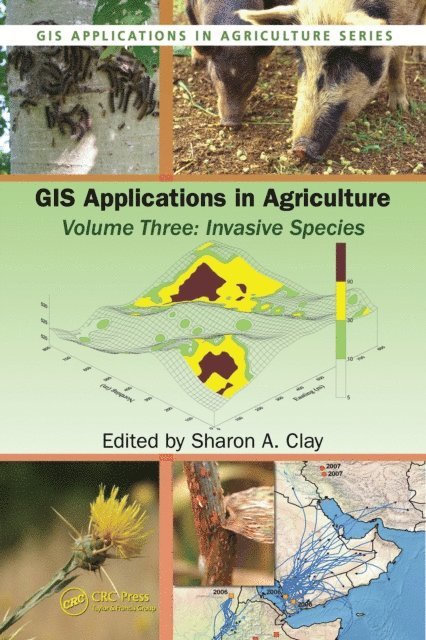
While many "alien" plant and animal species are purposefully introduced into new areas as ornamentals, livestock, crops, and even pets, these species can escape into other areas and threaten agricultural and native ecosystems causing economic and environmental harm, or harm to human health. Increasingly, scientists are using Geographic Information Systems (GIS) to track and manage the invaders, mitigate the potential rate of spread and level of impact, and protect the native economy and ecosystem.
Beginning with an introduction to the use of GIS technology to capture, store, analyze, manage, and present data, GIS Applications in Agriculture, Volume Three: Invasive Species examines five relevant categories of geographic information including dispersal and transport, prediction and forecasting, mapping of current infestations, maps for management and control tactics, and impact assessment and method of control. It address GIS for studying the population ecology of a new species, niche requirements for species success, and the monitoring and control of several different species including Australian examples of intentionally introduced invasive species, insects and other animals that may also vector a disease, and invasive weed management from prediction to management.
Chapters cover maps and imageries available on various Web sites and provide step-by-step tutorials or case studies that allow manipulation of datasets featured on the accompanyingdownloadable resources to make maps, perform statistical analyses, and predict future problems. It offers hands-on experience with a variety of software programs that create interactive queries (user-created searches), analyze spatial information, edit data and maps, and present the results of these operations in several different formats. Some of the programs are freeware, others are not, but each can be used to integrate, edit, share, and display geographic information. Color figures are
2 635 kr
Skickas inom 10-15 vardagar
1 073 kr
Läs direkt efter köp
While many "alien" plant and animal species are purposefully introduced into new areas as ornamentals, livestock, crops, and even pets, these species can escape into other areas and threaten agricultural and native ecosystems causing economic and environmental harm, or harm to human health. Increasingly, scientists are using Geographic Information Systems (GIS) to track and manage the invaders, mitigate the potential rate of spread and level of impact, and protect the native economy and ecosystem.
Beginning with an introduction to the use of GIS technology to capture, store, analyze, manage, and present data, GIS Applications in Agriculture, Volume Three: Invasive Species examines five relevant categories of geographic information including dispersal and transport, prediction and forecasting, mapping of current infestations, maps for management and control tactics, and impact assessment and method of control. It address GIS for studying the population ecology of a new species, niche requirements for species success, and the monitoring and control of several different species including Australian examples of intentionally introduced invasive species, insects and other animals that may also vector a disease, and invasive weed management from prediction to management.
Chapters cover maps and imageries available on various Web sites and provide step-by-step tutorials or case studies that allow manipulation of datasets featured on the accompanyingdownloadable resources to make maps, perform statistical analyses, and predict future problems. It offers hands-on experience with a variety of software programs that create interactive queries (user-created searches), analyze spatial information, edit data and maps, and present the results of these operations in several different formats. Some of the programs are freeware, others are not, but each can be used to integrate, edit, share, and display geographic information. Color figures are