Simon Bronitt – författare
644 kr
Skickas inom 10-15 vardagar
2 087 kr
Skickas inom 10-15 vardagar
774 kr
Skickas inom 10-15 vardagar
913 kr
Läs direkt efter köp
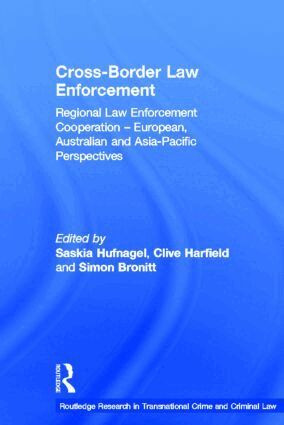
This innovative volume explores issues of law enforcement cooperation across borders from a variety of disciplinary perspectives. In doing so it adopts a comparative framework hitherto unexplored; namely the EU and the Australsian/Asia-Pacific region whose relative geopolitical remoteness from each other decreases with every incremental increase in globalisation. The borders under examination include both macro-level cooperation between nation-states, as well as micro-level cooperation between different Executive agencies within a nation-state. In terms of disciplinary borders the contributions demonstrate the breadth of academic insight that can be brought to bear on this topic. The volume contributes to the wider context for evidence-based policy-making and knowledge-based policing by bringing together leading academics, public policy-makers, legal practitioners and law enforcement officials from Europe, Australia and the Asian-Pacific region, to shed new light on the pressing problems impeding cross-border policing and law enforcement globally and regionally. Problems common to all jurisdictions are discussed and innovative ‘best practice’ solutions and models are considered.
The book is structured in four parts: Police cooperation in the EU; in Australia; in the Asia-Pacific Region; and finally it considers issues of jurisdiction and due process/human rights issues, with a focus on regional cooperation strategies for countering human trafficking, organised crime and terrorism.
The book will be of interest to both academic and practitioner communities in policing, criminology, international relations, and comparative Asia-Pacific and EU legal studies.
913 kr
Läs direkt efter köp
This innovative volume explores issues of law enforcement cooperation across borders from a variety of disciplinary perspectives. In doing so it adopts a comparative framework hitherto unexplored; namely the EU and the Australsian/Asia-Pacific region whose relative geopolitical remoteness from each other decreases with every incremental increase in globalisation. The borders under examination include both macro-level cooperation between nation-states, as well as micro-level cooperation between different Executive agencies within a nation-state. In terms of disciplinary borders the contributions demonstrate the breadth of academic insight that can be brought to bear on this topic. The volume contributes to the wider context for evidence-based policy-making and knowledge-based policing by bringing together leading academics, public policy-makers, legal practitioners and law enforcement officials from Europe, Australia and the Asian-Pacific region, to shed new light on the pressing problems impeding cross-border policing and law enforcement globally and regionally. Problems common to all jurisdictions are discussed and innovative ‘best practice’ solutions and models are considered.
The book is structured in four parts: Police cooperation in the EU; in Australia; in the Asia-Pacific Region; and finally it considers issues of jurisdiction and due process/human rights issues, with a focus on regional cooperation strategies for countering human trafficking, organised crime and terrorism.
The book will be of interest to both academic and practitioner communities in policing, criminology, international relations, and comparative Asia-Pacific and EU legal studies.
2 087 kr
Skickas inom 10-15 vardagar
758 kr
Läs direkt efter köp
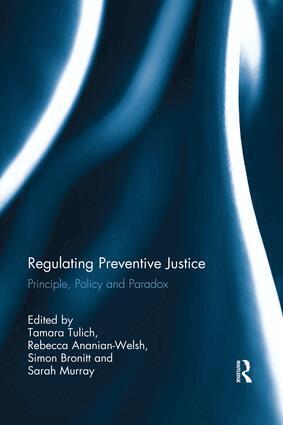
Like medicine, law is replete with axioms of prevention. ‘Prevention is better than cure’ has a long pedigree in both fields. 17th century jurist Sir Edward Coke observed that ‘preventing justice excelleth punishing justice’. A century later, Sir William Blackstone similarly stated that ‘preventive justice is ...preferable in all respects to punishing justice’. This book evaluates the feasibility and legitimacy of state attempts to regulate prevention. Though prevention may be desirable as a matter of policy, questions are inevitably raised as to its limits and legitimacy, specifically, how society reconciles the desirability of averting risks of future harm with respect for the rule of law, procedural fairness and human rights.
While these are not new questions for legal scholars, they have been brought into sharper relief in policy and academic circles in the wake of the September 11 terrorist attacks. Over the past 15 years, a body of legal scholarship has tracked the intensified preventive focus of anti-terrorism law and policy, observing how this focus has impacted negatively upon traditional legal frameworks. However, preventive law and policy in other contexts, such as environmental protection, mental health, immigration and corruption has not received sustained focus. This book extends that body of scholarship, through use of case studies from these diverse regulatory settings, in order to examine and critique the principles, policies and paradoxes of preventive justice.
"Whereas earlier scholars looked upon preventive justice as a source and means of regulation, the powerfully argued contributions to this volume provide forceful reasons to consider whether we would do better talk about regulating preventive justice."
Professor Lucia Zedner, Oxford University
758 kr
Läs direkt efter köp
Like medicine, law is replete with axioms of prevention. ‘Prevention is better than cure’ has a long pedigree in both fields. 17th century jurist Sir Edward Coke observed that ‘preventing justice excelleth punishing justice’. A century later, Sir William Blackstone similarly stated that ‘preventive justice is ...preferable in all respects to punishing justice’. This book evaluates the feasibility and legitimacy of state attempts to regulate prevention. Though prevention may be desirable as a matter of policy, questions are inevitably raised as to its limits and legitimacy, specifically, how society reconciles the desirability of averting risks of future harm with respect for the rule of law, procedural fairness and human rights.
While these are not new questions for legal scholars, they have been brought into sharper relief in policy and academic circles in the wake of the September 11 terrorist attacks. Over the past 15 years, a body of legal scholarship has tracked the intensified preventive focus of anti-terrorism law and policy, observing how this focus has impacted negatively upon traditional legal frameworks. However, preventive law and policy in other contexts, such as environmental protection, mental health, immigration and corruption has not received sustained focus. This book extends that body of scholarship, through use of case studies from these diverse regulatory settings, in order to examine and critique the principles, policies and paradoxes of preventive justice.
"Whereas earlier scholars looked upon preventive justice as a source and means of regulation, the powerfully argued contributions to this volume provide forceful reasons to consider whether we would do better talk about regulating preventive justice."
Professor Lucia Zedner, Oxford University
1 323 kr
Läs direkt efter köp
1 276 kr
Läs direkt efter köp
1 286 kr
Skickas inom 10-15 vardagar
518 kr
Skickas inom 10-15 vardagar
557 kr
Läs direkt efter köp
1 222 kr
Skickas inom 10-15 vardagar
613 kr
Tillfälligt slut
467 kr
Tillfälligt slut
868 kr
Tillfälligt slut