Srividya Ramasubramanian - Böcker
Visar alla böcker från författaren Srividya Ramasubramanian. Handla med fri frakt och snabb leverans.
5 produkter
5 produkter
1 672 kr
Skickas inom 5-8 vardagar
The urgency and complexity of contemporary social justice issues facing the world today mean that activists, scholars, and storytellers need a readily available compendium of cutting-edge scholarship on media and social justice. The Oxford Handbook of Media and Social Justice gathers over forty leading scholars and presents a state-of-the-art systematic overview of media and social justice. Representing leading voices across positionalities and perspectives, geographies and generations, meta-theories and methods, and issues and identities, the Handbook explores intersecting identities, social structures, and power networks within media ownership, representation, selection, uses, effects, networks, and social transformation. These theories, methods, and practices expose media and digital divides, polarization, marginalization, exclusion, alienation, invisibilities, stigma, and trivializations. Yet, they also showcase how individuals and communities also have agency through refusal and resistance. Each of the 32 chapters includes a brief history, key concepts, contemporary debates and dialogues, and future directions, and the volume concludes with reflections on resistances, reckoning, and reparative justice.Connecting critical media scholarship with intersectional feminism, postcolonial/anticolonial theory, Indigenous approaches, queer theory, diaspora studies, and environmental justice frameworks, the Handbook re-envisions the role of media and technology with an inclusive trauma-informed approach to scholarship that is essential for the future of this research.
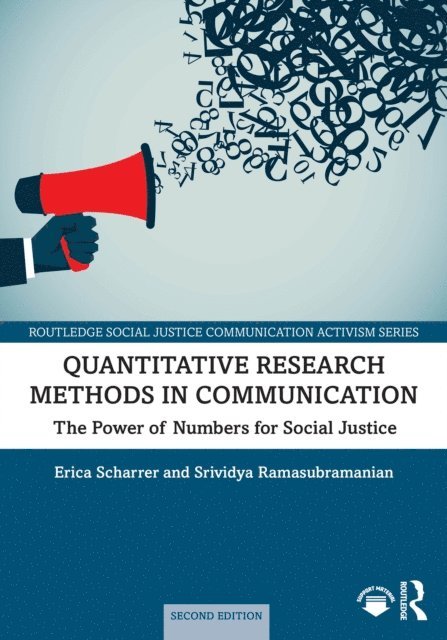
Quantitative Research Methods in Communication
The Power of Numbers for Social Justice
Häftad, Engelska, 2025
940 kr
Skickas inom 10-15 vardagar
This fully updated second edition offers an advanced introduction to quantitative methods that focuses on why and how to conduct research that contributes to social justice.Providing both inspiration and step-by-step guidance on how to conceive, design, and carry out a quantitative study, the book shows how research can be used to work toward a more just and equitable world. The authors provide a detailed guide to quantitative methods and statistical analysis, showing how researchers can engage with social justice issues in systematic, rigorous, ethical, and meaningful ways. This new edition includes a new chapter on writing literature reviews and better aligns with the stages of quantitative research as well as the changing technologies that are available for researchers to both study and use in their work. It includes updated real-world case studies, interviews with scholar-activists, and definitions of key concepts as well as a deeper focus on ethics, social media, computational social sciences, data analytics, and data visualization techniques.Attuned to questions of access, equity, justice, diversity, and inclusion, this textbook is ideal for graduate and advanced undergraduate courses in research methods for communication and the social sciences. It will also be of interest to researchers who wish to engage with the transformation of structures, practices, and understandings in society through community and civic engagement and policy formation.Online resources for instructors include a test bank, PowerPoint slides, sample dataset, and YouTube tutorials. They are available online at www.routledge.com/9781032599878.
Quantitative Research Methods in Communication
The Power of Numbers for Social Justice
Inbunden, Engelska, 2025
2 103 kr
Skickas inom 10-15 vardagar
This fully updated second edition offers an advanced introduction to quantitative methods that focuses on why and how to conduct research that contributes to social justice.Providing both inspiration and step-by-step guidance on how to conceive, design, and carry out a quantitative study, the book shows how research can be used to work toward a more just and equitable world. The authors provide a detailed guide to quantitative methods and statistical analysis, showing how researchers can engage with social justice issues in systematic, rigorous, ethical, and meaningful ways. This new edition includes a new chapter on writing literature reviews and better aligns with the stages of quantitative research as well as the changing technologies that are available for researchers to both study and use in their work. It includes updated real-world case studies, interviews with scholar-activists, and definitions of key concepts as well as a deeper focus on ethics, social media, computational social sciences, data analytics, and data visualization techniques.Attuned to questions of access, equity, justice, diversity, and inclusion, this textbook is ideal for graduate and advanced undergraduate courses in research methods for communication and the social sciences. It will also be of interest to researchers who wish to engage with the transformation of structures, practices, and understandings in society through community and civic engagement and policy formation.Online resources for instructors include a test bank, PowerPoint slides, sample dataset, and YouTube tutorials. They are available online at www.routledge.com/9781032599878.
575 kr
Skickas inom 10-15 vardagar
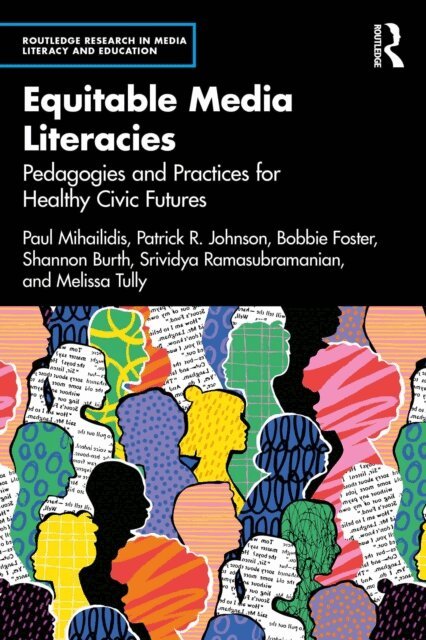
Interrogating three core assumptions made within the field of media literacy—that media literacy practices empower individuals, support communities, and contribute to engaged citizenship within a democracy—this book presents a new framework for equitable media literacy practices.Using the results of a large-scale research project to interrogate these long-held assumptions and explore the connection between impactful media literacy practices and equity, the authors demonstrate the crucial need to shift the focus of media literacy practices from that of individual skill transfer to that of equity-driven community-oriented media practices. They offer a clear framework for embracing equity and inclusion at the outset of media literacy intervention, focusing on the Six E’s Framework, the Equitable Media Literacy Practice Model, and a Field Guide with the five categories for practice: Where Do I Stand, Who Cares, Imagining Inclusive Futures, With Community, and Where Do We Stand. Each category repositions media literacies with explicit focus on inclusion, justice, and the pursuit of equitable futures.This book will appeal to students and scholars studying and researching in the space of media literacy, digital culture, social justice, and equity in media and communication studies departments and beyond, as well as those working at the educational and policy level around issues of media literacy, media education, and civic engagement.
Equitable Media Literacies
Pedagogies and Practices for Healthy Civic Futures
Inbunden, Engelska, 2025
2 103 kr
Skickas inom 10-15 vardagar
Interrogating three core assumptions made within the field of media literacy—that media literacy practices empower individuals, support communities, and contribute to engaged citizenship within a democracy—this book presents a new framework for equitable media literacy practices.Using the results of a large-scale research project to interrogate these long-held assumptions and explore the connection between impactful media literacy practices and equity, the authors demonstrate the crucial need to shift the focus of media literacy practices from that of individual skill transfer to that of equity-driven community-oriented media practices. They offer a clear framework for embracing equity and inclusion at the outset of media literacy intervention, focusing on the Six E’s Framework, the Equitable Media Literacy Practice Model, and a Field Guide with the five categories for practice: Where Do I Stand, Who Cares, Imagining Inclusive Futures, With Community, and Where Do We Stand. Each category repositions media literacies with explicit focus on inclusion, justice, and the pursuit of equitable futures.This book will appeal to students and scholars studying and researching in the space of media literacy, digital culture, social justice, and equity in media and communication studies departments and beyond, as well as those working at the educational and policy level around issues of media literacy, media education, and civic engagement.