Stanley N. Salthe - Böcker
Visar alla böcker från författaren Stanley N. Salthe. Handla med fri frakt och snabb leverans.
3 produkter
3 produkter
2 054 kr
Skickas inom 3-6 vardagar
A bold effort to find a functional and transactional framework for synthetic evolutionary theory, "Evolving Hierarchical Systems" seeks to represent the order in nature by discriminating a hierarchical system and defining the logical boundaries of the concepts inherent in this system (such as time, causality, complexity, partitioning, scale, and polarity). Salthe's basic assumption is that the world is unlimitedly complex. Biology and some other sciences, such as geology and applied physics, have become entangled in this complexity with, the author writes, 'as little ability to negotiate it as a fly in a spider's web'. He argues that biological nature in particular is undercharacterized in our representations, and because of that so is the rest of nature. The book first describes the principles of hierarchical structure and discusses the process of discovering the relevant aspects of the hierarchy of nature.It then brings in the concept of self-reference and moves onto an interpretation and explanation of organic evolution in this framework.While Salthe's focus is in biology, the outline of a hierarchy theory he presents is asserted to be a 'philosophical machine' that can be applied as a hermeneutical tool to many fields of inquiry concerned with change in complex systems. Felt by the author to also be a response to Jacques Monod's "Chance and Necessity", this book is a significant statement on the hierarchical organization of the surface of the earth. It is provocative reading not only for biologists but also for anthropologists, sociologists, geologists, and scientists interested in general systems research.
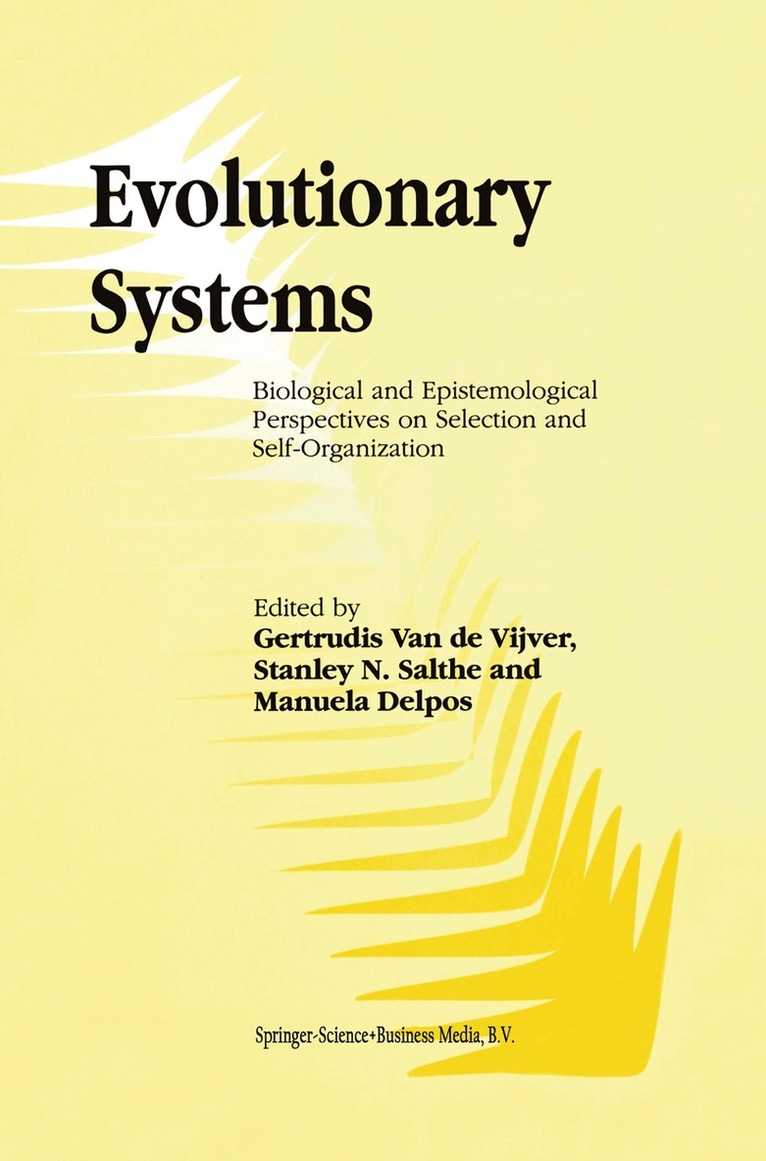
Evolutionary Systems
Biological and Epistemological Perspectives on Selection and Self-Organization
Inbunden, Engelska, 1998
1 787 kr
Skickas inom 10-15 vardagar
To understand how complex dynamic systems, living or non-living, linguistic or non-linguistic, come to be organized as systems, to understand how their inherent dynamic nature gives rise to organizations and forms that have found a balance between potentiality for change and evolution on the one hand, and requisite stability in a given environment on the other, is the main ambition of the study of evolutionary systems. The aim of the present volume is to elucidate the scientific and philosophical backgrounds that play a role in the debate taking place in evolutionary systems, namely that on the relation between selection and self-organization. The book represents an interdisciplinary forum in which the major representatives of evolutionary systems take part.
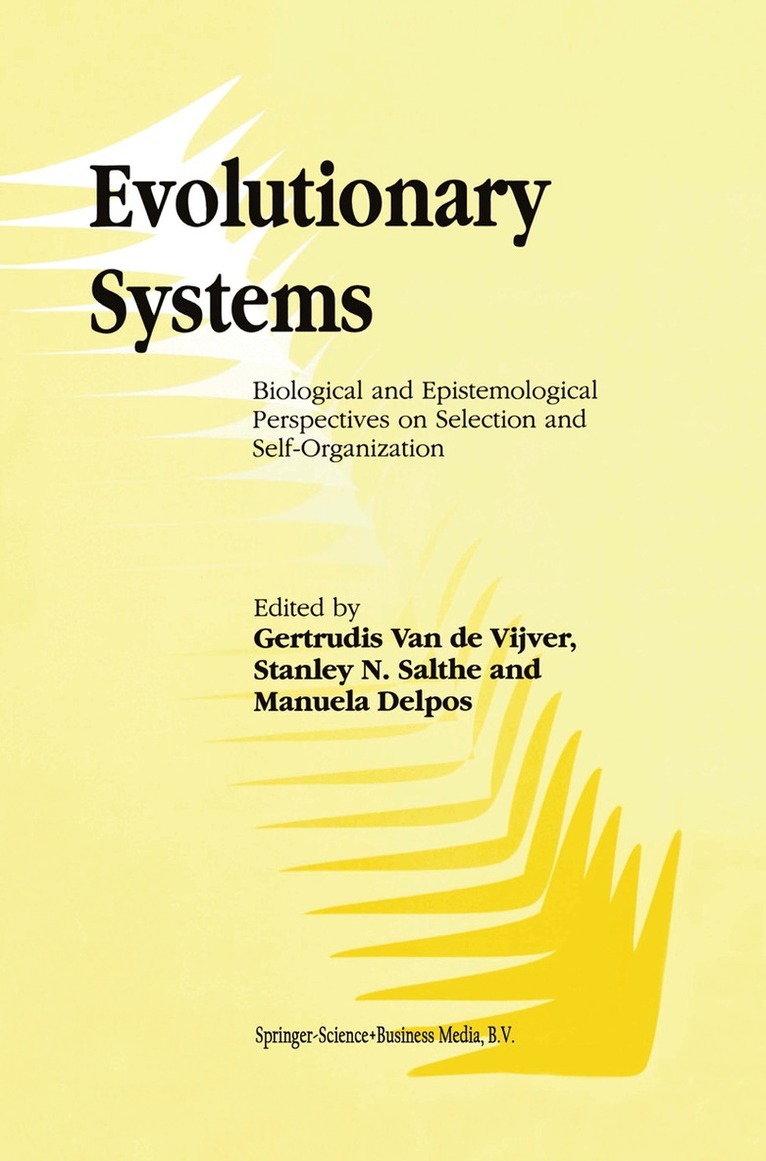
Evolutionary Systems
Biological and Epistemological Perspectives on Selection and Self-Organization
Häftad, Engelska, 2010
1 787 kr
Skickas inom 10-15 vardagar
To understand how complex dynamic systems, living or non-living, linguistic or non-linguistic, come to be organized as systems, to understand how their inherent dynamic nature gives rise to organisations and forms that have found a balance between potentiality for change and evolution on the one hand, and requisite stability in a given environment on the other, is the main ambition of the study of evolutionary systems. The aim of the present volume is to elucidate the scientific and philosophical backgrounds that play a role in one of the major debates taking place in that field, namely that on the relation between selection and self-organization. The book represents a genuine interdisciplinary forum in which the major representatives of evolutionary systems take part. Audience: This volume will be interest to biologists, philosophers of science, systems scientists, mathematicians, physicists, sociologists of science. It is highly recommended to those interested in an interdisciplinary and complex approach to evolution, as well as to those interested in developing a genuinely historical viewpoint in the sciences.