• Fri frakt över 249 kr
  • •
  • Snabba leveranser
  • •
  • Billiga böcker
Kundservice

Du är på sajten för privatpersoner.

Företag, bibliotek eller offentlig verksamhet?

Du handlar på classic.bokus.com, där alla dina funktioner finns intakta.
Till classic.bokus.com
Bokus logotyp. Gå till startsidan.
  • Erbjudanden
  • Nyheter
  • Student
  • Topplistor
  • Barn & ungdom
  • Bokus Play
  • E-böcker
  • Pocketböcker
  • Spel & pussel

10% rabatt på allt med kod NYSTART10 →

Sidfot

Mina sidor

    Hjälp

    • Kundservice
    • Vanliga frågor och svar
    • Frakt och leverans
    • Retur vid ångerrätt
    • Reklamera vara
    • Betalning
    • Köpvillkor
    • Allmänna villkor
    • Information om webbplatsens tillgänglighet

    Om Bokus

    • Om oss
    • Pressrum
    • För studenter
    • För företag
    • För bibliotek och offentlig verksamhet
    • För leverantörer
    • Hållbarhet

    Populärt

    • Aktuella erbjudanden
    • Presentkort
    • Studentlitteratur
    • Nya böcker
    • Topplistor
    • Signerade böcker
    • Engelska böcker

    Inspiration

    • Boktips
    • BookTok
    • Populära bokserier
    • Barnbokskaraktärer
    • Populära författare
    Logotyp för Bokus
    Följ oss på Facebook (extern länk)Följ oss på Instagram (extern länk)Följ oss på YouTube (extern länk)Följ oss på TikTok (extern länk)
    bokus @ CookiesAnpassa cookiesIntegritetspolicyKöpvillkor
    Till Citymail hemsida (extern länk)Till Budbee hemsida (extern länk)Till Postnord hemsida (extern länk)Till Schenker hemsida (extern länk)Till Early Bird hemsida (extern länk)Till Walleys hemsida (extern länk)
    1. Naturvetenskap och teknik
    2. Matematik och naturvetenskap
    3. Biologi
    4. Biovetenskap

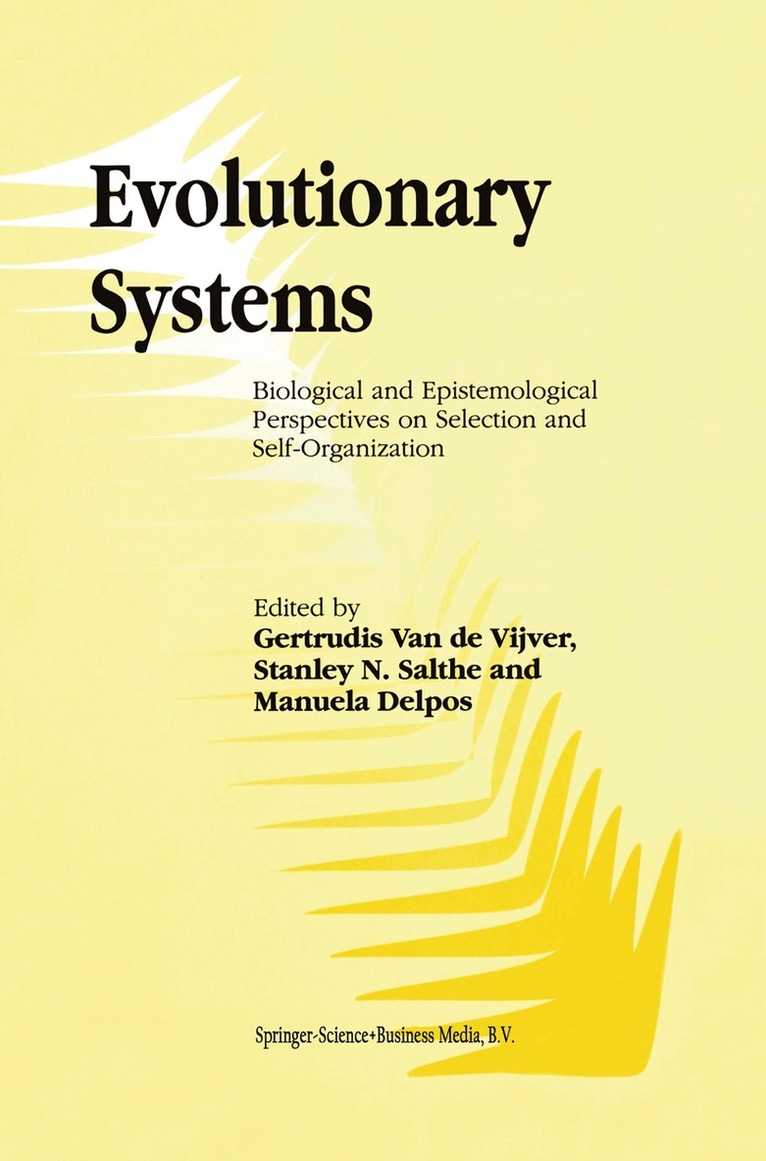
    Evolutionary Systems

    Biological and Epistemological Perspectives on Selection and Self-Organization

    AvGertrudis Van De Vijver,Manuela Delpos

    Inbunden, Engelska, 1998

    1 839 kr

    Beställningsvara. Skickas inom 10-15 vardagar. Fri frakt över 249 kr.

    Beskrivning

    The three well known revolutions of the past centuries - the Copernican, the Darwinian and the Freudian - each in their own way had a deflating and mechanizing effect on the position of humans in nature. They opened up a richness of disillusion: earth acquired a more modest place in the universe, the human body and mind became products of a long material evolutionary history, and human reason, instead of being the central, immaterial, locus of understanding, was admitted into the theater of discourse only as a materialized and frequently out-of-control actor. Is there something objectionable to this picture? Formulated as such, probably not. Why should we resist the idea that we are in certain ways, and to some degree, physically, biologically or psychically determined? Why refuse to acknowledge the fact that we are materially situated in an ever evolving world? Why deny that the ways of inscription (traces of past events and processes) are co-determinative of further "evolutionary pathways"? Why minimize the idea that each intervention, of each natural being, is temporally and materially situated, and has, as such, the inevitable consequence of changing the world? The point is, however, that there are many, more or less radically different, ways to consider the "mechanization" of man and nature. There are, in particular, many ways to get the message of "material and evolutionary determination", as well as many levels at which this determination can be thought of as relevant or irrelevant.

    Produktinformation

    • Utgivningsdatum:1998-10-31
    • Mått:155 x 235 x 29 mm
    • Vikt:846 g
    • Format:Inbunden
    • Språk:Engelska
    • Antal sidor:438
    • Upplaga:1998
    • Förlag:Kluwer Academic Publishers
    • ISBN:9780792352600

    Utforska kategorier

    • Biovetenskap inom Naturvetenskap och teknik
    • Naturvetenskapens filosofi inom Naturvetenskap och teknik

    Recensioner i media

    '...the book is a statement of exciting open problems at the interface of self-organization and selection, and of how multidisciplinary perspectives can help refine evolutionary theory. It should prove valuable to future work on the subject.' The Quarterly Review of Biology, 76:3(2001)

    Innehållsförteckning

    • Evolution: Model or metaphor?.- The role of natural selection theory in understanding evolutionary systems.- Darwinism and developmentalism: Prospects for convergence.- Towards high evolvability dynamics.- The beginning of the end: On the origin of final cause.- Emergence of life and biological selection from the perspective of complex systems dynamics.- Self-organization and self-construction of order.- Self-organization and optimization: Conflicting or complementary approaches?.- Pleiotropy and the evolution of adaptibility.- The unified theory and selection processes.- Information increase in biological systems: How does adaptation fit?.- Canonical ensembles, evolution of competing species, and the arrow of time.- Spontaneous order, evolution, and autocatakinetics: The nomological basis for the emergence of meaning.- Pragmatic information and the emergence of meaning.- Emergence of chaos in evolving Volterra ecosystems.- Immanent causality: A Spinozist viewpoint on evolution and theory of action.- Causality as constraint.- Evolutionary systems and the four causes: A real Aristotelian story?.- Evolution as its own cause and effect.- Dealing with complex systems or how to decipher language and organisms.- The unfolding semiosphere.- Competence of natural languages for describing the physical origin of life.- Towards a “meta-ethic” derived from evolutionary lineages.- On some relations between cognitive and organic evolution.- Selected self-organization and the semiotics of evolutionary systems.- Towards an evolutionary semiotics: The emergence of new sign-functions in organisms and devices.- The evolution of the symbolic domain in living systems and artificial life.- Embodiment of natural and artificial agents.- Are life and meaning coextensive ?.