Steffen Jorgensen – författare
Visar alla böcker från författaren Steffen Jorgensen. Handla med fri frakt och snabb leverans.
7 produkter
7 produkter
Häftad, Engelska, 2000
749 kr
Skickas inom 7-10 vardagar
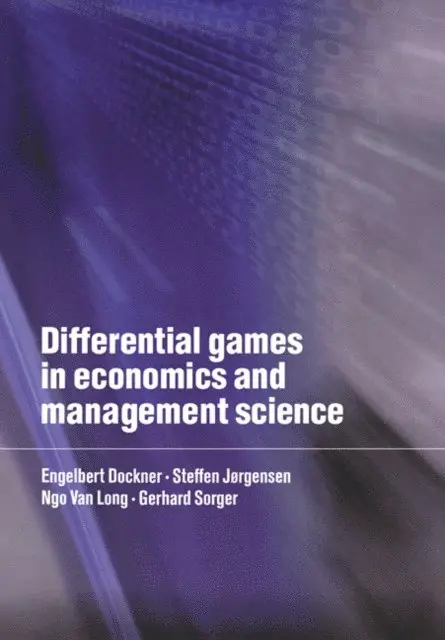
A comprehensive, self-contained survey of the theory and applications of differential games, one of the most commonly used tools for modelling and analysing economics and management problems which are characterised by both multiperiod and strategic decision making. Although no prior knowledge of game theory is required, a basic knowledge of linear algebra, ordinary differential equations, mathematical programming and probability theory is necessary. Part One presents the theory of differential games, starting with the basic concepts of game theory and going on to cover control theoretic models, Markovian equilibria with simultaneous play, differential games with hierarchical play, trigger strategy equilibria, differential games with special structures, and stochastic differential games. Part Two offers applications to capital accumulation games, industrial organization and oligopoly games, marketing, resources and environmental economics.
Del 9 - Annals of the International Society of Dynamic Games
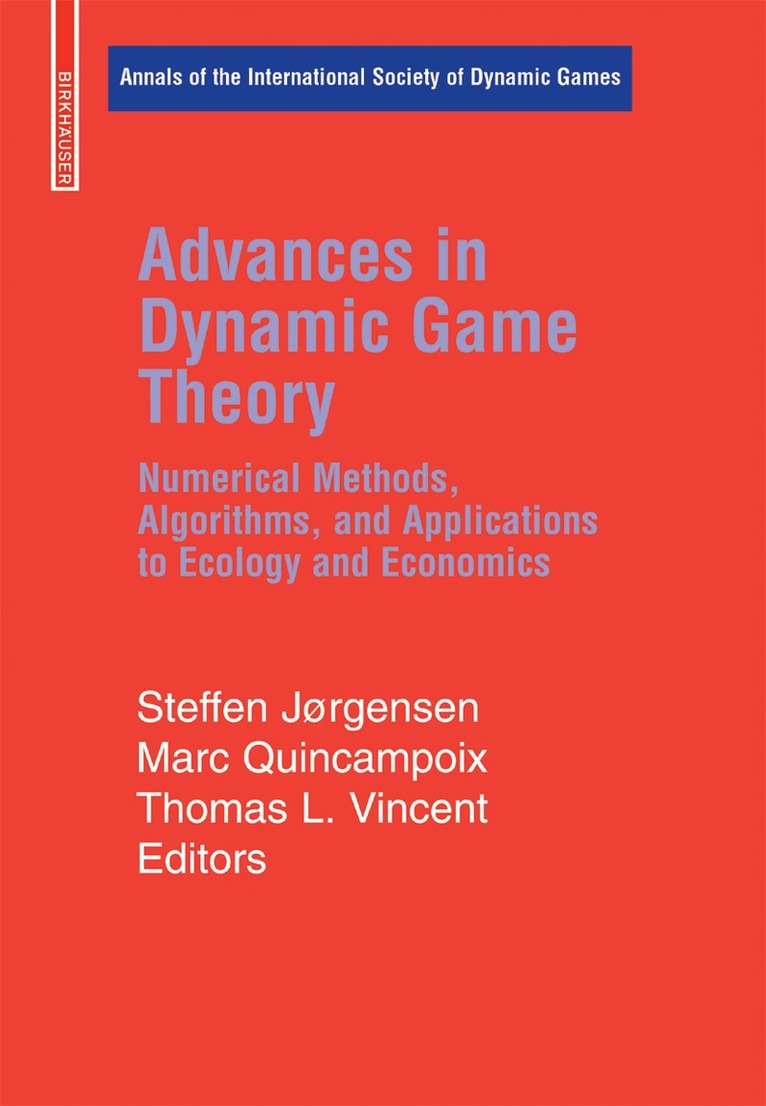
Advances in Dynamic Game Theory
Numerical Methods, Algorithms, and Applications to Ecology and Economics
Inbunden, Engelska, 2007
1 616 kr
Skickas inom 10-15 vardagar
The theory of dynamic games continues to evolve, and one purpose of this volume is to report a number of recent theoretical advances in the ?eld, which are covered in Parts I, II and IV. Another aim of this work is to present some new applications of dynamic games in various areas, including pursuit-evasion games (Part III), ecology (Part IV), and economics (Part V). The volume concludes with a number of contributions in the ?eld of numerical methods and algorithms in dynamic games (Part VI). With a single exception, the contributions of this volume are outgrowths of talks that were presented at the Eleventh International Symposium on Dynamic Games and Applications, held in Tucson, Arizona, USA, in December 2004, and organized by the International Society of Dynamic Games. The symposium was co-sponsored by the University of Arizona, College of Engineering and Aerospace and Mechanical Engineering, as well as GERAD, Montréal, Canada, and the ISDG Organizing Society. The volume contains thirty-?ve chapters that have been peer-reviewed according to the standards of international journals in game theory and applications. Part I deals with the theory of dynamic games and contains six chapters. Cardaliaguet, Quincampoix, and Saint-Pierre provide a survey of the state-- the-art of the use of viability theory in the formulation and analysis of differential games, in particular zero-sum games. An important result of viability theory is that many zero-sum differential games can be formulated as viability problems.
E-bok
PDF, Engelska, 20072 049 kr
Läs direkt efter köp
The theory of dynamic games continues to evolve, and one purpose of this volume is to report a number of recent theoretical advances in the ?eld, which are covered in Parts I, II and IV. Another aim of this work is to present some new applications of dynamic games in various areas, including pursuit-evasion games (Part III), ecology (Part IV), and economics (Part V). The volume concludes with a number of contributions in the ?eld of numerical methods and algorithms in dynamic games (Part VI). With a single exception, the contributions of this volume are outgrowths of talks that were presented at the Eleventh International Symposium on Dynamic Games and Applications, held in Tucson, Arizona, USA, in December 2004, and organized by the International Society of Dynamic Games. The symposium was co-sponsored by the University of Arizona, College of Engineering and Aerospace and Mechanical Engineering, as well as GERAD, Montréal, Canada, and the ISDG Organizing Society. The volume contains thirty-?ve chapters that have been peer-reviewed according to the standards of international journals in game theory and applications. Part I deals with the theory of dynamic games and contains six chapters. Cardaliaguet, Quincampoix, and Saint-Pierre provide a survey of the state-- the-art of the use of viability theory in the formulation and analysis of differential games, in particular zero-sum games. An important result of viability theory is that many zero-sum differential games can be formulated as viability problems.
E-bok
PDF, Engelska, 2000913 kr
Läs direkt efter köp
A comprehensive, self-contained survey of the theory and applications of differential games, one of the most commonly used tools for modelling and analysing economics and management problems which are characterised by both multiperiod and strategic decision making. Although no prior knowledge of game theory is required, a basic knowledge of linear algebra, ordinary differential equations, mathematical programming and probability theory is necessary. Part One presents the theory of differential games, starting with the basic concepts of game theory and going on to cover control theoretic models, Markovian equilibria with simultaneous play, differential games with hierarchical play, trigger strategy equilibria, differential games with special structures, and stochastic differential games. Part Two offers applications to capital accumulation games, industrial organization and oligopoly games, marketing, resources and environmental economics.
E-bok
PDF, Engelska, 20122 110 kr
Läs direkt efter köp
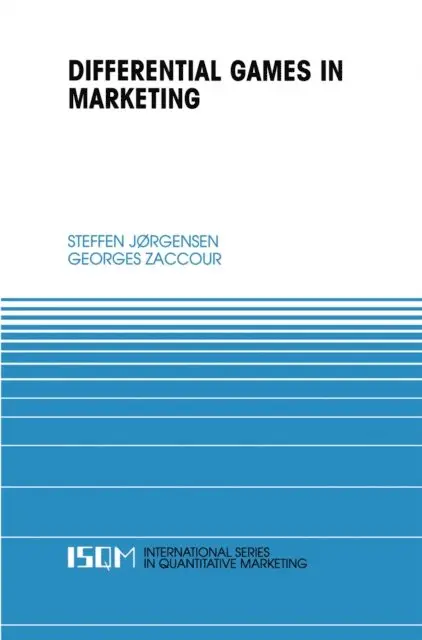
Game theory has proven useful to represent and conceptualize problems of conflict and cooperation in a formal way, and to predict the outcome of such situations. Differential games are dynamic games that are particularly designed to study systems where observations and decisions are made in real time. The book conveys to the reader the state of the art of research in marketing applications of differential game theory. This research started about 25 years ago and the literature has now reached an extent and a maturity that makes it natural to take stock. The book deals with differential games in advertising, pricing, and marketing channels, as well as with marketing-production and pricing-advertising interfaces. It provides also a tutorial on main concepts in differential games.
Del 444 - Lecture Notes in Economics and Mathematical Systems
Dynamic Competitive Analysis in Marketing
Proceedings of the International Workshop on Dynamic Competitive Analysis in Marketing, Montréal, Canada, September 1–2, 1995
Häftad, Engelska, 1996
1 079 kr
Skickas inom 10-15 vardagar
This volume contains a selection of papers that were presented at the International Workshop on Dynamic Competitive Analysis, held in Montr6al, Canada, September 1-2, 1995. The workshop was organized by the editors of the proceedings volume. The proceedings contain both "full papers" and shorter pieces, to be considered as "work in progress". The choice of a rather broad theme for the workshop was deliberate and done in order to attract researchers from different areas of the marketing science community that usually do not get together. Obviously, a volume like this cannot be exhaustive in the coverage of the dynamics of marketing competition but we are confident that it will convey to the reader an impression of what are the current themes in this field of research. The book should be useful to researchers in marketing science, applied game theorists, graduate students, as well as practitioners in marketing with an interest in methods and examples of dynamic competitive analysis.
E-bok
PDF, Engelska, 20121 367 kr
Läs direkt efter köp
This volume contains a selection of papers that were presented at the International Workshop on Dynamic Competitive Analysis, held in Montr6al, Canada, September 1-2, 1995. The workshop was organized by the editors of the proceedings volume. The proceedings contain both "full papers" and shorter pieces, to be considered as "work in progress". The choice of a rather broad theme for the workshop was deliberate and done in order to attract researchers from different areas of the marketing science community that usually do not get together. Obviously, a volume like this cannot be exhaustive in the coverage of the dynamics of marketing competition but we are confident that it will convey to the reader an impression of what are the current themes in this field of research. The book should be useful to researchers in marketing science, applied game theorists, graduate students, as well as practitioners in marketing with an interest in methods and examples of dynamic competitive analysis.