Sten Lindstrom – författare
Visar alla böcker från författaren Sten Lindstrom. Handla med fri frakt och snabb leverans.
6 produkter
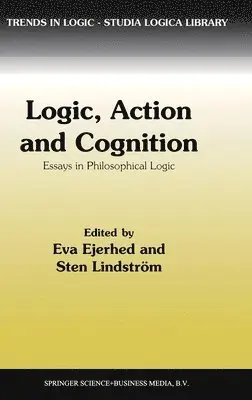
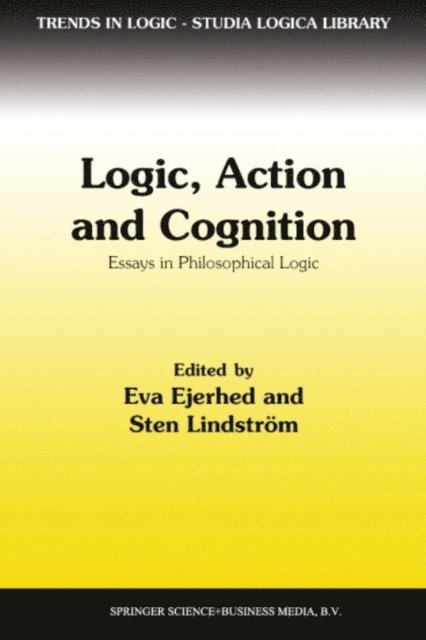
Logic, Action and Cognition
Essays in Philosophical Logic
Av Eva Ejerhed, Sten Lindstrom
Inbunden, 1997
879 kr
Lägg i varukorg
This book is divided into three parts. In the first part, Action, are collected papers that concern the formal theory of action, the logic of norms, and the theory of rational decision. The papers in the second part, Belief Change, concern the theory of belief dynamics. The third part, Cognition, …
Logicism, Intuitionism, and Formalism
What Has Become of Them?
Av Viggo Stoltenberg-Hansen, Krister Segerberg m. fl.
E-bok, 2008
4066 kr
Lägg i varukorg
Epistemology versus Ontology
Essays on the Philosophy and Foundations of Mathematics in Honour of Per Martin-Löf
Av B.G. Sundholm, Erik Palmgren m. fl.
E-bok, 2012
2925 kr
Lägg i varukorg
This book brings together philosophers, mathematicians and logicians to penetrate important problems in the philosophy and foundations of mathematics. In philosophy, one has been concerned with the opposition between constructivism and classical mathematics and the different ontological and …
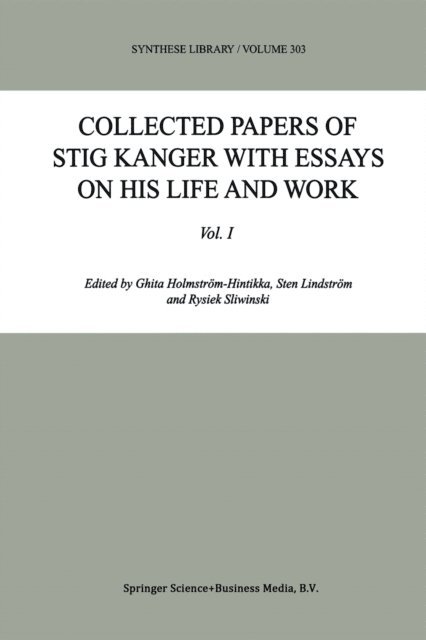
Collected Papers of Stig Kanger with Essays on his Life and Work
Av R. Sliwinski, Sten Lindstrom m. fl.
E-bok, 2012
1459 kr
Lägg i varukorg
Stig Kanger (1924-1988) made important contributions to logic and formal philosophy. Kanger''s dissertation Provability in Logic , 1957, contained significant results in proof theory as well as the first fully worked out model-theoretic interpretation of quantified modal logic. It is generally …
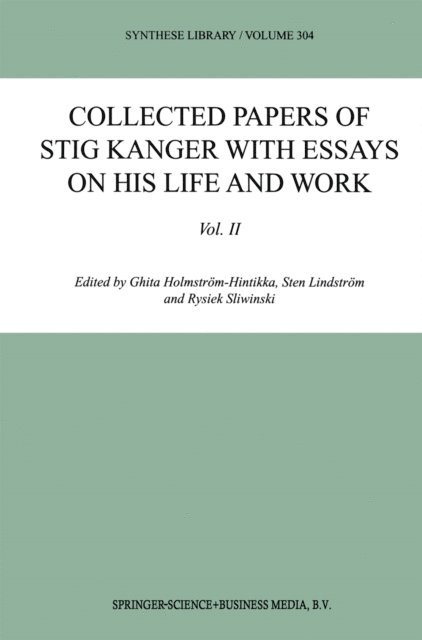
Collected Papers of Stig Kanger with Essays on his Life and Work Volume II
Av R. Sliwinski, Sten Lindstrom m. fl.
E-bok, 2012
1413 kr
Lägg i varukorg
Logic, Action and Cognition
Essays in Philosophical Logic
Av Sten Lindstrom, Eva Ejerhed
E-bok, 2012
734 kr
Lägg i varukorg
The present volume has its origin in a meeting of philosophers, linguists and cognitive scientists that was held at Umea University, Sweden, September 24-26, 1993. The meeting was organized by the Department of Philosophy in cooperation with the Department of Linguistics, and it was called …