Steven A. Orszag - Böcker
Visar alla böcker från författaren Steven A. Orszag. Handla med fri frakt och snabb leverans.
7 produkter
7 produkter
1 064 kr
Skickas inom 10-15 vardagar
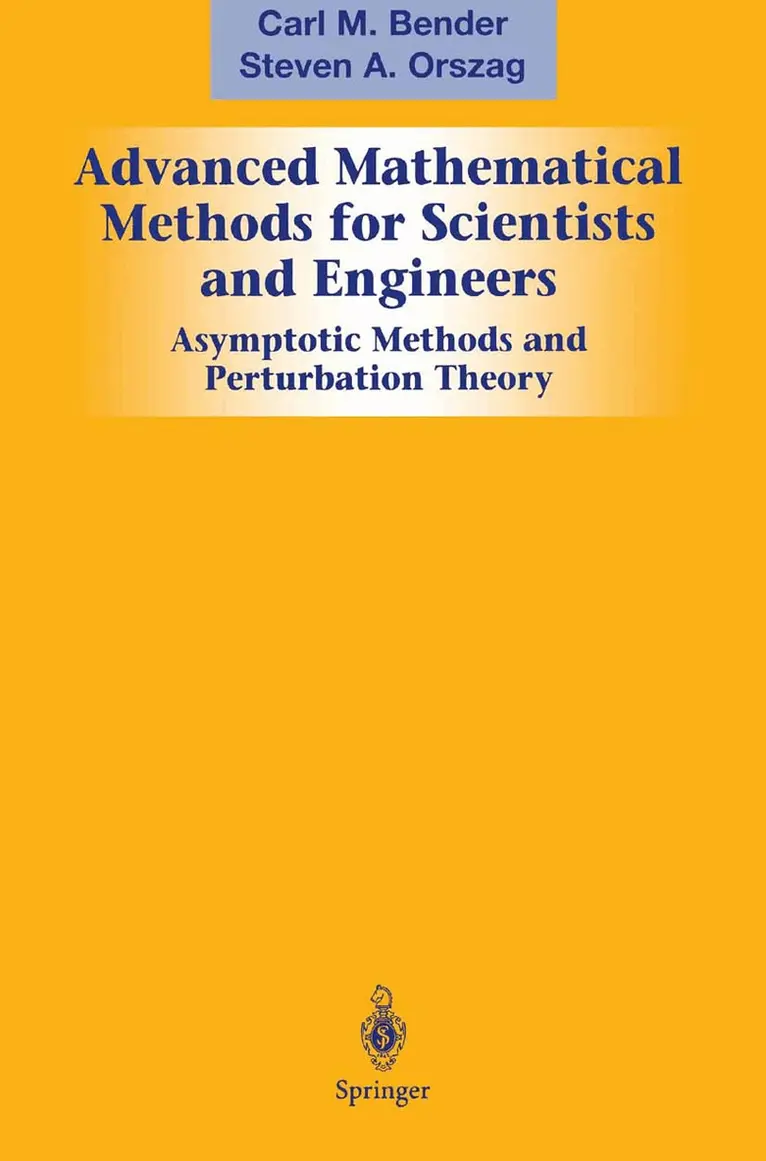
Advanced Mathematical Methods for Scientists and Engineers I
Asymptotic Methods and Perturbation Theory
Inbunden, Engelska, 1999
958 kr
Skickas inom 7-10 vardagar
-Sherlock Holmes, The Valley of Fear Sir Arthur Conan Doyle The main purpose of our book is to present and explain mathematical methods for obtaining approximate analytical solutions to differential and difference equations that cannot be solved exactly.
750 kr
Skickas inom 7-10 vardagar
Originally published in 1993, this book was the first to offer a comprehensive review of large eddy simulations (LES) - the history, state of the art, and promising directions for research. Among topics covered are fundamentals of LES; LES of incompressible, compressible, and reacting flows; LES of atmospheric, oceanic, and environmental flows; and LES and massivelt parallel computing. The book grew out of an international workshop that, for the first time, brought together leading researchers in engineering and geophysics to discuss developments and applications of LES models in their respective fields. It will be of value to anyone with an interest in turbulence modelling.
611 kr
Tillfälligt slut
A unified discussion of the formulation and analysis of special methods of mixed initial boundary-value problems. The focus is on the development of a new mathematical theory that explains why and how well spectral methods work. Included are interesting extensions of the classical numerical analysis.
Advanced Mathematical Methods for Scientists and Engineers I
Asymptotic Methods and Perturbation Theory
Häftad, Engelska, 2010
694 kr
Skickas inom 10-15 vardagar
-Sherlock Holmes, The Valley of Fear Sir Arthur Conan Doyle The main purpose of our book is to present and explain mathematical methods for obtaining approximate analytical solutions to differential and difference equations that cannot be solved exactly.
Supercomputers and Fluid Dynamics
Proceedings of the First Nobeyama Workshop September 3–6, 1985
Häftad, Engelska, 1986
1 064 kr
Skickas inom 10-15 vardagar
In the past several years, it has become apparent that computing will soon achieve a status within science and engineering to the classical scientific methods of laboratory experiment and theoretical analysis. The foremost tools of state-of-the-art computing applications are supercomputers, which are simply the fastest and biggest computers available at any given time. Supercomputers and supercomputing go hand-in-hand in pacing the development of scientific and engineering applications of computing. Experience has shown that supercomputers improve in speed and capability by roughly a factor 1000 every 20 years. Supercomputers today include the Cray XMP and Cray-2, manufactured by Cray Research, Inc., the Cyber 205, manufactured by Control Data Corporation, the Fujitsu VP, manufactured by Fujitsu, Ltd., the Hitachi SA-810/20, manufactured by Hitachi, Ltd., and the NEC SX, manufactured by NEC, Inc. The fastest of these computers are nearly three orders-of-magnitude faster than the fastest computers available in the mid-1960s, like the Control Data CDC 6600. While the world-wide market for supercomputers today is only about 50 units per year, it is expected to grow rapidly over the next several years to about 200 units per year.
Recent Advances in Computational Fluid Dynamics
Proceedings of the US/ROC (Taiwan) Joint Workshop on Recent Advances in Computational Fluid Dynamics
Häftad, Engelska, 1989
1 064 kr
Skickas inom 10-15 vardagar
From the preface: Fluid dynamics is an excellent example of how recent advances in computational tools and techniques permit the rapid advance of basic and applied science. The development of computational fluid dynamics (CFD) has opened new areas of research and has significantly supplemented information available from experimental measurements. Scientific computing is directly responsible for such recent developments as the secondary instability theory of transition to turbulence, dynamical systems analyses of routes to chaos, ideas on the geometry of turbulence, direct simulations of turbulence, three-dimensional full-aircraft flow analyses, and so on. We believe that CFD has already achieved a status in the tool-kit of fluid mechanicians equal to that of the classical scientific techniques of mathematical analysis and laboratory experiment.