W. Shyy – författare
Visar alla böcker från författaren W. Shyy. Handla med fri frakt och snabb leverans.
3 produkter
3 produkter
E-bok
PDF, Engelska, 2013979 kr
Läs direkt efter köp
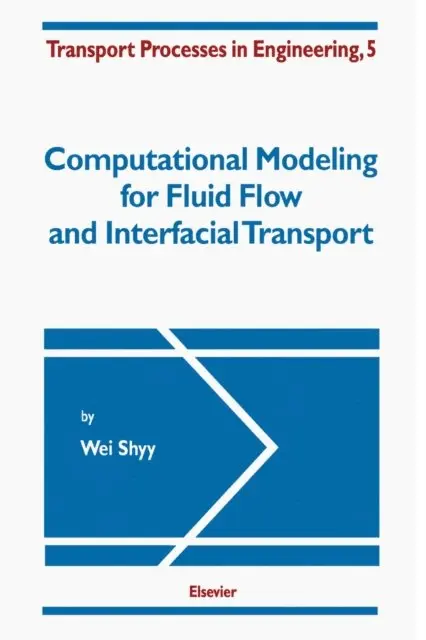
Transport processes are often characterized by the simultaneous presence of multiple dependent variables, multiple length scales, body forces, free boundaries and strong non-linearities. The various computational elements important for the prediction of complex fluid flows and interfacial transport are presented in this volume. Practical applications, presented in the form of illustrations and examples are emphasized, as well as physical interpretation of the computed results. The book is intended as a reference for researchers and graduate students in mechanical, aerospace, chemical and materials engineering.Both macroscopic and microscopic (but still continuum) features are addressed. In order to lay down a good foundation to facilitate discussion of more advanced techniques, the book has been divided into three parts. Part I presents the basic concepts of finite difference schemes for solving parabolic, elliptic and hyperbolic partial differential equations. Part II deals with issues related to computational modeling for fluid flow and transport phenomena. Existing algorithms to solve the Navier-Stokes equations can be generally classified as density-based methods and pressure-based methods. In this book the pressure-based method is emphasized. Recent efforts to improve the performance of the pressure-based algorithm, both qualitatively and quantitatively, are treated, including formulation of the algorithm and its generalization to all flow speeds, choice of coordinate system and primary velocity variables, issues of grid layout, open boundary treatment and the role of global mass conservation, convection treatment and convergence. Practical engineering applications, including gas-turbine combustor flow, heat transfer and convection in high pressure discharge lamps, thermal management under microgravity, and flow through hydraulic turbines are also discussed.Part III addresses the transport processes involving interfacial dynamics. Specifically those influenced by phase change, gravity, and capillarity are emphasized, and both the macroscopic and morphological (microscopic) scales are presented. Basic concepts of interface, capillarity, and phase change processes are summarized to help clarify physical mechanisms, followed by a discussion of recent developments in computational modeling. Numerical solutions are also discussed to illustrate the salient features of practical engineering applications. Fundamental features of interfacial dynamics have also been illustrated in the form of case studies, to demonstrate the interplay between fluid and thermal transport of macroscopic scales and their interaction with interfacial transport.
Häftad, Engelska, 1989
1 091 kr
Skickas inom 10-15 vardagar
From the preface: Fluid dynamics is an excellent example of how recent advances in computational tools and techniques permit the rapid advance of basic and applied science. The development of computational fluid dynamics (CFD) has opened new areas of research and has significantly supplemented information available from experimental measurements. Scientific computing is directly responsible for such recent developments as the secondary instability theory of transition to turbulence, dynamical systems analyses of routes to chaos, ideas on the geometry of turbulence, direct simulations of turbulence, three-dimensional full-aircraft flow analyses, and so on. We believe that CFD has already achieved a status in the tool-kit of fluid mechanicians equal to that of the classical scientific techniques of mathematical analysis and laboratory experiment.
E-bok
PDF, Engelska, 20131 367 kr
Läs direkt efter köp
From the preface: Fluid dynamics is an excellent example of how recent advances in computational tools and techniques permit the rapid advance of basic and applied science. The development of computational fluid dynamics (CFD) has opened new areas of research and has significantly supplemented information available from experimental measurements. Scientific computing is directly responsible for such recent developments as the secondary instability theory of transition to turbulence, dynamical systems analyses of routes to chaos, ideas on the geometry of turbulence, direct simulations of turbulence, three-dimensional full-aircraft flow analyses, and so on. We believe that CFD has already achieved a status in the tool-kit of fluid mechanicians equal to that of the classical scientific techniques of mathematical analysis and laboratory experiment.