Thomas Braunl – författare
840 kr
Läs direkt efter köp
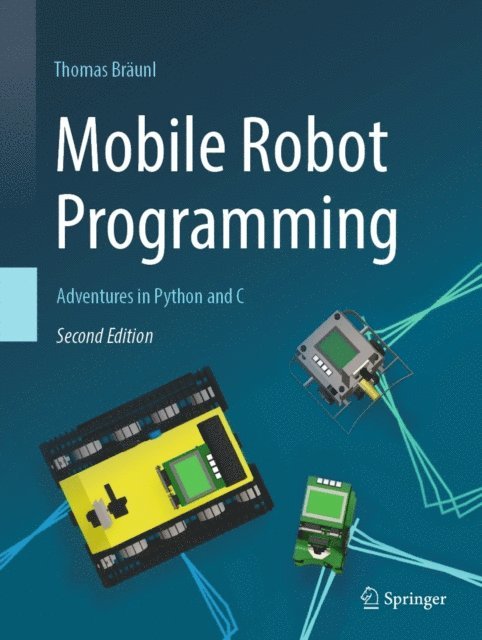
In this book the author stresses software as the most important topic in modern robotics. In particular the book concentrates on software for mobile robots, and the author demonstrates how inexpensive solutions can be constructed by mounting Raspberry Pi controllers and cameras onto model cars or other simple mechanical drive systems. He introduces EyeSim-VR, a freely available system that can realistically simulate driving, swimming, diving, and walking robots. The emphasis throughout is on algorithm development and all software assignments can run on real robot hardware, as well as on the simulation system presented.
The book is suitable for undergraduate and graduate courses in artificial intelligence and robotics, and also for self-study by practitioners. All software used in this book, including all example programs, can be freely downloaded online, with native applications for MacOS, Windows, Linux, and Raspberry Pi.
1 069 kr
Läs direkt efter köp
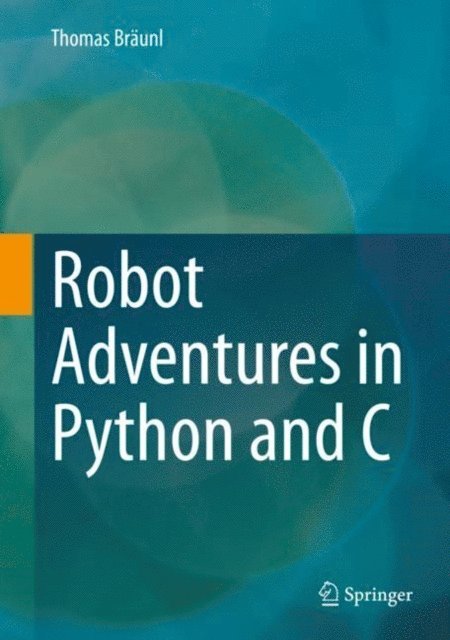
This book emphasizes software design as the most important topic in modern robotics and demonstrates practical code examples in Python and C. The book introduces the free simulation system EyeSim in combination with EyeBot robots, which can be built from inexpensive embedded processors, sensors and motors – or by adapting the control inputs of model cars.
EyeSim is a free software for MacOS, Windows and Linux, which uses a realistic physics simulation engine and is source-code compatible to the EyeBot mobile robots. So, each robot program can first be tested on the simulator before running it on a real robot. EyeSim includes modules for driving, walking, swimming and diving robots, as well as for robot manipulators. EyeSim also runs on the Meta/Oculus Quest, providing a fully immersive robotics experience in virtual reality.
Beginning with simple driving algorithms and sensor data processing for distance sensors, Lidar and camera, the book progresses to more complex localization and navigation tasks, as well as vision-based navigation and genetic algorithms. It concludes with artificial intelligence applications for mobile robots in traffic scenarios and full-size autonomous vehicles.
This book is suitable as a text for undergraduate and graduate courses in Robotics, Automation and Artificial Intelligence, as well as a self-study guide for practitioners and hobbyists. All robot application programs in this book are available as free downloads for MacOS, Windows, Linux, and Raspberry Pi OS.
708 kr
Läs direkt efter köp
Thisbook constitutes the thoroughly refereed post-conference proceedings of the 7thPacific Rim Symposium on Image and Video Technology, PSIVT 2015, held in Auckland,New Zealand, in November 2015.
Thetotal of 61 revised papers was carefully reviewed and selected from 133submissions. The papers are organized in topical sections on color and motion,image/video coding and transmission, computational photography and arts, computervision and applications, image segmentation and classification, videosurveillance, biomedical image processing and analysis, object and patternrecognition, computer vision and pattern recognition, image/video processingand analysis, and pattern recognition.
506 kr
Skickas inom 5-8 vardagar
825 kr
Läs direkt efter köp
1 138 kr
Läs direkt efter köp
544 kr
Skickas inom 10-15 vardagar
668 kr
Läs direkt efter köp
Progress in Robotics
FIRA RoboWorld Congress 2009, Incheon, Korea, August 16-20, 2009. Proceedings
1 082 kr
Skickas inom 10-15 vardagar
1 367 kr
Läs direkt efter köp
565 kr
Läs direkt efter köp
489 kr
Läs direkt efter köp
570 kr
Läs direkt efter köp
1 100 kr
Läs direkt efter köp
764 kr
Läs direkt efter köp
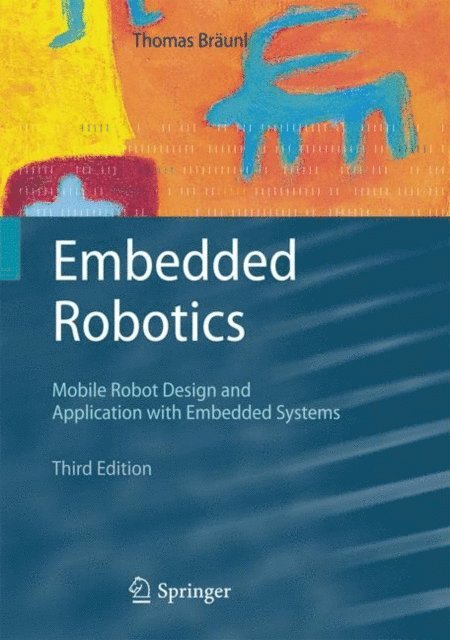
This textbook presents a unique examination of mobile robots and autonomous vehicles using embedded systems, from introductory to advanced level. It is structured in four parts, dealing with Embedded Systems (processors, sensors, actuators, control, multitasking and communication), Robot Hardware (driving and walking robots, autonomous boats and planes, as well as robot manipulators), Robot Software (localization, navigation, image processing and automotive systems), and Artificial Intelligence (neural networks, genetic algorithms and deep learning). The book is organized for ease of use, with numerous figures, photographs, and worked example programs. The book is written as a text for courses in computer science, computer engineering, IT, electronics engineering, and mechatronics, as well as a guide for robot hobbyists and researchers. In this 4th edition the text has been thoroughly updated and extended. It now uses the Raspberry Pi and Arduino embedded processors for all mobile robot systems.